

You will not be allowed to compare more than 4 products at a time
View compareDICLOFENAC TEVA*GEL120G 10MG/G
DICLOFENAC TEVA*GEL120G 10MG/G
Regular price
€13,20 EUR
Sale price
€13,20 EUR
Regular price
€12,40 EUR
Unit price
per
Tax included.
SKU
047883057Low stock
Vendor
TEVA B.V.Delivery time: 48/72 hours
Free Shipping: Orders over €70
Description
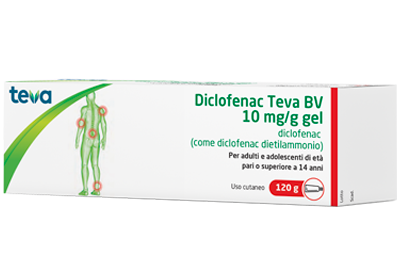
Diclofenac Teva BV 10 mg/g gel
Diclofenac (as diclofenac diethylammonium)
What it is and what it is used for
Diclofenac Teva BV contains the active ingredient diclofenac, which belongs to a class of medicines called non-steroidal anti-inflammatory drugs (NSAIDs).
Diclofenac Teva BV is indicated for adults and adolescents aged 14 years and older.
Adults
For the symptomatic treatment of pain:
- associated with acute muscle strains, sprains, or bruises resulting from impact trauma;
- of soft tissues adjacent to the joint (e.g., bursae, tendons, tendon sheaths, ligaments, muscle insertions, and joint capsules) in osteoarthritis of the knee and finger joints;
- in epicondylitis (inflammation of tendon insertions in the elbow area, also known as tennis elbow or golfer's elbow);
- in acute muscular pain, e.g., in the back.
Adolescents aged 14 years and older
For short-term treatment.
For local symptomatic treatment of pain associated with acute tears, sprains, or bruises resulting from impact trauma.
What you need to know before taking this medicine
Do not use Diclofenac Teva BV
- if you are allergic to diclofenac or any of the other ingredients of this medicine listed in section 6;
- if you have developed breathing problems (asthma, bronchospasm), skin reactions (hives), inflamed nose, or swelling of the face or tongue after taking or using acetylsalicylic acid or other non-steroidal anti-inflammatory drugs (e.g., ibuprofen);
- on open wounds, skin inflammations or infections, on eczema, or on mucous membranes;
- in the last trimester of pregnancy (see "Pregnancy");
- in children and adolescents under 14 years of age.
Warnings and precautions
Talk to your doctor or pharmacist before using Diclofenac Teva BV.
If you suffer from asthma, allergic rhinitis, swelling of the nasal mucosa (so-called nasal polyps) or chronic obstructive pulmonary disease, chronic respiratory tract infections (particularly associated with symptoms similar to allergic rhinitis) or hypersensitivity to other pain-relieving and anti-rheumatic medicines of any type, you are more at risk, compared to other patients, of asthma attacks (so-called analgesic intolerance or analgesic asthma), local swelling of the skin or mucous membranes (so-called Quincke's edema) and urticaria.
In these patients, Diclofenac Teva BV can only be used with certain precautions (emergency preparedness) and under direct medical supervision. The same applies to patients who are also allergic to other substances and exhibit, for example, skin reactions, itching or urticaria.
When Diclofenac Teva BV is applied to an extensive skin area and for a prolonged period, the possibility of systemic side effects associated with the application cannot be excluded.
Apply Diclofenac Teva BV only to intact, healthy, and unbroken skin. Avoid contact with eyes and oral mucous membranes. The gel must not be swallowed.
After applying the gel to the skin, a permeable (non-occlusive) dressing can be used, but the gel should first be allowed to dry on the skin for a few minutes. Occlusive dressings that do not allow air to pass through cannot be used.
A doctor should be consulted if the gel is used in acute conditions associated with severe redness, swelling, or overheating of the joints, prolonged joint pain, or severe back pain radiating to the legs and/or associated with neurological deficits (e.g., numbness, tingling).
Consult your doctor if symptoms worsen or do not improve within 3-5 days.
The use of Diclofenac Teva BV should be discontinued if you develop a skin rash.
Avoid exposure to sunlight, including sunlamps, while using this medicine. The necessary precautions should be taken to prevent children from touching the area where the gel is applied.
Children and adolescents
Diclofenac Teva BV is contraindicated in children and adolescents under 14 years of age.
Possible side effects
Like all medicines, this medicine can cause side effects, although not everybody gets them.
Some rare and very rare side effects can be serious.
If you experience any of the following signs of allergy, stop using Diclofenac Teva BV and tell your doctor or pharmacist immediately.
• Rash with blisters; hives (may affect up to 1 in 1,000 people).
• Wheezing, shortness of breath, or chest tightness (asthma) (may affect less than 1 in 10,000 people).
• Swelling of the face, lips, tongue, or throat (may affect up to 1 in 10,000 people).
Other possible side effects:
Common side effects (may affect up to 1 in 10 people)
Rash, itching, redness, eczema, dermatitis (skin inflammation), including contact dermatitis.
Uncommon side effects (may affect up to 1 in 100 people)
Peeling, skin dehydration, swelling (edema).
Very rare side effects (may affect up to 1 in 10,000 people)
Rash with pustules, gastrointestinal disturbances, hypersensitivity reactions (including hives), photosensitivity with skin reactions following exposure to sunlight.
Side effects with unknown frequency (frequency cannot be estimated from the available data)
Burning sensation at the application site, dry skin.
When Diclofenac Teva BV is applied to an extensive skin area and for a prolonged period, the possibility of systemic side effects (e.g., renal, hepatic, or gastrointestinal side effects, systemic hypersensitivity reactions) similar to those that may occur after systemic administration of diclofenac-containing medicines cannot be excluded.
Reporting of side effects
If you get any side effects, including any possible side effects not listed in this leaflet, talk to your doctor or pharmacist. You can also report side effects directly via the national reporting system at: https://www.aifa.gov.it/content/segnalazionireazioni-avverse.
By reporting side effects you can help provide more information on the safety of this medicine.