

You will not be allowed to compare more than 4 products at a time
View compareDICLOREUM ANT LOC*SCH 50G 3%
DICLOREUM ANT LOC*SCH 50G 3%
Regular price
€13,10 EUR
Sale price
€13,10 EUR
Regular price
€16,70 EUR
Unit price
per
Tax included.
SKU
042685040In stock
Vendor
ALFASIGMA SpADelivery time: 48/72 hours
Free Shipping: Orders over €70
Description
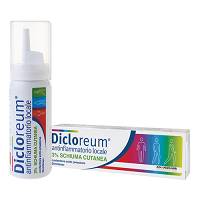
Dicloreum Antinfiammatorio Locale 3% cutaneous foam, pressurized container
Diclofenac
What it is and what it is used for
Dicloreum Antinfiammatorio Locale is a foam to be applied to the skin containing the active ingredient diclofenac, which belongs to a category of medicines called non-steroidal anti-inflammatory drugs (NSAIDs).
Dicloreum Antinfiammatorio Locale is indicated for the local treatment of pain and inflammation of joints, muscles, tendons and ligaments due to rheumatic diseases or trauma.
What you need to know before taking the medicine
Do not use Dicloreum Antinfiammatorio Locale:
• if you are allergic to diclofenac or any of the other ingredients of this medicine (listed in paragraph 6);
• if you are allergic to medicines containing acetylsalicylic acid (e.g. aspirin) and other non-steroidal anti-inflammatory drugs (NSAIDs) or to a disinfectant called isopropanol;
• in case of previous asthma attacks, skin rash (hives) or cold occurring after taking medicines containing acetylsalicylic acid (e.g. aspirin), other non-steroidal anti-inflammatory drugs and isopropanol;
• if you are in the last 3 months of pregnancy as it may cause damage to the heart, lungs and kidneys of the fetus (see paragraph Pregnancy, breastfeeding and fertility);
• in children and adolescents under 14 years of age as data on the safety and efficacy of the medicine in this age group are unknown.
Warnings and precautions
The use, especially if prolonged and on extensive skin surfaces, of local anti-inflammatory drugs could give rise to undesirable effects on the body.
Use Dicloreum Antinfiammatorio Locale:
- only on intact, healthy skin, free from open wounds or lesions;
- only with air-permeable bandages and not with tight bandages.
Be careful not to let the foam come into contact with your eyes and avoid ingesting it.
Use Dicloreum Antinfiammatorio Locale with particular caution:
- if you have had allergic reactions in the past, such as asthma attacks, skin rashes or acute allergic rhinitis, following the intake of non-steroidal anti-inflammatory drugs or painkillers;
- if you suffer from asthma, chronic obstructive bronchial diseases, allergic rhinitis or inflammation of the nasal mucosa (nasal polyps) because you may experience asthma attacks, local skin or mucous membrane inflammation (Quincke's edema) and skin rash (hives) more easily than other patients;
- if you are an elderly patient or suffer from stomach problems, because you should avoid taking other anti-inflammatory drugs to be taken orally, rectally or by injection at the same time as this medicine.
Stop treatment and consult your doctor or pharmacist:
• if a skin rash appears after applying the medicine;
• if allergic reactions occur after prolonged application of other medicines for local use.
Avoid excessive sun exposure during the use of Dicloreum Antinfiammatorio Locale to avoid possible photosensitivity phenomena.
Possible side effects
Like all medicines, this medicine can cause side effects, although not everybody gets them.
Common side effects (may affect up to 1 in 10 people):
- skin rash (eruption);
- intense skin redness and appearance of blisters (eczema, erythema);
- inflammatory skin reactions (dermatitis, including contact dermatitis);
- itching.
Rare side effects (may affect up to 1 in 1,000 people):
- skin inflammation with blisters (bullous dermatitis).
Very rare side effects (may affect up to 1 in 10,000 people):
• allergic reactions, including skin rash (hives);
• rapid swelling of the skin (angioneurotic edema);
• skin eruption with pustules;
• asthma;
• skin reactions to sunlight (photosensitivity).
Dicloreum in combination with other diclofenac-containing medicines may cause the following side effects:
- light hypersensitivity;
- skin rash with blister formation;
- eczema;
- erythema;
- severe skin reactions (Stevens-Johnson syndrome, Lyell's syndrome).
Reporting of side effects
If you get any side effects, including any not listed in this leaflet, tell your doctor or pharmacist. You can also report side effects directly via the national reporting system at: https://www.aifa.gov.it/content/segnalazionireazioni-avverse.
By reporting side effects you can help provide more information on the safety of this medicine.
