

You will not be allowed to compare more than 4 products at a time
View compareDICLOREUM UNIDIE*5PATCH 136MG24H
DICLOREUM UNIDIE*5PATCH 136MG24H
Regular price
€14,36 EUR
Sale price
€14,36 EUR
Regular price
€19,10 EUR
Unit price
per
Tax included.
SKU
037184013In stock
Vendor
ALFASIGMA SpADelivery time: 48/72 hours
Free Shipping: Orders over €70
Description
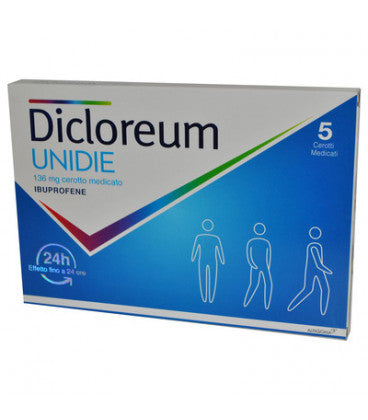
Dicloreum Unidie 136 mg medicated patch
Ibuprofen
What it is and what it is used for
Dicloreum Unidie is a medicated patch containing ibuprofen as an active ingredient, a non-steroidal anti-inflammatory drug (NSAID) with anti-inflammatory and analgesic action, which is released transdermally.
Dicloreum Unidie is indicated for the local treatment of pain and inflammation of rheumatic and traumatic origin of joints, muscles, tendons and ligaments.
What you need to know before taking the medicine
Do not use Dicloreum Unidie
- If you are allergic to ibuprofen or any of the other ingredients of this medicine (listed in paragraph 6).
- On open wounds or lesions, but only on intact skin. Avoid contact with eyes and mucous membranes.
- If you have previously experienced hypersensitivity (asthma, allergic rhinitis, skin rashes and anaphylactic reactions) or gastrointestinal bleeding from anti-inflammatory drugs.
- If you have an active peptic ulcer, bronchial asthma, or are on anticoagulant therapy.
- If you are in the last 3 months of pregnancy and breastfeeding.
- In children under 12 years of age.
- In cases of severe heart failure.
- In cases of severe renal or hepatic impairment.
Warnings and precautions
Analgesics, antipyretics, non-steroidal anti-inflammatory drugs, including ibuprofen, can cause hypersensitivity reactions, potentially severe even in individuals not previously exposed to this type of drug.
Severe skin reactions including exfoliative dermatitis, erythema multiforme, Stevens-Johnson syndrome, toxic epidermal necrolysis, drug reaction with eosinophilia and systemic symptoms (DRESS), acute generalized exanthematous pustulosis (AGEP) have been reported in association with ibuprofen treatment. Stop using Dicloreum Unidie and contact your doctor immediately if you notice any of the symptoms related to these severe skin reactions described in paragraph 4.
Dicloreum Unidie should be used with great caution and on medical advice:
• In the elderly.
• In patients with chronic bronchitis, allergic rhinitis or inflammation of the nasal mucosa (polyps) in whom asthmatic attacks or severe inflammatory skin and mucous membrane reactions are more frequent.
• In patients with a history of gastrointestinal diseases (such as peptic ulcer, gastrointestinal bleeding, ulcerative colitis or Crohn's disease).
• In patients with a history of gastrointestinal bleeding even if not caused by NSAID administration or with other bleeding disorders.
• In patients with liver or kidney dysfunction or heart failure.
• If you suffer or have suffered from high blood pressure.
Possible side effects
Like all medicines, Dicloreum Unidie can cause side effects, although not everyone experiences them.
In controlled clinical studies performed on this product, the following side effects were observed:
Very common side effects (may affect more than 1 in 10 people):
• slight skin redness or mild irritation at the application site
Common side effects (may affect up to 1 in 10 people):
• dry mouth
• headache
• altered taste
• nausea
• facial edema (swelling)
• skin blisters
• general malaise
• itching
• burning
• noticeable skin irritation with redness
• skin exfoliation
• small skin lesions
These side effects were mild and transient.
The following side effects have been reported in the literature:
Frequency unknown (frequency cannot be estimated from the available data):
• local hypersensitivity
• contact dermatitis
• numbness and tingling at the application site
• skin becomes sensitive to light
With this type of medicine, rare cases of extensive and severe skin lesions such as Quincke's edema and, very rarely, bullous reactions have also been reported.
Stop using ibuprofen and consult your doctor immediately if you notice any of the following symptoms:
• Reddish, non-raised, target-shaped or circular patches on the trunk, often with central blisters, skin peeling, ulcers of the mouth, throat, nose, genitals and eyes. These severe skin rashes may be preceded by fever and flu-like symptoms [exfoliative dermatitis, erythema multiforme, Stevens-Johnson syndrome, toxic epidermal necrolysis].
• Widespread rash, high body temperature, enlarged lymph nodes and increased eosinophils, a type of white blood cell (DRESS syndrome).
• Widespread, red and scaly rash, with bumps under the skin and blisters, accompanied by fever. Symptoms usually appear at the beginning of treatment (acute generalized exanthematous pustulosis).
Systemic adverse reactions following topical use of ibuprofen are unlikely as plasma levels of ibuprofen detected after applying Dicloreum Unidie are much lower than those detectable with systemic administration of ibuprofen-based drugs. However, after prolonged application, beyond the recommended period, and non-observance of contraindications and warnings, the appearance of systemic adverse effects, especially at the gastrointestinal level, cannot be excluded.
Adherence to the instructions in the package leaflet reduces the risk of side effects.
Reporting of side effects
If you get any side effects, including those not listed in this leaflet, talk to your doctor or pharmacist. You can also report side effects directly via the national reporting system at: https://www.aifa.gov.it/content/segnalazionireazioni-avverse.
By reporting side effects, you can help provide more information on the safety of this medicine.
