

You will not be allowed to compare more than 4 products at a time
View compareDULCOLAX*40COATED TABLETS 5MG
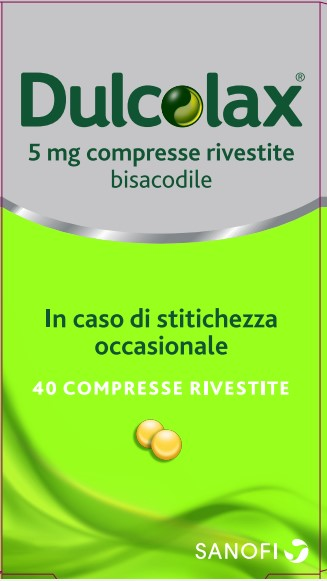
DULCOLAX*40COATED TABLETS 5MG
Regular price
€11,05 EUR
Sale price
€11,05 EUR
Regular price
€13,90 EUR
Unit price
per
Tax included.
SKU
008997064In stock
Vendor
OPELLA HEALTHCARE ITALY SrlDelivery time: 48/72 hours
Free Shipping: Orders over €70
Description
DULCOLAX 5 mg coated tablets
DULCOLAX adults 10 mg suppositories
Bisacodyl
What it is and what it is used for
Dulcolax contains bisacodyl. It belongs to a group of medicines called contact laxatives.
Dulcolax works by stimulating bowel movements, accelerating the passage of intestinal content.
Dulcolax is used in adults, children and adolescents aged between 2 and 18 years for the short-term treatment of occasional constipation.
Consult your doctor if you do not feel better or if you feel worse after 7 days.
What you need to know before taking the medicine
Do not take/do not give Dulcolax to your child
- if you and/or your child are allergic to bisacodyl or any of the other ingredients of this medicine (listed in paragraph 6);
- if you and/or your child suffer from an arrest of intestinal content progression due to a blockage of the intestinal muscles (paralytic ileus);
- if you and/or your child suffer from acute abdominal conditions, such as inflammation of the appendix, a part of the intestine (appendicitis), and severe abdominal pain associated with nausea and vomiting that may be indicative signs of serious illnesses;
- if you and/or your child suffer from obstruction or narrowing of the intestine (intestinal stenosis);
- if you and/or your child suffer from acute inflammation of the stomach and intestine;
- if you and/or your child suffer from bleeding from the rectum of unknown origin;
- if you and/or your child suffer from severe fluid loss from the body (dehydration);
- if you and/or your child suffer from a hereditary disease that may be incompatible with the assumption of one of the excipients (see paragraph 2. Dulcolax contains lactose and sucrose);
- if your child is under 2 years of age;
- if you and/or your child suffer from anal fissures and ulcers, do not take/do not give your child suppositories (perianal pain and bleeding may occur).
If you are pregnant or breastfeeding, see paragraph Pregnancy and breastfeeding.
Warnings and precautions
Consult your doctor or pharmacist before taking/giving Dulcolax to your child.
Cases of dizziness and/or fainting (syncope) have been reported after taking Dulcolax. The data relating to these cases suggest that the events, rather than a phenomenon related to the assumption of Dulcolax, could be interpreted as a manifestation of fainting (syncope) from defecation (attributable to the effort of the act of defecation), or as a reflex response to abdominal pain related to constipation itself.
The use of suppositories can lead to painful sensations and local irritation, particularly in the presence of fissures and inflammatory bowel disease of the rectum (ulcerative proctitis) (see paragraph 2 Do not take/do not give Dulcolax to your child).
Like all laxatives, do not take/do not give Dulcolax to your child daily or for prolonged periods without your doctor having first evaluated the cause of constipation. The treatment of chronic or recurrent constipation always requires the intervention of a doctor for diagnosis, prescription of medicines and monitoring during therapy.
In particular, consult your doctor:
• when the need for the laxative results from a sudden change in previous bowel habits (frequency and characteristics of bowel movements) that has lasted for more than two weeks or when the use of the laxative fails to produce effects;
• if you are elderly or in poor health;
• if you/your child suffer from diabetes mellitus, high blood pressure (hypertension) or heart disease (cardiopathy).
Abuse of laxatives
Abuse of laxatives (frequent or prolonged use or with excessive doses) can cause persistent diarrhea with consequent loss of fluids (dehydration) or decreased blood potassium levels (hypokalemia).
In the most severe cases, the decrease in potassium can cause heart or muscle disorders, especially if you are undergoing concomitant treatment with certain heart medications (cardiac glycosides), with drugs that increase urine production (diuretics) or with those used to treat inflammation (corticosteroids).
Symptoms of intestinal fluid loss (dehydration) can be thirst and reduced elimination of the amount of urine (oliguria).
Fluid loss (dehydration) can be dangerous if you/your child suffer from reduced kidney function (kidney failure) or if you are elderly; therefore, stop treatment with Dulcolax and consult your doctor.
The presence of blood in the stool (hematochezia) may also occur, which is generally mild and resolves on its own.
Avoid frequent or prolonged use of the medicine as it can lead to addiction and dependence (i.e., the need to progressively increase the dosage and not be able to do without the medicine), as well as chronic constipation and loss of normal bowel function (intestinal atony).
Stimulant laxatives including Dulcolax do not contribute to weight loss.
Children
In children aged between 2 and 10 years, the medicine can only be used after consulting a doctor.
Dulcolax should not be used in children under two years of age.
Possible side effects
Like all medicines, this medicine can cause side effects, although not everyone experiences them.
The following side effects are listed by frequency:
common (may affect up to 1 in 10 patients)
• abdominal cramps, abdominal pain, diarrhea, nausea
uncommon (may affect up to 1 in 100 patients)
• dizziness,
• blood in the stool (hematochezia), vomiting, abdominal discomfort, anorectal discomfort
rare (may affect up to 1 in 1,000 patients)
• anaphylactic reactions, swelling of the skin and mucous membranes of the face, lips and throat (angioedema), hypersensitivity,
• fluid loss (dehydration),
• fainting (syncope),
• inflammation of the intestine (colitis, including ischemic colitis).
Reporting of side effects
If you experience any side effects, including those not listed in this leaflet, consult your doctor or pharmacist. You can also report side effects directly via the national reporting system at: https://www.aifa.gov.it/content/segnalazionireazioni-avverse.
By reporting side effects, you can help provide more information on the safety of this medicine.
