

You will not be allowed to compare more than 4 products at a time
View compareFLECTOR UNIDIE*4CER MED 14MG
FLECTOR UNIDIE*4CER MED 14MG
Regular price
€10,41 EUR
Sale price
€10,41 EUR
Regular price
€15,90 EUR
Unit price
per
Tax included.
SKU
038354015Low stock
Vendor
IBSA FARMACEUTICI ITALIA SrlDelivery time: 48/72 hours
Free Shipping: Orders over €70
Description
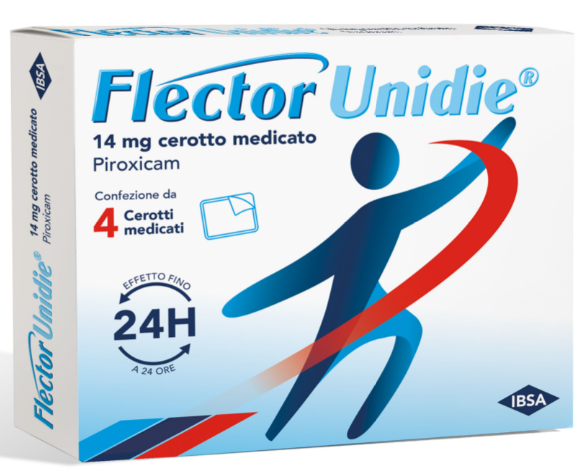
FLECTOR UNIDIE 14 mg, medicated plaster
Piroxicam
What it is and what it is used for
FLECTOR UNIDIE is a medicine that contains piroxicam, an active ingredient belonging to the class of non-steroidal anti-inflammatory drugs (NSAIDs) that act against pain, fever, and inflammation.
FLECTOR UNIDIE plaster is applied to the skin and is used to reduce pain and inflammation in joints, muscles, tendons, and ligaments, due to trauma or rheumatic diseases.
Consult your doctor if you do not feel better or if you feel worse after a short period of treatment.
What you need to know before taking the medicine
Do not use FLECTOR UNIDIE if:
• you are allergic (hypersensitive) to the active ingredient or any of the other ingredients of this medicine (listed in paragraph 6);
• you have had an allergic reaction after taking other pain and inflammation medications (NSAIDs);
• you have asthma;
• you have a stomach and/or duodenal ulcer (peptic);
• you have experienced stomach or intestinal bleeding (including blood in vomit or during bowel movements or black, tarry stools) after taking other pain and inflammation medications (NSAIDs);
• you are taking blood-thinning medications (anticoagulants);
• you are pregnant or breastfeeding (see Pregnancy, breastfeeding and fertility).
FLECTOR UNIDIE should not be used in children under 12 years of age.
Warnings and precautions
Consult your doctor before using FLECTOR UNIDIE if:
• you have heart problems;
• you have severe kidney problems;
• you have severe liver problems;
• you have had a stomach or duodenal ulcer (peptic);
• you suffer from intestinal diseases, such as ulcerative colitis or Crohn's disease;
• you have experienced stomach or intestinal bleeding (including blood in vomit or during bowel movements or black, tarry stools);
• you are prone to bleeding (hemorrhagic disorders);
• you have respiratory problems such as nasal inflammation due to allergy (allergic rhinitis), nasal polyps, bronchial diseases (chronic bronchitis);
• you are elderly as you are more likely to develop side effects to this medicine.
If you develop a rash or skin symptoms, you must immediately stop taking FLECTOR UNIDIE, contact a doctor immediately and inform them that you are taking this medicine.
PAY ATTENTION
• Do not expose yourself to direct sunlight after applying FLECTOR UNIDIE. This will reduce the risk of adverse reaction to light (photosensitivity).
• Like other topical medicines, FLECTOR UNIDIE can cause redness and itching (sensitization phenomena), especially in cases of prolonged or repeated therapy.
STOP TREATMENT AND CONTACT YOUR DOCTOR OR PHARMACIST IF YOU NOTICE SKIN REACTIONS AT THE APPLICATION SITE WHILE USING THIS PLASTER (see paragraph 4).
Possible side effects
Like all medicines, FLECTOR UNIDIE can cause side effects, although not everybody gets them. Following the instructions in this leaflet reduces the risk of side effects.
Stop using FLECTOR UNIDIE immediately and consult your doctor if you experience any of the following:
• allergic reactions such as: more or less sudden appearance of skin lesions, for example, patchy or widespread color changes (erythema), itching, burning, skin inflammation (contact dermatitis), numbness or tingling at the site where you applied the plaster;
• widespread and severe skin reactions, even after sun exposure (photosensitivity), such as urticaria, swelling (angioedema) of the face, eyes, lips, tongue and throat with breathing difficulties, erythema multiforme;
• severe breathing difficulties (asthma attacks).
Since FLECTOR UNIDIE plaster is applied directly to the affected area, the risk of systemic side effects, such as stomach or intestinal problems, is lower compared to taking piroxicam by mouth.
If the medicated plasters are not used correctly, are used on large areas of skin and/or for a very long period, such effects may still occur (see paragraph 3, If you use more FLECTOR UNIDIE than you should).
Cases of fixed drug eruption (which may appear as round or oval patches of skin redness and swelling), blisters (urticaria), itching may occur, with unknown frequency (frequency cannot be estimated from the available data).
Reporting of side effects
If you get any side effects, including any not listed in this leaflet, talk to your doctor or pharmacist. You can also report side effects directly via the national reporting system at: https://www.aifa.gov.it/content/segnalazionireazioni-avverse.
By reporting side effects you can help provide more information on the safety of this medicine.
