

You will not be allowed to compare more than 4 products at a time
View compareIMIDAZYL*COLL 10FL 1D 1MG/ML
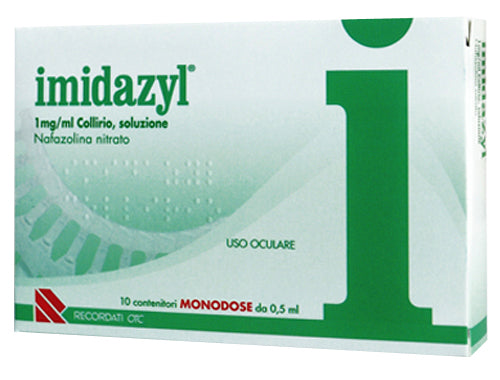
IMIDAZYL*COLL 10FL 1D 1MG/ML
Regular price
€10,50 EUR
Sale price
€10,50 EUR
Regular price
Unit price
per
Tax included.
SKU
003410065Low stock
Vendor
RECORDATI SpADelivery time: 48/72 hours
Free Shipping: Orders over €70
This product page, including its Product Information Leaflet, has been automatically translated.
Description
Imidazyl 1 mg/ml eye drops, solution
naphazoline nitrate
What it is and what it is used for
Imidazyl contains the active ingredient naphazoline nitrate, which belongs to a group of medicines called decongestants.
Imidazyl is used to treat allergies and inflammation of the eye (conjunctiva), characterized by a burning sensation, also caused by external agents, associated with excessive tearing, discomfort to light, and redness.
Consult your doctor if you do not feel better or if you feel worse after 4 days of treatment.
What you need to know before taking the medicine
Do not use Imidazyl
- if you are allergic to the active ingredient or any of the other ingredients of this medicine (listed in section 6)
- if you are allergic to other medicines belonging to the same class as Imidazyl; in particular xylometazoline, oxymetazoline, tetryzoline
- if you have a disease due to high pressure inside the eye (narrow-angle glaucoma) or if you have other serious eye diseases
- if you are simultaneously taking certain medicines used to treat depression (monoamine oxidase inhibitors) (see section “Other medicines and Imidazyl)
- in children under 12 years of age.
Warnings and precautions
Consult your doctor or pharmacist before using Imidazyl:
• if you suffer from high blood pressure (hypertension);
• if you have heart problems;
• if you suffer from an overactive thyroid gland (hyperthyroidism);
• if you have high blood sugar levels (hyperglycemia, diabetes);
• if you have breathing difficulties (bronchial asthma).
Imidazyl is not suitable for treating infections, mechanical damage (trauma), chemical or heat damage, or for removing foreign bodies from the eye.
Children
Imidazyl is contraindicated in children under 12 years of age.
Imidazyl should be kept out of the reach of children as accidental ingestion can cause toxic phenomena (see section “If you use more Imidazyl than you should”).
Possible side effects
Like all medicines, this medicine can cause side effects, although not everybody gets them.
The use of the medicine may sometimes cause:
• pupil dilation,
• increased internal eye pressure,
• nausea,
• headache,
• general effects on the body such as:
- increased blood pressure,
- heart problems,
- increased blood sugar levels (glucose).
Allergic reactions (hypersensitivity) may rarely occur; in this case, stop the treatment and consult your doctor.
Adhering to the instructions in the package leaflet reduces the risk of side effects.
These side effects are generally temporary. If they occur, consult your doctor or pharmacist.
Reporting of side effects
If you get any side effects, including any not listed in this leaflet, tell your doctor or pharmacist. You can also report side effects directly via the national reporting system at: https://www.aifa.gov.it/content/segnalazionireazioni-avverse.
By reporting side effects you can help provide more information on the safety of this medicine.
