

You will not be allowed to compare more than 4 products at a time
View compareITAMI*10MED CER 140MG
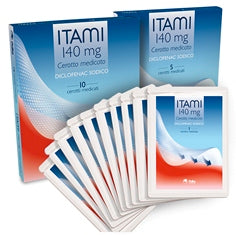
ITAMI*10MED CER 140MG
Regular price
€12,03 EUR
Sale price
€12,03 EUR
Regular price
€21,30 EUR
Unit price
per
Tax included.
SKU
035482025In stock
Vendor
FIDIA FARMACEUTICI SpADelivery time: 48/72 hours
Free Shipping: Orders over €70
This product page, including its Product Information Leaflet, has been automatically translated.
Description
Itami 140 mg Medicated Plaster
Diclofenac sodium
Equivalent medicinal product
What it is and what it is used for
Itami contains the active ingredient diclofenac and belongs to a group of medicines called non-steroidal anti-inflammatory drugs (NSAIDs).
Itami is indicated for the local treatment of pain and inflammation of rheumatic origin or resulting from trauma to joints, muscles, tendons and ligaments.
Consult your doctor if you do not feel better or if you feel worse after 14 days.
What you need to know before taking the medicine
Do not use Itami if:
- you are allergic to diclofenac or any of the other ingredients of this medicine listed in section 6;
- you are allergic to acetylsalicylic acid or other non-steroidal anti-inflammatory medicines;
- following the intake of aspirin or other non-steroidal anti-inflammatory medicines (NSAIDs), you have experienced allergic reactions such as difficulty breathing (asthma attacks), inflammation of the nasal mucosa (rhinitis), sudden appearance of a more or less itchy skin rash (hives);
- you have damaged skin due to: skin inflammation with blister formation (exudative dermatitis), eczema, infected lesion, burns or wounds;
- you are in the third trimester of pregnancy (see section Pregnancy, breastfeeding and fertility);
- you have stomach or intestinal lesions (active peptic ulcer).
Itami should not be used in children and adolescents under 16 years of age.
Warnings and precautions
Consult your doctor or pharmacist before using Itami.
Stop treatment with Itami immediately and consult your doctor if:
- you develop a skin rash after applying the plaster.
Pay particular attention:
- if you are taking other NSAIDs or other diclofenac-based medicines, including topical medicines;
- if you have kidney, heart, or liver problems, have had a peptic ulcer, an inflammatory bowel disease, or have a predisposition to develop bleeding;
- if you are elderly, as you are subject to an increased frequency of side effects;
- if you have had an allergic reaction in the past after taking NSAIDs or analgesic medicines, as asthmatic patients with chronic obstructive bronchial diseases, nasal mucosal inflammation (allergic rhinitis), nasal polyps develop asthma attacks, local skin or mucosal inflammation (Quincke's edema) or hives more often than other patients;
- if you intend to become pregnant, have fertility problems or need to undergo fertility investigations; treatment with Itami should be suspended;
- if you use Itami on large areas of skin or for a prolonged period, as you may develop systemic side effects;
- plasters should not come into contact with eyes, mucous membranes and should not be swallowed;
- if you need to expose yourself to direct sunlight or sun lamps; wait at least one day after removing the plaster to reduce the risk of light sensitivity.
The side effects of NSAIDs can be minimised by using the lowest effective dose and for the shortest possible duration of treatment, sufficient to control symptoms.
Children and adolescents
Itami should not be used in children and adolescents under 16 years of age.
Possible side effects
Like all medicines, this medicine can cause side effects, although not everybody gets them.
The concomitant use of Itami with other diclofenac-based medicines can lead to serious skin diseases with blister formation, redness and desquamation (Steven-Johnson syndrome) or diseases that lead to skin necrosis (Lyell's syndrome).
Common side effects (may affect up to 1 in 10 people):
- skin rash, eczema, erythema, dermatitis (including allergic dermatitis and contact dermatitis), itching, reactions at the application site of the plaster.
Rare side effects (may affect up to 1 in 1,000 people):
- bullous dermatitis;
- dry skin.
Very rare side effects (may affect up to 1 in 10,000 people):
- allergic reaction (hypersensitivity) including hives, anaphylactoid reaction, swelling of the face, hands and feet, lips, tongue, throat and/or larynx (angioneurotic edema);
- skin rash with blister formation;
- asthma;
- light sensitivity (photosensitivity).
Side effects not known:
- burning sensation at the application site.
Reporting of side effects
If you get any side effects, including any not listed in this leaflet, talk to your doctor or pharmacist. You can also report side effects directly via the national reporting system at: https://www.aifa.gov.it/content/segnalazionireazioni-avverse.
By reporting side effects, you can help provide more information on the safety of this medicine.