

You will not be allowed to compare more than 4 products at a time
View compareITAMIDOL*CUTANEOUS FOAM 50G 3%
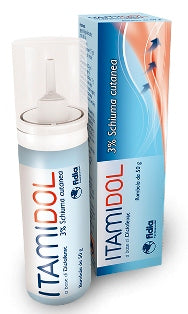
ITAMIDOL*CUTANEOUS FOAM 50G 3%
Regular price
€7,70 EUR
Sale price
€7,70 EUR
Regular price
€12,90 EUR
Unit price
per
Tax included.
SKU
036786010In stock
Vendor
FIDIA FARMACEUTICI SpADelivery time: 48/72 hours
Free Shipping: Orders over €70
This product page, including its Product Information Leaflet, has been automatically translated.
Description
ITAMIDOL 3% Cutaneous foam
Diclofenac
What it is and what it is used for
ITAMIDOL contains the active ingredient diclofenac, which belongs to the group of medicines called non-steroidal anti-inflammatory drugs (NSAIDs), used to reduce pain and inflammation.
ITAMIDOL is indicated for the local treatment of painful and inflammatory conditions of rheumatic or traumatic origin affecting:
• joints
• muscles
• tendons and ligaments
Consult your doctor if you do not feel better or if you feel worse after 7 days of treatment.
What you need to know before taking the medicine
Do not use ITAMIDOL
- if you are allergic to diclofenac or any of the other ingredients of this medicine (listed in section 6);
- if you are allergic to acetylsalicylic acid or other non-steroidal anti-inflammatory drugs (NSAIDs) and, following the use of these medicines, have experienced asthma attacks, allergic skin reactions (urticaria) or nasal irritation (rhinitis);
- if you are allergic to isopropanol, a type of alcohol;
- if you are in the third trimester of pregnancy (See section "Pregnancy and breastfeeding");
- if the person who needs to use this medicine is a child or adolescent under 14 years of age (See section "Children");
Warnings and precautions
Consult your doctor or pharmacist before using ITAMIDOL.
Consult your doctor before using ITAMIDOL:
• if you suffer or have suffered from asthma
• if you suffer or have suffered from chronic diseases with bronchial obstruction
• if you suffer or have suffered from allergic rhinitis (inflammation of the nose due to allergy)
• if you suffer or have suffered from inflammation of the nasal mucosa (nasal polyp)
because you may be more likely than other patients to experience asthma attacks, local skin inflammation, mucosal inflammation (Quincke's edema) or urticaria.
Pay particular attention:
• do not ingest ITAMIDOL
• do not apply ITAMIDOL on damaged, diseased skin or open wounds
• avoid ITAMIDOL coming into contact with eyes or mucous membranes
• if you are an elderly patient and/or have stomach problems, do not use ITAMIDOL with other anti-inflammatory medicines taken orally, by injection or rectally
• do not use ITAMIDOL with an occlusive dressing, i.e. covering the affected area with a plastic film that does not allow air to pass through. You can, however, use ITAMIDOL with a gauze that allows air to pass through
• the use, especially for long periods of time, of medicines for local use can cause allergic reactions such as skin rash. If this occurs, stop treatment with ITAMIDOL and consult your doctor, who will prescribe appropriate therapy
• avoid excessive exposure to sunlight while using ITAMIDOL; this will reduce the risk of sun-related skin reactions
• if you use diclofenac on large areas of skin and for long periods of time, you may experience side effects affecting the entire body.
Children
ITAMIDOL should not be used in children and adolescents under 14 years of age.
Possible side effects
Like all medicines, this medicine can cause side effects, although not everybody gets them.
After application to the skin, the amount of diclofenac that reaches the blood is very low, therefore the risk of experiencing side effects affecting the body is limited.
However, stomach and intestinal problems may occur following prolonged applications over large areas.
The following side effects may occur:
Common (may affect up to 1 in 10 people)
- skin irritations (rash, eczema);
- redness (erythema);
- skin inflammation (dermatitis), including contact dermatitis;
- itching.
Rare (may affect up to 1 in 1,000 people)
- skin inflammation with blistering (bullous dermatitis).
Very rare (may affect up to 1 in 10,000 people)
- allergic reactions including urticaria and swelling of the face, lips, mouth, tongue or throat that may cause potentially fatal difficulty in swallowing or breathing (angioedema);
- skin irritation with vesicle formation (rash with pustules);
- asthma;
- light sensitivity (photosensitivity).
Not known
- burning sensation at the application site
- dry skin
If you use this medicine together with other diclofenac-containing medicines, severe skin reactions (Stevens-Johnson syndrome, Lyell's syndrome) may occur.
Reporting of side effects
If you get any side effects, including any possible side effects not listed in this leaflet, talk to your doctor or pharmacist. You can also report side effects directly via the national reporting system at: https://www.aifa.gov.it/content/segnalazionireazioni-avverse.
By reporting side effects you can help provide more information on the safety of this medicine.