

You will not be allowed to compare more than 4 products at a time
View compareLASONIL ANTINFIAMM*24TAB 220MG
LASONIL ANTINFIAMM*24TAB 220MG
Regular price
€12,50 EUR
Sale price
€12,50 EUR
Regular price
€14,10 EUR
Unit price
per
Tax included.
SKU
032790040In stock
Vendor
BAYER SpADelivery time: 48/72 hours
Free Shipping: Orders over €70
This product page, including its Product Information Leaflet, has been automatically translated.
Description
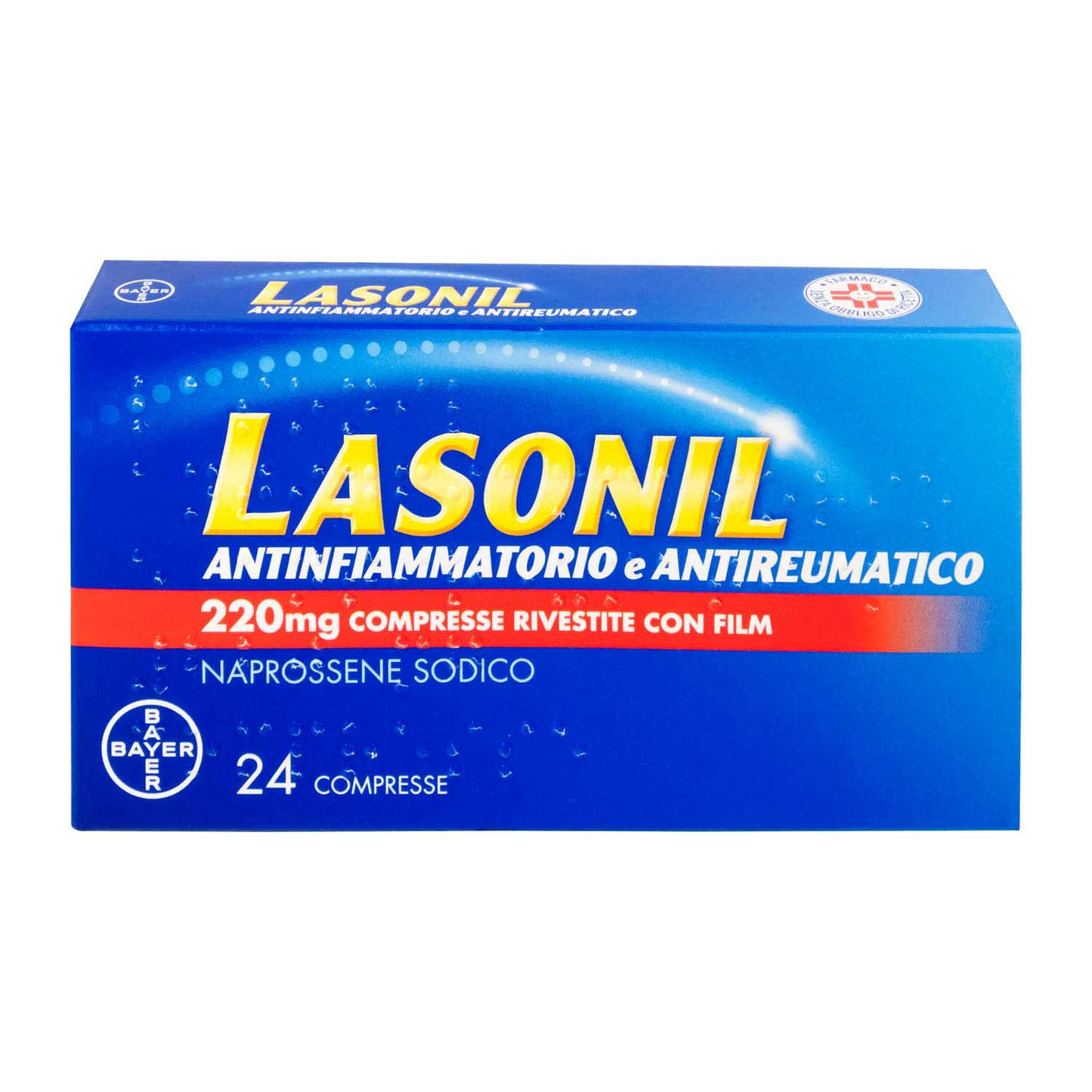
Lasonil anti-inflammatory and anti-rheumatic 220 mg film-coated tablets
Naproxen sodium
What it is and what it is used for
Lasonil anti-inflammatory and anti-rheumatic is a medicine that belongs to the category of non-steroidal anti-inflammatory/anti-rheumatic drugs, so-called NSAIDs.
This medicine is used for the symptomatic treatment of headaches, backaches, joint and muscle pain, toothaches, and colds. It is also indicated for menstrual pain and minor pain in arthritis and osteoarthritis.
Consult your doctor if you do not feel better or if you feel worse after 3 days in case of a cold, or after 7 days if you take the medicine for symptomatic pain treatment.
What you need to know before taking the medicine
Do not take Lasonil anti-inflammatory and anti-rheumatic
• If you are allergic to naproxen or any of the other ingredients of this medicine (listed in paragraph 6);
• If you have previously suffered from asthma, hives (itching and small spots on the skin) or allergic reactions after taking acetylsalicylic acid or other painkillers, antipyretics, non-steroidal anti-inflammatory drugs;
• If you suffer from severe kidney failure (the laboratory test to evaluate kidney function, called creatinine clearance, gives values below 20 ml/min);
• If you suffer from severe heart failure;
• If you suffer from liver cirrhosis or a severe form of hepatitis (inflammation of the liver);
• If you are undergoing intensive therapy with diuretics (medicines that increase urine production);
• If you suffer from gastric or duodenal ulcer;
• If you are currently bleeding or are at risk of bleeding;
• If you are being treated with anticoagulants (medicines that slow down blood clotting), as this medicine enhances their action;
• If you are pregnant or breastfeeding (see Pregnancy, breastfeeding and fertility);
• If you are under 16 years of age;
• If you have previously experienced gastrointestinal bleeding or perforation following treatment with certain medicines or have suffered from recurrent gastrointestinal bleeding/ulcer (two or more distinct episodes of confirmed ulceration or bleeding).
Warnings and precautions
Talk to your doctor or pharmacist before taking Lasonil anti-inflammatory and anti-rheumatic.
Do not use the product for gastrointestinal tract pain.
Avoid using Lasonil anti-inflammatory and anti-rheumatic concomitantly with other NSAIDs, including selective COX-2 inhibitors.
After administration of painkillers, antipyretics, non-steroidal anti-inflammatory drugs, asthma may worsen.
To minimize side effects, take the lowest effective dose for the shortest possible duration of treatment needed to control symptoms (see the paragraphs below on gastrointestinal and cardiovascular risks).
If the pain persists or if the painful area becomes red/swollen, or if new symptoms appear compared to those for which you took the medicine, consult your doctor.
Take the medicine only after consulting your doctor:
- if you suffer from liver failure (reduced liver function) and if you are undergoing intensive therapy with diuretics (medicines that increase urine production);
- if you are undergoing concomitant treatment with other medicines that may increase the risk of ulceration or bleeding, such as antidepressants, other painkillers or steroidal medicines (e.g. cortisone);
- if you have previously experienced undesirable effects on the gastrointestinal tract caused by taking painkillers, antipyretics, NSAIDs;
- if you have a history of gastrointestinal disease (ulcerative colitis, Crohn's disease);
- if you suffer from hypertension (high blood pressure) and/or heart failure because, in association with NSAID treatment, fluid retention, hypertension and oedema (swelling) and a modest increase in the risk of arterial thrombotic events (e.g. myocardial infarction or stroke) have been observed;
- if you suffer from coagulation disorders or if you are on anticoagulant therapy (medicines that delay blood clotting); in this case you must be carefully monitored by your doctor, as naproxen inhibits platelet aggregation and can prolong bleeding time.
Allergic or pseudo-allergic reactions
Painkillers, antipyretics, non-steroidal anti-inflammatory drugs can cause allergic reactions, potentially fatal. These reactions can occur in subjects with a history of angioedema (swelling of the facial skin and mucous membranes), altered bronchial reactivity (asthma), rhinitis (runny nose), nasal polyposis (small growths in the nasal cavities), allergic diseases, chronic respiratory diseases or allergy to acetylsalicylic acid. This can also happen in patients who experience allergic reactions (skin reactions, hives) to naproxen or other NSAIDs.
Skin reactions
Serious skin reactions including exfoliative dermatitis, Stevens-Johnson syndrome, toxic epidermal necrolysis, drug reaction with eosinophilia and systemic symptoms (DRESS) have been reported in association with Lasonil anti-inflammatory and anti-rheumatic.
If you notice any of the symptoms related to these serious skin reactions, described in paragraph 4, stop treatment with Lasonil anti-inflammatory and anti-rheumatic and contact your doctor immediately.
Elderly
Elderly patients are more likely to experience adverse reactions to NSAIDs, especially gastrointestinal bleeding and perforations, which can be fatal (see How to take Lasonil anti-inflammatory and anti-rheumatic).
Gastrointestinal bleeding, ulceration and perforation During treatment with all NSAIDs, at any time, with or without warning symptoms or a previous history of serious gastrointestinal events, gastrointestinal bleeding, ulceration and perforation have been reported, which can be fatal.
The risk of gastrointestinal bleeding, ulceration or perforation is higher in the elderly and in patients with a history of ulcer, especially if complicated by bleeding or perforation (see Do not take Lasonil anti-inflammatory and anti-rheumatic). Since the risk increases with increasing doses of NSAIDs, these patients should start treatment with the lowest available dose (see How to take Lasonil anti-inflammatory and anti-rheumatic).
Caution is also required in patients who are concomitantly taking medicines that could increase the risk of ulceration or bleeding, such as oral corticosteroids, selective serotonin reuptake inhibitors (medicines used for depression) or antiplatelet agents such as acetylsalicylic acid (see Other medicines and Lasonil anti-inflammatory and anti-rheumatic).
In all these cases, the concomitant use of protective agents (misoprostol or proton pump inhibitors) should be considered.
Patients with a history of gastrointestinal toxicity, particularly the elderly, should report any unusual gastrointestinal symptoms (especially gastrointestinal bleeding), particularly in the early stages of treatment.
If gastrointestinal bleeding or ulceration occurs while you are taking Lasonil anti-inflammatory and anti-rheumatic, stop treatment immediately.
NSAIDs should be administered with caution in patients with a history of gastrointestinal disease (ulcerative colitis, Crohn's disease), as these conditions can be exacerbated (see Possible side effects).
Cardiovascular and cerebrovascular effects
Medicines such as Lasonil anti-inflammatory and anti-rheumatic may be associated with a modest increased risk of heart attack (myocardial infarction) or stroke. The risk is greater with high doses and prolonged treatment. Do not exceed the recommended dose or duration of treatment (7 days for symptomatic pain treatment and 3 days for colds).
If you have heart problems or a history of stroke or if you think you may be at risk for these conditions (for example, high blood pressure, diabetes or high cholesterol or smoking) you should discuss your therapy with your doctor or pharmacist.
Painkillers, antipyretics, non-steroidal anti-inflammatory drugs can cause fluid retention which rarely, especially in elderly patients, can precipitate congestive heart failure.
Naproxen can reduce the antiplatelet effect of acetylsalicylic acid. Patients should consult their doctor if they are being treated with acetylsalicylic acid and intend to use naproxen/naproxen sodium (see section Other medicines and Lasonil anti-inflammatory and anti-rheumatic).
Liver effects
Severe liver reactions, including jaundice (yellowish discoloration of the skin and whites of the eyes) and hepatitis (in some cases fatal) have been reported with the use of naproxen or other NSAIDs. Cross-reactivity has also been reported.
Children and adolescents
This medicine must not be taken by children and adolescents under 16 years of age (see Do not take Lasonil anti-inflammatory and anti-rheumatic).
Possible side effects
Like all medicines, this medicine can cause side effects, although not everyone gets them.
The most commonly observed adverse events concern the stomach and intestines. Peptic ulcers, gastrointestinal perforation or bleeding, sometimes fatal, may occur, particularly in the elderly.
After administration of Lasonil anti-inflammatory and anti-rheumatic, the following have been reported: nausea, vomiting, diarrhoea, flatulence (gas in the intestine), constipation, dyspepsia (indigestion), abdominal pain, melena (black, tarry stools), haematemesis (vomiting blood or coffee ground material), ulcerative stomatitis (inflammation of the oral mucosa), exacerbation of colitis (inflammation of the last part of the intestine) and Crohn's disease (chronic inflammatory bowel disease).
Gastritis has been observed less frequently.
Oedema (swelling), hypertension (high blood pressure) and heart failure have been reported in association with NSAID treatment.
Very rarely, bullous reactions including Stevens-Johnson syndrome and toxic epidermal necrolysis (two severe, potentially fatal skin diseases) have occurred.
Medicines such as Lasonil anti-inflammatory and anti-rheumatic may be associated with a modest increased risk of heart attack (myocardial infarction) or stroke.
Lasonil anti-inflammatory and anti-rheumatic causes a modest and transient dose-dependent increase in bleeding time. However, these values often do not exceed the upper limit of the reference range.
Side effects observed with medicines based on naproxen and naproxen sodium, including those subject to medical prescription, are listed below.
Stop taking Lasonil anti-inflammatory and anti-rheumatic and contact your doctor immediately if you notice any of the following side effects:
Common side effects (may affect up to 1 in 10 people)
- dizziness;
- headache;
- lightheadedness;
- dyspepsia (indigestion);
- nausea;
- heartburn;
- abdominal pain (stomach ache).
Uncommon side effects (may affect up to 1 in 100 people)
- drowsiness (deep sleep);
- insomnia;
- somnolence;
- vertigo;
- diarrhoea;
- constipation;
- vomiting;
- skin rash;
- itching;
- urticaria (itching and small spots on the skin).
Rare side effects (may affect up to 1 in 1,000 people)
- hyperglycaemia (increase in blood sugar level);
- hypoglycaemia (decrease in blood sugar level);
- tachycardia (accelerated heart beat);
- peptic ulcer with or without bleeding or perforation;
- gastrointestinal bleeding;
- haematemesis (vomiting blood or coffee ground material);
- melena (black, tarry stools);
- angioedema (swelling of the facial skin and mucous membranes);
- myalgia (muscle pain);
- muscle weakness;
- impaired kidney function;
- glomerulonephritis (a type of kidney inflammation);
- peripheral oedema (swelling of the extremities), particularly in patients with high blood pressure or kidney failure;
- fever (including chills).
Very rare side effects (may affect up to 1 in 10,000 people)
- anaphylaxis/anaphylactoid reactions (severe allergic or pseudo-allergic reactions), including fatal shock;
- haematopoietic disorders (of blood cell production): leucopenia (deficiency of white blood cells), thrombocytopenia (deficiency of platelets), agranulocytosis (lack of blood cells called granulocytes), aplastic anaemia (due to lack of red blood cell production), eosinophilia (increase in blood cells called eosinophils), haemolytic anaemia (due to destruction of red blood cells);
- psychiatric disorders;
- depression;
- sleep disorders;
- difficulty concentrating;
- aseptic meningitis (non-infectious inflammation of the meninges);
- cognitive disorders (memory problems);
- seizures;
- visual disturbances;
- corneal opacities;
- papillitis (inflammation of the anterior part of the optic nerve);
- retrobulbar optic neuritis (inflammation of the posterior part of the optic nerve);
- papilledema (swelling of the optic disc at the back of the eye);
- hearing loss;
- tinnitus (ringing or buzzing in the ear);
- hearing disorders;
- interstitial nephritis (a type of kidney inflammation);
- papillary necrosis (kidney damage from painkiller abuse);
- nephrotic syndrome (kidney disease characterised by protein loss in the urine);
- kidney failure (reduced kidney function);
- kidney disease;
- haematuria (blood in the urine);
- proteinuria (protein in the urine);
- congestive heart failure (inability of the heart to pump blood);
- hypertension (high blood pressure);
- pulmonary oedema (fluid in the lungs);
- palpitations (sensation of irregular or accelerated heartbeat);
- vasculitis (inflammation of blood vessels);
- dyspnoea (difficulty breathing);
- asthma;
- eosinophilic pneumonia (a type of lung inflammation);
- alveolitis (inflammation of the pulmonary alveoli);
- pancreatitis (inflammation of the pancreas);
- colitis (inflammation of the last part of the intestine);
- aphthous ulcers (small ulcers in the mouth);
- stomatitis (inflammation of the oral mucosa);
- oesophagitis (inflammation of the oesophagus);
- intestinal ulcerations;
- crampy abdominal pain;
- hepatitis (inflammation of the liver, including fatal cases);
- jaundice (yellowish discoloration of the skin and whites of the eyes);
- alopecia (hair loss, usually reversible);
- photosensitivity (sensitivity to sunlight);
- porphyria (a rare disease in which the activity of particular enzymes is altered);
- erythema multiforme (red cockade-shaped patches on the skin);
- severe bullous reactions, including Stevens-Johnson syndrome and toxic epidermal necrolysis (two severe, potentially fatal skin diseases);
- erythema nodosum (red nodules under the skin);
- fixed erythema (redness and blisters);
- lichen planus (inflammatory reaction with formation of small purplish papules);
- pustules;
- skin rashes;
- systemic lupus erythematosus (autoimmune disease manifesting with muscle and joint pain);
- photosensitivity reactions, including porphyria cutanea tarda (pseudoporphyria) or epidermolysis bullosa;
- ecchymosis (bruises);
- purpura (red spots on the skin);
- sweating;
- ductus arteriosus closure (small tube necessary for fetal blood circulation);
- infertility (in women);
- oedema (swelling);
- thirst;
- malaise;
- increased creatinine in the blood;
- altered liver function tests;
- increased potassium in the blood.
Side effects with unknown frequency: frequency cannot be estimated from the available data:
- widespread skin rash, high body temperature, increased liver enzymes, blood abnormalities (eosinophilia), enlarged lymph nodes and involvement of other organs (drug reaction with eosinophilia and systemic symptoms, also known as DRESS). See also paragraph 2;
- a distinctive allergic skin reaction known as fixed drug eruption, which usually recurs in the same location or locations upon re-exposure to the medicine and may appear as round or oval patches with skin redness and swelling, rash with vesicles (hives), itching sensation.
Reporting of side effects
If you get any side effects, including any not listed in this leaflet, talk to your doctor or pharmacist. You can also report side effects directly via the national reporting system at: https://www.aifa.gov.it/content/segnalazionireazioni-avverse.
By reporting side effects you can help provide more information on the safety of this medicine.