

You will not be allowed to compare more than 4 products at a time
View compareLEVIOGEL*GEL 100G 1%
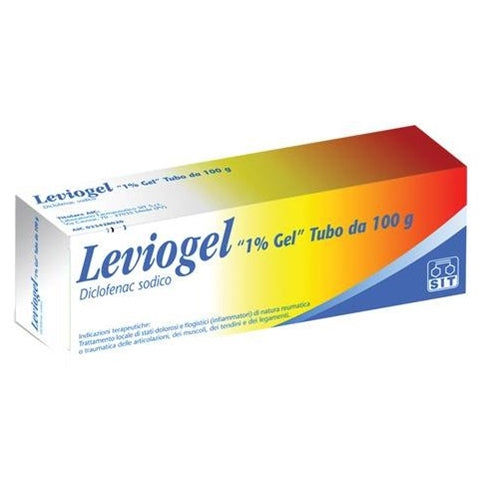
LEVIOGEL*GEL 100G 1%
Regular price
€6,61 EUR
Sale price
€6,61 EUR
Regular price
€10,60 EUR
Unit price
per
Tax included.
SKU
033428020In stock
Vendor
SIT LABORATORIO FARMAC. SrlDelivery time: 48/72 hours
Free Shipping: Orders over €70
This product page, including its Product Information Leaflet, has been automatically translated.
Description
LEVIOGEL 10 mg/g gel
Diclofenac sodium
What it is and what it is used for
LEVIOGEL contains diclofenac sodium, which belongs to the group of Non-Steroidal Anti-inflammatory Drugs (or NSAIDs) that act by reducing the pain and swelling typical of inflammation.
This medicine is used to reduce pain, swelling, and inflammation of joints, muscles, tendons, and ligaments in cases of rheumatism or trauma.
Consult your doctor if you do not feel better or if you feel worse.
What you need to know before taking the medicine
Do not use LEVIOGEL
- if you are allergic to the active substance or any of the other ingredients of this medicine (listed in paragraph 6);
- if you have had an allergic reaction to diclofenac or other non-steroidal anti-inflammatory drugs such as aspirin, accompanied by difficulty breathing (asthma), skin rash with hives (urticaria), or sudden rhinitis (acute rhinitis);
- if you are in the last three months of pregnancy (see paragraph 2 Pregnancy and breastfeeding);
- in children and adolescents under 14 years of age.
Warnings and precautions
Consult your doctor or pharmacist before using LEVIOGEL.
If a skin rash occurs after applying the product to the skin, stop treatment and consult your doctor.
Avoid using this medicine on large areas of skin and for long periods of time.
This medicine should only be used on intact and healthy skin; do not apply the product to wounds or open lesions. After application, do not cover the area with a dressing that does not allow the treated part to breathe (occlusive dressing) (see paragraph 3 How to use LEVIOGEL).
This medicine must not come into contact with the eyes or nose and mouth (mucous membranes).
It is for external use only, do not swallow.
Children and adolescents
This medicine is not suitable for children and adolescents under 14 years of age (see paragraph 2 Do not use LEVIOGEL).
Possible side effects
Like all medicines, this medicine can cause side effects, although not everybody gets them.
The following side effects may occur with the use of this medicine, categorized by frequency:
Common (may affect up to 1 in 10 people):
- skin rash, skin manifestations characterized by the appearance of lesions (eczema) or redness (erythema), inflammation of the skin (dermatitis) including that due to contact with an irritant substance (contact dermatitis), itching.
Rare (may affect up to 1 in 1,000 people):
- skin lesion manifested by the appearance of blisters (bullous dermatitis).
Very rare (may affect up to 1 in 10,000 people):
- hypersensitivity reactions (allergic reactions), swelling of the skin and mucous membranes (angioneurotic edema);
- skin rash characterized by the appearance of pustules (rash);
- excessive sensitivity reaction of the skin to sun and UV rays (photosensitivity reaction);
- difficulty breathing (asthma).
Not known (frequency cannot be estimated from the available data):
- burning sensation at the application site;
- dry skin.
Reporting of side effects
If you get any side effects, including any not listed in this leaflet, tell your doctor or pharmacist. You can also report side effects directly via the national reporting system at: https://www.aifa.gov.it/content/segnalazionireazioni-avverse.
By reporting side effects you can help provide more information on the safety of this medicine.