

You will not be allowed to compare more than 4 products at a time
View compareLISOMUCIL DRY COUGH*SYR 200ML
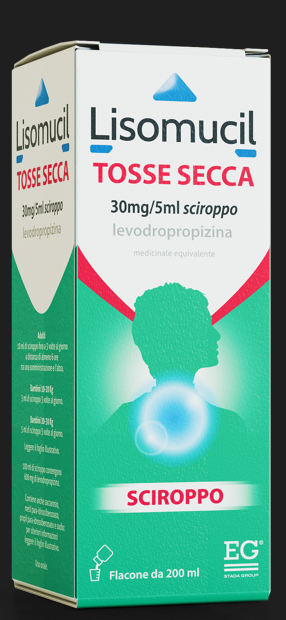
LISOMUCIL DRY COUGH*SYR 200ML
Regular price
€8,94 EUR
Sale price
€8,94 EUR
Regular price
€11,20 EUR
Unit price
per
Tax included.
SKU
039732021In stock
Vendor
EG SpADelivery time: 48/72 hours
Free Shipping: Orders over €70
This product page, including its Product Information Leaflet, has been automatically translated.
Description
Lisomucil Dry Cough 30 mg/5 ml syrup
Levodropropizine
Equivalent medicine
What it is and what it is used for
Lisomucil Dry Cough contains the active ingredient levodropropizine, a substance that belongs to a group of medicines called cough suppressants.
This medicine is used to treat cough symptoms.
Consult your doctor if you do not feel better or if you feel worse after 2 weeks of treatment.
What you need to know before taking the medicine
Do not take Lisomucil Dry Cough
- if you are allergic to levodropropizine or any of the other ingredients of this medicine (listed in paragraph 6);
- if you suffer from a bronchial disease, characterised by excessive mucus production (bronchial hypersecretion);
- if you suffer from birth from certain disorders of the respiratory mucosa characterised by reduced ability to expel mucus (Kartagener's syndrome, ciliary dyskinesia);
- if you are pregnant or breastfeeding (See the section Pregnancy and breastfeeding).
Do not administer this medicine to children under two years of age (see the section Children).
Warnings and precautions
Consult your doctor or pharmacist before taking Lisomucil Dry Cough:
- if you suffer from severe kidney function reduction (severe renal insufficiency with creatinine clearance below 35 ml/min);
- if you are elderly, as sensitivity to various medicines is altered in the elderly;
- if you are taking sedative medicines for the treatment of anxiety and are a particularly sensitive individual (See the section Other medicines and Lisomucil Dry Cough).
Cough medicines only treat symptoms and should only be used while awaiting diagnosis of the underlying cause and/or the effect of therapy for the underlying disease.
Do not therefore use for prolonged treatments. After a short period of treatment (2 weeks) without appreciable results, consult your doctor.
Lisomucil Dry Cough does not contain gluten, therefore it is not contraindicated if you suffer from coeliac disease.
Children
Do not give this medicine to children under 2 years of age (see the section Do not take Lisomucil Dry Cough).
Possible side effects
Like all medicines, this medicine can cause side effects, although not everybody gets them.
Most adverse reactions that have occurred after taking levodropropizine are not serious and the symptoms have resolved with discontinuation of therapy and, in some cases, with specific pharmacological treatment.
The adverse reactions reported have an unknown frequency (frequency cannot be estimated from the available data):
- mydriasis (pupil dilation), bilateral blindness (affecting both eyes);
- allergic and anaphylactoid reactions, eyelid oedema (swelling of the eyelid), angioedema (swelling of the deep dermis and subcutaneous tissue that may also affect the mucous membranes), urticaria;
- nervousness, drowsiness, personality alteration, personality disorder;
- syncope (transient loss of consciousness), dizziness, vertigo, tremors, paraesthesia (abnormal sensation on the skin, tingling), tonic-clonic seizure (grand mal) and petit mal attack, hypoglycaemic coma (loss of consciousness caused by a severe reduction in blood sugar levels);
- palpitations, tachycardia (accelerated heart rate), atrial bigeminy (irregular heart beat);
- hypotension (low blood pressure);
- dyspnoea (difficulty breathing), cough, oedema (swelling) of the respiratory tract;
- stomach pain, abdominal pain, nausea, vomiting, diarrhoea;
- cholestatic hepatitis (inflammation of the liver due to blocked bile excretion);
- urticaria, erythema (skin redness), rash (skin eruption), itching, angioedema (swelling of the face and mucous membranes), skin reactions, glossitis (inflammation of the tongue) and aphthous stomatitis (painful ulcers in the mouth);
- epidermolysis (rare and potentially serious skin diseases);
- weakness of the lower limbs;
- general malaise, generalised oedema (swelling), asthenia (physical weakness).
Additional side effects in breastfed infants whose mothers took levodropropizine.
A case of drowsiness, hypotonia (reduced muscle tone) and vomiting has been reported in an infant after the nursing mother took levodropropizine. Symptoms appeared after feeding and resolved spontaneously by interrupting breastfeeding for a few feeds.
Following the instructions in the package leaflet reduces the risk of side effects.
Reporting of side effects
If you get any side effects, including any not listed in this leaflet, talk to your doctor or pharmacist. You can also report side effects directly via the national reporting system at: https://www.aifa.gov.it/content/segnalazionireazioni-avverse.
By reporting side effects, you can help provide more information on the safety of this medicine.