

You will not be allowed to compare more than 4 products at a time
View compareMAALOX NAUSEA*20EFF TABS 5MG
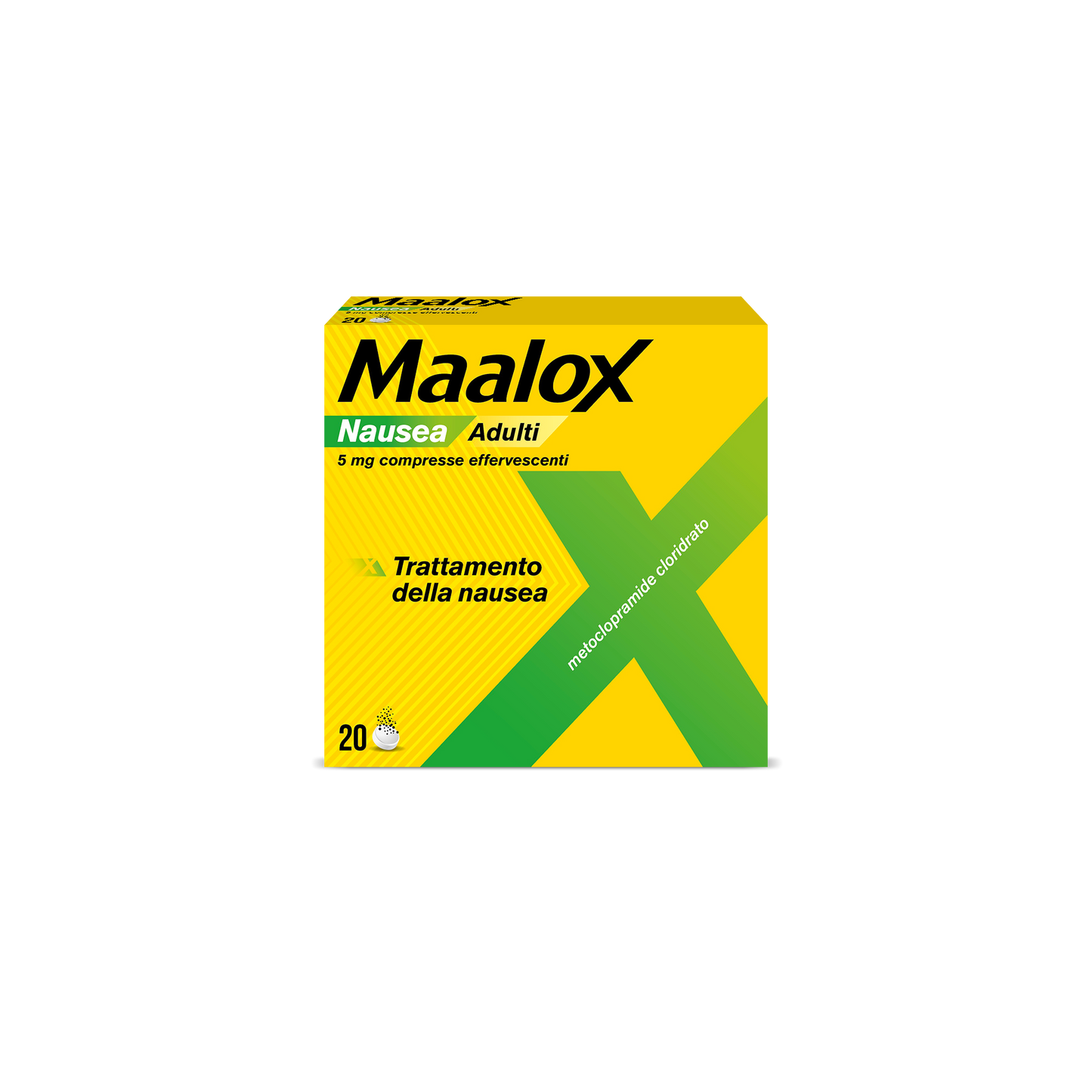
MAALOX NAUSEA*20EFF TABS 5MG
Regular price
€10,07 EUR
Sale price
€10,07 EUR
Regular price
€13,90 EUR
Unit price
per
Tax included.
SKU
033013018In stock
Vendor
OPELLA HEALTHCARE ITALY SrlDelivery time: 48/72 hours
Free Shipping: Orders over €70
This product page, including its Product Information Leaflet, has been automatically translated.
Description
Maalox Nausea adults 5 mg effervescent tablets
Maalox Nausea adults 5 mg effervescent granules
Metoclopramide hydrochloride
What it is and what it is used for
Maalox Nausea is a medicine that contains a substance called metoclopramide and is used to treat nausea.
Consult your doctor if you do not feel better or if you feel worse after 3 days.
What you need to know before taking the medicine
Do not take Maalox Nausea
- if you are allergic to metoclopramide hydrochloride or any of the other ingredients of this medicine (listed in section 6);
- if you have bleeding, an obstruction (blockage) or a gastrointestinal perforation (tear in the stomach or intestine);
- if you have or suspect you have a rare tumour of the adrenal glands, located next to the kidneys (phaeochromocytoma);
- if you have ever had involuntary muscle spasms (tardive dyskinesia) after taking certain medicines;
- if you suffer from epilepsy;
- if you suffer from Parkinson's disease;
- if you are taking levodopa or dopamine agonists (medicines for Parkinson's disease and other nervous system disorders) (see Other medicines and Maalox Nausea);
- if you are being treated with medicines for nervous system diseases (monoamine oxidase inhibitors, neuroleptics such as phenothiazines, butyrophenones, thioxanthenes);
- if you have had a condition called NADH cytochrome-b5 deficiency or alterations in the haemoglobin contained in your blood (methaemoglobinaemia);
- if you are under 16 years of age (see Children and adolescents);
- if you are in the first trimester of pregnancy or during breastfeeding (see Pregnancy and breastfeeding).
Warnings and precautions
Talk to your doctor or pharmacist before taking Maalox Nausea.
Use Maalox Nausea with particular caution:
- if you have heart diseases (congenital long QT syndrome);
- if you have a slow heartbeat (bradycardia);
- if your blood tests show altered potassium, sodium, and magnesium values;
- if you are taking medicines that can affect your heartbeat such as antiarrhythmics (medicines that affect the heartbeat), tricyclic antidepressants (medicines used for depression), macrolides (antibiotics), antipsychotics (medicines used for psychiatric disorders);
- if you have severe liver problems (severe hepatic insufficiency);
- if you have kidney problems (renal insufficiency);
- if you are concurrently treated with medicines used to treat nervous system diseases such as phenothiazines (neuroleptic medicines);
- if you suffer from epilepsy;
- if you are between 16 and 18 years of age.
An increase in a hormone called prolactin may occur, particularly if you have breast cancer or a prolactin-producing tumour (pituitary adenoma).
In case of reduced activity of an enzyme (called CYP2D6) involved in the degradation of the medicine in the body, the risk of side effects, including uncontrolled movements (extrapyramidal symptoms, see section 4), may increase.
An alteration of the haemoglobin contained in the blood (methaemoglobinaemia) has been reported. Your doctor may carry out blood tests to check blood haemoglobin.
Treatment should not exceed 3 months due to the risk of involuntary muscle spasms (tardive dyskinesia).
Children and adolescents
Maalox Nausea should not be taken by children and adolescents under 16 years of age.
The use of the medicine is not recommended in adolescents aged between 16 and 18 years.
Possible side effects
Like all medicines, this medicine can cause side effects, although not everybody gets them.
Stop treatment and talk to your doctor or pharmacist immediately if you experience any of the following symptoms during therapy with this medicine:
- uncontrollable movements (often affecting the head or neck). These may occur in children or young adults, particularly if high doses are used. These symptoms usually appear at the beginning of treatment and may also occur after a single administration. The movements disappear if treated appropriately;
- high fever, high blood pressure, seizures, sweating, saliva production. These may be signs of a disorder called neuroleptic malignant syndrome;
- itching or skin disorders, swelling of the face, lips or throat, difficulty breathing. These may be signs of an allergic reaction, which could be serious.
Very common (may affect more than 1 in 10 people)
• drowsiness.
Common (may affect up to 1 in 10 people)
• depression;
• uncontrollable movements (extrapyramidal disorders);
• symptoms similar to Parkinson's disease such as stiffness and tremors (parkinsonism);
• restlessness (akathisia);
• decrease in blood pressure (hypotension);
• diarrhoea;
• feeling of weakness (asthenia).
Uncommon (may affect up to 1 in 100 people)
• increase in blood levels of a hormone called prolactin (hyperprolactinemia);
• absence of menstruation (amenorrhoea);
• hallucinations;
• alteration of muscle or nerve tone (dystonia);
• visual disturbances and involuntary eye deviation;
• alteration of movement (dyskinesia);
• reduced level of consciousness;
• slow heartbeat (bradycardia);
• hypersensitivity.
Rare (may affect up to 1 in 1,000 people)
• confusional state;
• seizures (especially in epileptic patients);
• milk production in men and non-breastfeeding women (galactorrhoea).
Not known (frequency cannot be estimated from the available data)
• severe allergic reactions (such as anaphylactic reaction, angioedema and urticaria).
Symptoms may include rash, itching, difficulty breathing, shortness of breath, swelling of the face, lips, throat or tongue, cold and clammy skin, palpitations, dizziness, weakness and fainting. Contact your doctor or another healthcare professional immediately or go to the nearest hospital emergency room immediately;
• alterations of haemoglobin, a substance present in the blood;
• abnormal breast development (gynaecomastia);
• involuntary muscle spasms (tardive dyskinesias) after prolonged use, particularly in elderly patients;
• high fever, high blood pressure, seizures, sweating, saliva production. These may be symptoms of a disorder called neuroleptic malignant syndrome;
• alterations of heart rhythm (atrioventricular block, sinus arrest, QT interval prolongation, torsade de pointes);
• cardiac arrest;
• shock (severe drop in pressure);
• fainting (syncope);
• very high blood pressure;
• increased blood pressure in patients suffering from a rare tumour of the adrenal glands (phaeochromocytoma) (see Do not take Maalox Nausea);
• suicidal ideation.
Following the instructions in the package leaflet reduces the risk of side effects.
Reporting of side effects
If you get any side effects, including any not listed in this leaflet, tell your doctor or pharmacist. You can also report side effects directly via the national reporting system at: https://www.aifa.gov.it/content/segnalazionireazioni-avverse.
By reporting side effects, you can help provide more information on the safety of this medicine.
