

You will not be allowed to compare more than 4 products at a time
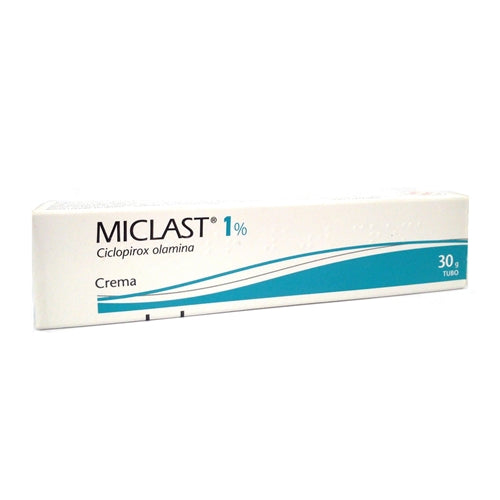
View compareMICLAST*CREAM 30G 10MG/G
MICLAST*CREAM 30G 10MG/G
Regular price
€11,28 EUR
Sale price
€11,28 EUR
Regular price
€12,20 EUR
Unit price
per
Tax included.
SKU
025218013In stock
Vendor
PIERRE FABRE ITALIA SpADelivery time: 48/72 hours
Free Shipping: Orders over €70
Description
MICLAST 1% cream
MICLAST 1% cutaneous powder
MICLAST 1% cutaneous solution
Ciclopirox olamine
What it is and what it is used for
MICLAST contains the active substance ciclopirox olamine.
MICLAST belongs to a group of medicines called antifungals.
MICLAST is used for certain fungal skin infections (cutaneous mycoses caused by sensitive fungi).
What you need to know before taking the medicine
Do not use MICLAST:
• if you are allergic to the active substance (ciclopirox olamine) or any of the other ingredients of this medicine (listed in section 6);
• on wounds in the case of MICLAST cutaneous powder.
Warnings and precautions
Talk to your doctor or pharmacist before using MICLAST.
Avoid contact with eyes.
Use MICLAST with caution and under direct medical supervision:
• if you are simultaneously being treated with other antifungals administered by routes other than the cutaneous route (systemic antifungal treatment);
• if you have been diagnosed with severe immune system defects (immunosuppression) in the past;
• if your immune system is compromised, such as in the case of transplantation and HIV infection;
• if you are diabetic.
In case of any allergic reaction, stop the treatment immediately, carefully remove the product and contact your doctor.
During treatment, carefully observe the hygiene measures recommended by your doctor and/or pharmacist.
If you have a Candida infection (a fungal infection), do not use an acidic soap, as it can promote its proliferation.
Cream:
Avoid contact with mucous membranes.
Do not apply to wounds.
Possible side effects
Like all medicines, this medicine can cause side effects, although not everybody gets them.
The following side effects may occur with the use of MICLAST:
Cream and cutaneous solution
Common side effects (may affect up to 1 in 10 people)
• transient worsening of symptoms in the application area;
• redness (erythema); or itching in the application area, these are mainly short-lived phenomena and treatment should not be interrupted;
• burning sensation of the skin.
Uncommon side effects (may affect up to 1 in 100 people)
• generalized allergic reactions (hypersensitivity) that can be severe and whose symptoms include swelling (edema), itching, rash, itchy rash (urticaria), breathing difficulties (dyspnea);
• vesicles in the application area.
If any of these side effects occur, you should stop treatment immediately and consult your doctor as soon as possible.
Side effects with unknown frequency (frequency cannot be estimated from the available data)
• local skin inflammation, such as eczema and contact dermatitis.
If you are undergoing prolonged treatment on large areas, on wounds, on mucous membranes or in the case of using bandages that do not allow the dispersion of the medicine (occlusive dressing), the risks related to the passage of the drug into the bloodstream should be considered: ask your doctor for advice.
Cutaneous powder
Side effects with unknown frequency (frequency cannot be estimated from the available data)
• skin inflammations, such as eczema and contact dermatitis.
Local allergic skin reactions (hypersensitivity), redness (erythema), itching, irritation, and/or numbness (hypoesthesia) may occur at the application site. Adhering to the instructions in this leaflet reduces the risk of side effects.
Reporting of side effects
If you get any side effects, including those not listed in this leaflet, talk to your doctor or pharmacist. You can also report side effects directly via the national reporting system at: https://www.aifa.gov.it/content/segnalazionireazioni-avverse.
By reporting side effects you can help provide more information on the safety of this medicine.