
You will not be allowed to compare more than 4 products at a time
View comparePRONTEX INTEGRA AUTOMATIC DIGITAL BLOOD PRESSURE MONITOR
PRONTEX INTEGRA AUTOMATIC DIGITAL BLOOD PRESSURE MONITOR
Regular price
€47,02 EUR
Sale price
€47,02 EUR
Regular price
€121,00 EUR
Unit price
per
Tax included.
SKU
939901512Low stock
Vendor
SAFETY SpADelivery time: 48/72 hours
Free Shipping: Orders over €70
Description
Prontex
Integra blood pressure monitor
Description
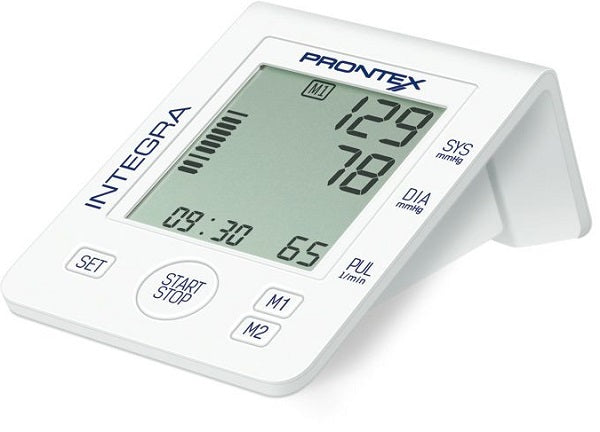
Integra Digital blood pressure monitor with user memory.
This device has been developed to non-invasively measure systolic and diastolic blood pressure, heart rate, and to determine pulse pressure values in adults. Designed for simple and convenient home use. This device features two memory channels, allowing measurements from two different users to be recorded separately.
This device measures blood pressure and heart rate using the oscillometric method. The cuff is connected to the main unit and should be wrapped around the arm. Sensors inside the cuff detect small pressure oscillations exerted against it during the dilation and contraction of the arm arteries in response to each individual heartbeat. The electronic system then measures the amplitude of each pressure wave, converts it into millimeters of mercury, and digitally displays the value on the large LCD screen.
INFLATING is the latest technology that ensures direct measurement of pressure values only during cuff inflation, thus ensuring greater comfort due to the lower constriction force applied to the arm and its shorter application time. With this technology, the measurement procedure consists of three distinct phases. In the first phase, the device rapidly inflates the cuff to an ideal preset value to secure the cuff to the limb and begin the second phase. The second phase begins when the device reduces the cuff inflation speed to allow accurate heart rate detection. The third and final phase is the actual measurement of pressure values and begins when the heart symbol starts flashing on the screen and ends when the device automatically deflates the cuff and displays the measurement result on the screen.
To shorten the measurement time and make it more comfortable, this special function adjusts the cuff inflation by the device, based on the values of the last three measurements present in the selected memory channel. If the last three recorded measurements in memory indicate high blood pressure values, the function will set a rapid cuff inflation to a higher value than the preset one. However, if this new setting is not suitable for the current blood pressure values, the device automatically deflates the cuff and resumes the measurement by setting a new and lower cuff inflation value. For this function to operate correctly, it is necessary for each of the two potential users of the device to select the memory channel before starting the measurement. The device records the last memory channel whose measurement was displayed before switching off and uses the data contained therein to set the personal mode for the next measurement. To select the correct personal mode, before starting the measurement, press the memory channel button, then press the START/STOP button to turn off the device, and then press it again to start the measurement.
The measured blood pressure values are classified according to the table below (WHO Guideline). When systolic and diastolic pressures fall into different categories, the higher class applies.
WHO: World Health Organization.
PULSE PRESSURE DISPLAY
This device also calculates and displays the pulse pressure value for each individual measurement. A pulse pressure value of 45 mmHg is generally considered normal. Pulse pressure alone is not an indicator of arteriosclerosis, however, it is important to monitor its trend over time.
Instructions for use
PREPARING THE DEVICE FOR USE
Before using the device, it is necessary to install the batteries and activate the clock. The device also works without setting the clock function, but in this case the data will be saved without any date and time reference for later consultation. If the batteries are removed, the clock stops working and will need to be reset. The device (and the clock) can also be powered by its designated AC adapter (see specific paragraph in this manual).
When the battery symbol starts flashing, the batteries are completely discharged and it may not be possible to take another measurement. The battery symbol remains flashing for 10 seconds after which the device automatically turns off. In this case, replace the exhausted batteries immediately. The batteries included in this package are for initial use of the device only and their life may be shorter than that of commercially available batteries. The batteries included in this package are not covered by the device warranty.
OPERATION WITH AC MAINS ADAPTER
The connector for the AC adapter is located on the back of the device. It is recommended to use only the AC mains adapter indicated by the manufacturer in this manual (ADP-W5 series). When the device is used with the power adapter, the batteries can be removed from their compartment. However, as soon as it is disconnected, the clock deactivates and, therefore, to keep it always running, it is possible to leave the batteries always inserted. Even if the batteries are left in the device for the sole purpose of keeping the clock running, it is suggested to occasionally perform some measurements without the use of the adapter, to prevent their prolonged non-use from causing internal fluid leakage. Electrical protection: this device is double insulated and protected by a primary thermal fuse against short circuits and overloads. Casing and protective covers: the main unit is protected from any possibility of contact with live parts or parts that conduct electricity (fingers, hooks, etc.). To avoid potential hazardous conditions, overheating, falls and/or accidental damage, it is recommended to unplug the power adapter from the power outlet immediately after finishing using the device.
Before starting to measure blood pressure, it is necessary to insert the air tube connector into the respective air tube connection hole identified by a blue ring.
Make sure that the air tube is not bent, twisted or crushed against the table.
The cuff can be applied to arms with a circumference between 22 and 42 cm. Therefore, before starting, it is appropriate to ensure that your arm falls within these measurements.
To effectively use the personal mode, it is suggested to select the memory bank before starting the measurement.
Use a table and a chair where you can sit comfortably, making sure your feet are flat on the floor and your arms and back can also rest comfortably.
The cuff should preferably be applied to the left arm (or always to the same arm as previous measurements) so that the air tube coming out of it is facing the hand.
If the cuff is applied over heavy clothing, tight clothing that may restrict blood circulation in the upper limb, or with the sleeve rolled up, the measurements taken may be inaccurate.
Wrap the cuff around the arm, securing it with the Velcro, only after ensuring that the lower edge is approximately 2-3 cm from the inner crease of the elbow. The cuff should be snug but comfortable, leaving enough space for two fingers to be inserted between it and the arm.
If the cuff is wrapped too tightly or too loosely than indicated, the measured values may be inaccurate.
Adjust the position of the cuff so that the AIR TUBE remains on the inside of the arm and above the area of the brachial artery.
Press the surface of the cuff to ensure it is securely fastened.
2. The forearm should rest naturally on the table and during the measurement the cuff should be at heart level.
If the cuff is at a lower (or higher) level than the heart, the measurement values tend to increase (or decrease).
Breathe deeply and relax.
Press the START/STOP button.
The device deflates the cuff. The device emits three short beeps and then automatically begins to inflate the cuff.
If it is necessary to interrupt the measurement, press the START/STOP button. The meter will rapidly and immediately deflate the air and then turn off.
The inflation symbol disappears and inflation slows down. As soon as the device detects the heartbeat, it displays the corresponding symbol on the display and begins measuring and identifying blood pressure values. As soon as the blood pressure values have been detected, the device stops the inflation phase and begins to deflate the cuff, meanwhile displaying the measurement results on the display and emitting an end-of-measurement sound. The measurement results, blood pressure values/pulse and pulse pressure, are displayed alternately on the screen.
To save the results, press one of the memory buttons, M1 or M2. The result will be stored in the selected bank.
To turn off the device, press the START/STOP button.
The device turns off. In any case, the device will automatically turn off after 2 minutes of inactivity. The measurement result is stored in the selected memory when the device is turned off. Never repeat measurements in rapid succession, as blood congestion could lead to false readings. Allow your arm to rest for at least 5/10 minutes between measurements. Do not take continuous measurements throughout the day; limit yourself to those indicated by your treating physician.
Display/delete data in memory (memory function):
1. Press the M1 button to review the readings saved in memory channel M1, press the M2 memory button to review those in memory channel M2.
The average value of the last three measurements is displayed with the indication A3;
2. The last reading taken and saved in the selected memory is displayed. The blood pressure and pulse values read are displayed alternately with respect to the pulse pressure value.
The progressive number of the record in memory, the date and time related to the blood pressure/heart rate measurement, alternating with the display of the pulse pressure value and its related date and time of measurement (always alternating with each other) are displayed sequentially on the display. The most recent measurement is displayed with memory number No. 1. Measurements are recalled in sequence from the most recent to the oldest by pressing the corresponding memory button. The larger the record number in memory, the older the date the measurement was performed.
Press the START/STOP button.
The device turns off, but even without pressing it, the data is displayed for a maximum of 2 minutes, after which the screen and the device automatically turn off.
To switch between memory channels, press the M2 button to switch from displaying data saved in memory channel M1 to those saved in memory channel M2, and press the M1 memory button if you want to switch from displaying data saved in memory channel M1 to those in memory channel M2. If a measurement was taken when the DATE/TIME function was deactivated and is displayed when the function has been restored, the date and time information will be displayed as --/-- and --:--.
Deleting a single measurement: press the memory button to view the recorded values. Then, scroll through the readings by repeatedly tapping the memory button until you reach the one to delete. Then hold down the memory button for 4 seconds until the display starts flashing and continue to hold the button for about another 4 seconds, until the reading is cleared and the display is cleared. To delete all data from a memory channel: as previously described in this manual, select and display the average of the readings of the memory channel to be deleted.
Then delete it by holding down the memory button continuously until the display is cleared. It is important to know the trend of your blood pressure values by taking measurements regularly and always under the same physical and mental conditions. Adjust the place and time to take measurements regularly every day. The symbol is displayed again on the screen at the end of the inflation and deflation actions of the cuff, which are repeated in the meantime when the initial pressure of the cuff is too high for reading the pressure, or when the arm or hand is moved, the cuff is deflated and the measurement procedure is repeated. This behavior is not an indication of any problem or malfunction of the device, do not move and/or speak during the measurement.
A symbol may appear on the screen due to overpressure, meaning that blood pressure values could not be detected due to disturbance induced by movement or conversation during the procedure, even though maximum cuff inflation is reached.
Do not move and/or speak during the measurement.
A symbol may appear on the screen because blood pressure measurement was not possible due to movement or conversation during the detection procedure.
Do not move or speak during the measurement.
A symbol may appear on the screen because the cuff is not correctly connected to the device. Secure the air connector. The cuff is not wrapped properly. Check how to correctly position the cuff.
A symbol may appear on the screen indicating:
batteries are low. Replace all batteries with new ones. No display on the screen;
batteries are exhausted. Replace all batteries with new ones;
batteries are inserted incorrectly. Check for correct battery insertion;
battery terminals are not clean. Clean battery terminals with a dry cloth. The AC adapter is not connected. Connect the AC adapter.
Time is not displayed.
The clock has not been activated.
Activate the DATE/TIME function and set the correct date and time parameters.
Date and time of measurement are displayed with a symbol on the screen and a symbol on the screen. The measurement was taken before the clock was set.
Date and time of measurement cannot be saved in memory without the clock having been previously activated. A symbol may appear on the screen indicating that the START / STOP button was held down during battery insertion or connection to the AC adapter. Turn off the device by pressing the START / STOP button once.
The end of the cuff is loose.
Place the cuff with the Velcro facing down and fold back the end with the metal hook. Then slide the other end of the cuff through the metal ring and fold it over.
If you cannot obtain an accurate measurement using the methods indicated in this manual, contact the retailer. Do not disassemble or tamper with the device under any circumstances. The manufacturer declares that the information contained in this manual is consistent with the technical and safety specifications of the device to which the manual refers. The declared technical specifications are updated as of the date of publication of this document and apply only to the device with which they are distributed. The manufacturer reserves the right to make changes or improvements to the content without prior notice.
CARE AND MAINTENANCE
It is recommended to always keep the device clean. It is good practice to check its cleanliness after each use. Check and make sure the device is not dirty before use. To clean the main unit, simply wipe it with a soft, dry cloth. Do not use gasoline, thinners or other types of strong solvents for cleaning. The cuff can be cleaned by gently wiping its surface with a cloth dampened with a detergent suitable for synthetic fabrics and then allowed to air dry completely. Always prevent fluids of any nature from entering the air connector of the cuff and then the corresponding tube. If this occurs, detach the tube and connector parts and dry them completely in the air.
The cuff should not be rubbed vigorously or machine washed. During storage, do not place heavy, hot or sharp objects on the device and its accessories. Never bend the cuff with excessive force or wrap the cuff tube to bend it at an angle. To detach the cuff from the main unit, do not pull the cuff or the tube but grasp the air connector and gently pull it out. Do not pull or twist and avoid contact with sharp or pointed objects. Do not replace, disassemble or modify components and parts of the device, to avoid malfunctions or damage that can also be dangerous for users. Immediately stop using the device and contact the retailer or manufacturer if visible damage is found on the product and its accessories. If you intend to store the device for a long period of time, remove the batteries. As a precaution against potential problems from poor maintenance, impacts, incorrect use, it is recommended to check the sphygmomanometer every 2 years. This operation can only be performed by the manufacturer or companies authorized by the manufacturer.
Warnings
It is recommended never to interpret the values obtained on your own.
For specific information on blood pressure, it is recommended to consult a doctor. You should not draw personal conclusions based solely on the indications provided by this device.
Always have blood pressure values interpreted by a qualified physician.
The device is not suitable for use on infants.
Before using the device to measure blood pressure on a child, pregnant woman or pre-eclampsia, it is always recommended to consult your doctor. The device is not intended for use during patient transport outside a healthcare facility.
Attention! Do not use rechargeable batteries or batteries of a type other than those indicated in this manual. In case of unsuitable batteries, the declared functional specifications and performance may vary. Do not touch other people with the batteries in your hands or when touching their terminals during insertion or replacement in the device. Close the battery compartment. Do not apply excessive force to the lid when closing it.
Do not mix new and old batteries or batteries of different types.
Do not connect the AC adapter to an electrical outlet that is not easily accessible and/or not up to standard.
Do not leave the power adapter plugged into the power outlet for a long time.
Do not hold your breath during the measurement session.
Do not cross your legs during the measurement session.
Do not move or speak during the measurement session.
PRECAUTIONS AND CONTRAINDICATIONS
If you are undergoing dialysis therapy or taking anticoagulants, antiplatelet agents or steroids, do not use this device without first consulting your doctor. The use of this instrument under these conditions could cause internal bleeding. For specific information on your blood pressure, it is always recommended to consult a doctor and never interpret the values obtained independently.
Do not use this product with implantable and wearable electromedical equipment, such as pacemakers, defibrillators or an electrocardiographic monitor. It must also not be used together with high-frequency surgical equipment. Do not use the device in environments with a potentially explosive atmosphere, for example in a room with flammable anesthetic substances or in an oxygen chamber.
The user is warned that the system may not provide an accurate measurement if used in temperature or humidity conditions outside the limits indicated in the Technical Specifications section of this manual. Use only the cuff and accessories from the original manufacturer. Otherwise, correct measurements cannot be guaranteed.
The medical device requires particular precautions regarding electromagnetic compatibility and must be installed and used according to the information provided in the accompanying documents: the device must be installed and used away from mobile and portable RF communication devices (mobile phones, microwave ovens, transceivers, etc.) that could affect the device itself. Do not use the cuff on an injured arm, an arm undergoing intravascular access or therapy or arteriovenous shunting, or on the arm on the side of a mastectomy. In these cases, the use of the device could be harmful.
Make sure that the cuff inflation does not impede blood circulation for too long. Also pay attention to any temporary functional anomaly of other monitoring medical devices that may be applied to the same arm to which the cuff is applied. To avoid potential problems arising from interference with normal circulatory flow by cuff inflation:
- Before measurement, ensure that the AIR TUBE is not twisted, bent and/or occluded. In such cases, inflation may not occur correctly or may be too prolonged;
- Never perform repeated measurements. To avoid any possibility of accidental strangulation, keep the device out of reach of children and avoid hanging the AIR HOSE around your neck.
Warning: The presence of small components and batteries poses a risk of choking if swallowed by children or pets, so it is recommended to store the product, its components, and batteries in places where children and pets cannot access them. This unit contains precision components. Therefore, be careful to avoid exposing the device to extreme temperature variations, humidity, shocks, dust, and/or direct sunlight. Do not drop or impact the unit. This device is not waterproof. Do not press on the display and buttons with excessive force, do not place the device with the display facing the support surface. Do not remove the batteries or disconnect the AC adapter while the device is on and/or operating.
Do not touch the AC adapter output connector during measurement. Inflate the cuff only when it has already been wrapped around the arm. Do not touch a patient while touching the battery, the device's battery terminals, or the AC adapter output plug, such as when replacing batteries or connecting/disconnecting the AC adapter.
This product is not designed for autonomous use by inexperienced persons in a public environment. Do not apply the cuff to the patient's limb where intravenous infusion is being administered. If the product is kept in an environment with a temperature above 40°C or below 10°C, leave the device in a suitable environment for at least 2 hours before taking a measurement.
Warning: Do not modify this device without the manufacturer's authorization. No electrical and/or mechanical parts contained in the device are designed to be repaired by the user. Failure to comply with the above may compromise the safety of the device and therefore its use.
Cod 19870
Integra Digital blood pressure monitor with user memory.
This device has been developed to non-invasively measure systolic and diastolic blood pressure, heart rate, and to determine pulse pressure values in adults. Designed for simple and convenient home use. This device features two memory channels, allowing measurements from two different users to be recorded separately.
This device measures blood pressure and heart rate using the oscillometric method. The cuff is connected to the main unit and should be wrapped around the arm. Sensors inside the cuff detect small pressure oscillations exerted against it during the dilation and contraction of the arm arteries in response to each individual heartbeat. The electronic system then measures the amplitude of each pressure wave, converts it into millimeters of mercury, and digitally displays the value on the large LCD screen.
INFLATING is the latest technology that ensures direct measurement of pressure values only during cuff inflation, thus ensuring greater comfort due to the lower constriction force applied to the arm and its shorter application time. With this technology, the measurement procedure consists of three distinct phases. In the first phase, the device rapidly inflates the cuff to an ideal preset value to secure the cuff to the limb and begin the second phase. The second phase begins when the device reduces the cuff inflation speed to allow accurate heart rate detection. The third and final phase is the actual measurement of pressure values and begins when the heart symbol starts flashing on the screen and ends when the device automatically deflates the cuff and displays the measurement result on the screen.
To shorten the measurement time and make it more comfortable, this special function adjusts the cuff inflation by the device, based on the values of the last three measurements present in the selected memory channel. If the last three recorded measurements in memory indicate high blood pressure values, the function will set a rapid cuff inflation to a higher value than the preset one. However, if this new setting is not suitable for the current blood pressure values, the device automatically deflates the cuff and resumes the measurement by setting a new and lower cuff inflation value. For this function to operate correctly, it is necessary for each of the two potential users of the device to select the memory channel before starting the measurement. The device records the last memory channel whose measurement was displayed before switching off and uses the data contained therein to set the personal mode for the next measurement. To select the correct personal mode, before starting the measurement, press the memory channel button, then press the START/STOP button to turn off the device, and then press it again to start the measurement.
The measured blood pressure values are classified according to the table below (WHO Guideline). When systolic and diastolic pressures fall into different categories, the higher class applies.
| WHO CLASSIFICATION | SYS (mmHg) | DIA (mmHg) |
| Optimal | <120 | <80 |
| Normal | 120-129 | 80-84 |
| High-normal | 130-139 | 85-89 |
| Hypertension (mild) | 140-159 | 90-99 |
| Hypertension (moderate) | 160-179 | 100-109 |
| Hypertension (severe) | >180 | >110 |
| Isolated systolic hypertension | >140 | <90 |
PULSE PRESSURE DISPLAY
This device also calculates and displays the pulse pressure value for each individual measurement. A pulse pressure value of 45 mmHg is generally considered normal. Pulse pressure alone is not an indicator of arteriosclerosis, however, it is important to monitor its trend over time.
Instructions for use
PREPARING THE DEVICE FOR USE
Before using the device, it is necessary to install the batteries and activate the clock. The device also works without setting the clock function, but in this case the data will be saved without any date and time reference for later consultation. If the batteries are removed, the clock stops working and will need to be reset. The device (and the clock) can also be powered by its designated AC adapter (see specific paragraph in this manual).
When the battery symbol starts flashing, the batteries are completely discharged and it may not be possible to take another measurement. The battery symbol remains flashing for 10 seconds after which the device automatically turns off. In this case, replace the exhausted batteries immediately. The batteries included in this package are for initial use of the device only and their life may be shorter than that of commercially available batteries. The batteries included in this package are not covered by the device warranty.
OPERATION WITH AC MAINS ADAPTER
The connector for the AC adapter is located on the back of the device. It is recommended to use only the AC mains adapter indicated by the manufacturer in this manual (ADP-W5 series). When the device is used with the power adapter, the batteries can be removed from their compartment. However, as soon as it is disconnected, the clock deactivates and, therefore, to keep it always running, it is possible to leave the batteries always inserted. Even if the batteries are left in the device for the sole purpose of keeping the clock running, it is suggested to occasionally perform some measurements without the use of the adapter, to prevent their prolonged non-use from causing internal fluid leakage. Electrical protection: this device is double insulated and protected by a primary thermal fuse against short circuits and overloads. Casing and protective covers: the main unit is protected from any possibility of contact with live parts or parts that conduct electricity (fingers, hooks, etc.). To avoid potential hazardous conditions, overheating, falls and/or accidental damage, it is recommended to unplug the power adapter from the power outlet immediately after finishing using the device.
Before starting to measure blood pressure, it is necessary to insert the air tube connector into the respective air tube connection hole identified by a blue ring.
Make sure that the air tube is not bent, twisted or crushed against the table.
The cuff can be applied to arms with a circumference between 22 and 42 cm. Therefore, before starting, it is appropriate to ensure that your arm falls within these measurements.
To effectively use the personal mode, it is suggested to select the memory bank before starting the measurement.
Use a table and a chair where you can sit comfortably, making sure your feet are flat on the floor and your arms and back can also rest comfortably.
The cuff should preferably be applied to the left arm (or always to the same arm as previous measurements) so that the air tube coming out of it is facing the hand.
If the cuff is applied over heavy clothing, tight clothing that may restrict blood circulation in the upper limb, or with the sleeve rolled up, the measurements taken may be inaccurate.
Wrap the cuff around the arm, securing it with the Velcro, only after ensuring that the lower edge is approximately 2-3 cm from the inner crease of the elbow. The cuff should be snug but comfortable, leaving enough space for two fingers to be inserted between it and the arm.
If the cuff is wrapped too tightly or too loosely than indicated, the measured values may be inaccurate.
Adjust the position of the cuff so that the AIR TUBE remains on the inside of the arm and above the area of the brachial artery.
Press the surface of the cuff to ensure it is securely fastened.
2. The forearm should rest naturally on the table and during the measurement the cuff should be at heart level.
If the cuff is at a lower (or higher) level than the heart, the measurement values tend to increase (or decrease).
Breathe deeply and relax.
Press the START/STOP button.
The device deflates the cuff. The device emits three short beeps and then automatically begins to inflate the cuff.
If it is necessary to interrupt the measurement, press the START/STOP button. The meter will rapidly and immediately deflate the air and then turn off.
The inflation symbol disappears and inflation slows down. As soon as the device detects the heartbeat, it displays the corresponding symbol on the display and begins measuring and identifying blood pressure values. As soon as the blood pressure values have been detected, the device stops the inflation phase and begins to deflate the cuff, meanwhile displaying the measurement results on the display and emitting an end-of-measurement sound. The measurement results, blood pressure values/pulse and pulse pressure, are displayed alternately on the screen.
To save the results, press one of the memory buttons, M1 or M2. The result will be stored in the selected bank.
To turn off the device, press the START/STOP button.
The device turns off. In any case, the device will automatically turn off after 2 minutes of inactivity. The measurement result is stored in the selected memory when the device is turned off. Never repeat measurements in rapid succession, as blood congestion could lead to false readings. Allow your arm to rest for at least 5/10 minutes between measurements. Do not take continuous measurements throughout the day; limit yourself to those indicated by your treating physician.
Display/delete data in memory (memory function):
1. Press the M1 button to review the readings saved in memory channel M1, press the M2 memory button to review those in memory channel M2.
The average value of the last three measurements is displayed with the indication A3;
2. The last reading taken and saved in the selected memory is displayed. The blood pressure and pulse values read are displayed alternately with respect to the pulse pressure value.
The progressive number of the record in memory, the date and time related to the blood pressure/heart rate measurement, alternating with the display of the pulse pressure value and its related date and time of measurement (always alternating with each other) are displayed sequentially on the display. The most recent measurement is displayed with memory number No. 1. Measurements are recalled in sequence from the most recent to the oldest by pressing the corresponding memory button. The larger the record number in memory, the older the date the measurement was performed.
Press the START/STOP button.
The device turns off, but even without pressing it, the data is displayed for a maximum of 2 minutes, after which the screen and the device automatically turn off.
To switch between memory channels, press the M2 button to switch from displaying data saved in memory channel M1 to those saved in memory channel M2, and press the M1 memory button if you want to switch from displaying data saved in memory channel M1 to those in memory channel M2. If a measurement was taken when the DATE/TIME function was deactivated and is displayed when the function has been restored, the date and time information will be displayed as --/-- and --:--.
Deleting a single measurement: press the memory button to view the recorded values. Then, scroll through the readings by repeatedly tapping the memory button until you reach the one to delete. Then hold down the memory button for 4 seconds until the display starts flashing and continue to hold the button for about another 4 seconds, until the reading is cleared and the display is cleared. To delete all data from a memory channel: as previously described in this manual, select and display the average of the readings of the memory channel to be deleted.
Then delete it by holding down the memory button continuously until the display is cleared. It is important to know the trend of your blood pressure values by taking measurements regularly and always under the same physical and mental conditions. Adjust the place and time to take measurements regularly every day. The symbol is displayed again on the screen at the end of the inflation and deflation actions of the cuff, which are repeated in the meantime when the initial pressure of the cuff is too high for reading the pressure, or when the arm or hand is moved, the cuff is deflated and the measurement procedure is repeated. This behavior is not an indication of any problem or malfunction of the device, do not move and/or speak during the measurement.
A symbol may appear on the screen due to overpressure, meaning that blood pressure values could not be detected due to disturbance induced by movement or conversation during the procedure, even though maximum cuff inflation is reached.
Do not move and/or speak during the measurement.
A symbol may appear on the screen because blood pressure measurement was not possible due to movement or conversation during the detection procedure.
Do not move or speak during the measurement.
A symbol may appear on the screen because the cuff is not correctly connected to the device. Secure the air connector. The cuff is not wrapped properly. Check how to correctly position the cuff.
A symbol may appear on the screen indicating:
batteries are low. Replace all batteries with new ones. No display on the screen;
batteries are exhausted. Replace all batteries with new ones;
batteries are inserted incorrectly. Check for correct battery insertion;
battery terminals are not clean. Clean battery terminals with a dry cloth. The AC adapter is not connected. Connect the AC adapter.
Time is not displayed.
The clock has not been activated.
Activate the DATE/TIME function and set the correct date and time parameters.
Date and time of measurement are displayed with a symbol on the screen and a symbol on the screen. The measurement was taken before the clock was set.
Date and time of measurement cannot be saved in memory without the clock having been previously activated. A symbol may appear on the screen indicating that the START / STOP button was held down during battery insertion or connection to the AC adapter. Turn off the device by pressing the START / STOP button once.
The end of the cuff is loose.
Place the cuff with the Velcro facing down and fold back the end with the metal hook. Then slide the other end of the cuff through the metal ring and fold it over.
If you cannot obtain an accurate measurement using the methods indicated in this manual, contact the retailer. Do not disassemble or tamper with the device under any circumstances. The manufacturer declares that the information contained in this manual is consistent with the technical and safety specifications of the device to which the manual refers. The declared technical specifications are updated as of the date of publication of this document and apply only to the device with which they are distributed. The manufacturer reserves the right to make changes or improvements to the content without prior notice.
CARE AND MAINTENANCE
It is recommended to always keep the device clean. It is good practice to check its cleanliness after each use. Check and make sure the device is not dirty before use. To clean the main unit, simply wipe it with a soft, dry cloth. Do not use gasoline, thinners or other types of strong solvents for cleaning. The cuff can be cleaned by gently wiping its surface with a cloth dampened with a detergent suitable for synthetic fabrics and then allowed to air dry completely. Always prevent fluids of any nature from entering the air connector of the cuff and then the corresponding tube. If this occurs, detach the tube and connector parts and dry them completely in the air.
The cuff should not be rubbed vigorously or machine washed. During storage, do not place heavy, hot or sharp objects on the device and its accessories. Never bend the cuff with excessive force or wrap the cuff tube to bend it at an angle. To detach the cuff from the main unit, do not pull the cuff or the tube but grasp the air connector and gently pull it out. Do not pull or twist and avoid contact with sharp or pointed objects. Do not replace, disassemble or modify components and parts of the device, to avoid malfunctions or damage that can also be dangerous for users. Immediately stop using the device and contact the retailer or manufacturer if visible damage is found on the product and its accessories. If you intend to store the device for a long period of time, remove the batteries. As a precaution against potential problems from poor maintenance, impacts, incorrect use, it is recommended to check the sphygmomanometer every 2 years. This operation can only be performed by the manufacturer or companies authorized by the manufacturer.
Warnings
It is recommended never to interpret the values obtained on your own.
For specific information on blood pressure, it is recommended to consult a doctor. You should not draw personal conclusions based solely on the indications provided by this device.
Always have blood pressure values interpreted by a qualified physician.
The device is not suitable for use on infants.
Before using the device to measure blood pressure on a child, pregnant woman or pre-eclampsia, it is always recommended to consult your doctor. The device is not intended for use during patient transport outside a healthcare facility.
Attention! Do not use rechargeable batteries or batteries of a type other than those indicated in this manual. In case of unsuitable batteries, the declared functional specifications and performance may vary. Do not touch other people with the batteries in your hands or when touching their terminals during insertion or replacement in the device. Close the battery compartment. Do not apply excessive force to the lid when closing it.
Do not mix new and old batteries or batteries of different types.
Do not connect the AC adapter to an electrical outlet that is not easily accessible and/or not up to standard.
Do not leave the power adapter plugged into the power outlet for a long time.
Do not hold your breath during the measurement session.
Do not cross your legs during the measurement session.
Do not move or speak during the measurement session.
PRECAUTIONS AND CONTRAINDICATIONS
If you are undergoing dialysis therapy or taking anticoagulants, antiplatelet agents or steroids, do not use this device without first consulting your doctor. The use of this instrument under these conditions could cause internal bleeding. For specific information on your blood pressure, it is always recommended to consult a doctor and never interpret the values obtained independently.
Do not use this product with implantable and wearable electromedical equipment, such as pacemakers, defibrillators or an electrocardiographic monitor. It must also not be used together with high-frequency surgical equipment. Do not use the device in environments with a potentially explosive atmosphere, for example in a room with flammable anesthetic substances or in an oxygen chamber.
The user is warned that the system may not provide an accurate measurement if used in temperature or humidity conditions outside the limits indicated in the Technical Specifications section of this manual. Use only the cuff and accessories from the original manufacturer. Otherwise, correct measurements cannot be guaranteed.
The medical device requires particular precautions regarding electromagnetic compatibility and must be installed and used according to the information provided in the accompanying documents: the device must be installed and used away from mobile and portable RF communication devices (mobile phones, microwave ovens, transceivers, etc.) that could affect the device itself. Do not use the cuff on an injured arm, an arm undergoing intravascular access or therapy or arteriovenous shunting, or on the arm on the side of a mastectomy. In these cases, the use of the device could be harmful.
Make sure that the cuff inflation does not impede blood circulation for too long. Also pay attention to any temporary functional anomaly of other monitoring medical devices that may be applied to the same arm to which the cuff is applied. To avoid potential problems arising from interference with normal circulatory flow by cuff inflation:
- Before measurement, ensure that the AIR TUBE is not twisted, bent and/or occluded. In such cases, inflation may not occur correctly or may be too prolonged;
- Never perform repeated measurements. To avoid any possibility of accidental strangulation, keep the device out of reach of children and avoid hanging the AIR HOSE around your neck.
Warning: The presence of small components and batteries poses a risk of choking if swallowed by children or pets, so it is recommended to store the product, its components, and batteries in places where children and pets cannot access them. This unit contains precision components. Therefore, be careful to avoid exposing the device to extreme temperature variations, humidity, shocks, dust, and/or direct sunlight. Do not drop or impact the unit. This device is not waterproof. Do not press on the display and buttons with excessive force, do not place the device with the display facing the support surface. Do not remove the batteries or disconnect the AC adapter while the device is on and/or operating.
Do not touch the AC adapter output connector during measurement. Inflate the cuff only when it has already been wrapped around the arm. Do not touch a patient while touching the battery, the device's battery terminals, or the AC adapter output plug, such as when replacing batteries or connecting/disconnecting the AC adapter.
This product is not designed for autonomous use by inexperienced persons in a public environment. Do not apply the cuff to the patient's limb where intravenous infusion is being administered. If the product is kept in an environment with a temperature above 40°C or below 10°C, leave the device in a suitable environment for at least 2 hours before taking a measurement.
Warning: Do not modify this device without the manufacturer's authorization. No electrical and/or mechanical parts contained in the device are designed to be repaired by the user. Failure to comply with the above may compromise the safety of the device and therefore its use.
Cod 19870