

You will not be allowed to compare more than 4 products at a time
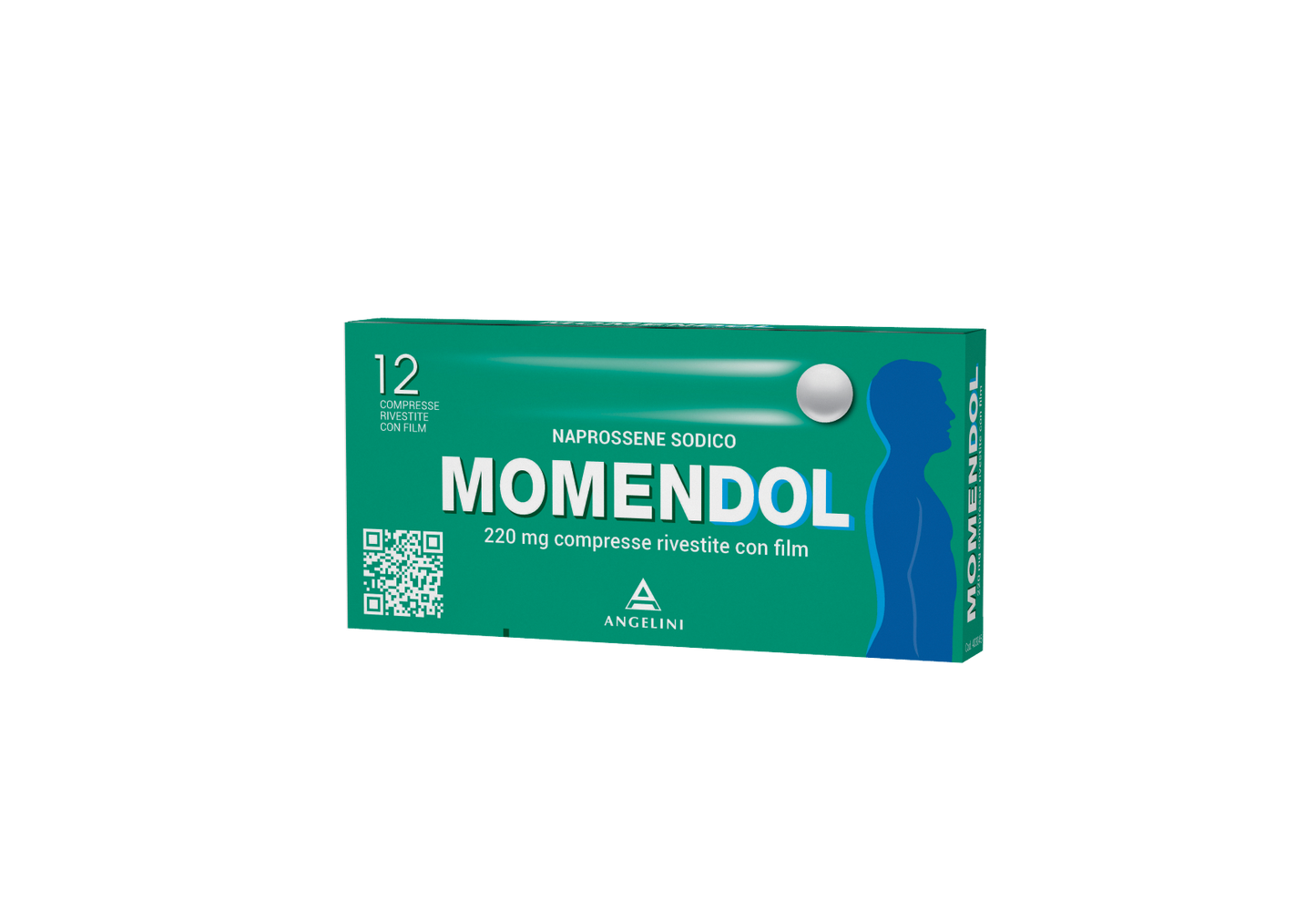
View compareMOMENDOL*12COATED TABS 220MG
MOMENDOL*12COATED TABS 220MG
Regular price
€8,32 EUR
Sale price
€8,32 EUR
Regular price
€9,90 EUR
Unit price
per
Tax included.
SKU
025829084In stock
Vendor
ANGELINI PHARMA ITALIA SpADelivery time: 48/72 hours
Free Shipping: Orders over €70
Description
MOMENDOL 220 mg film-coated tablets
Naproxen sodium
What it is and what it is used for
Momendol belongs to the class of analgesic-anti-inflammatory-antirheumatic non-steroidal drugs, i.e., medicines that combat pain, inflammation, fever, and are useful in the symptomatic treatment of rheumatic diseases.
Momendol is used for the short-term symptomatic treatment of mild to moderate pain, such as muscle and joint pain (e.g., backache, stiff neck), headache, toothache, and menstrual pain.
Momendol can also be used for the treatment of fever.
Consult your doctor if you do not feel better or if you feel worse after 7 days of pain treatment, and after 3 days of fever treatment.
What you need to know before taking the medicine
Do not take MOMENDOL
• If you are allergic to naproxen sodium or any of the other ingredients of this medicine (listed in section 6), or to other chemically related substances.
• If you suffer from allergic manifestations, such as asthma, urticaria, rhinitis, nasal polyps, angioedema, and allergic reactions induced by acetylsalicylic acid, analgesics, anti-inflammatory and/or antirheumatic drugs.
• If you have a history of gastrointestinal bleeding or perforation, recurrent active or previous peptic ulcer, chronic inflammatory bowel diseases (ulcerative colitis, Crohn's disease), severe hepatic insufficiency, severe cardiac insufficiency, severe renal insufficiency (creatinine clearance <30 ml/min), angioedema, during intensive diuretic therapy, in subjects with active bleeding and at risk of bleeding during anticoagulant therapy (See "Other medicines and MOMENDOL" and "Warnings and precautions").
• During pregnancy, from the third trimester, and during breastfeeding (See "Pregnancy, breastfeeding and fertility").
• The medicine cannot be administered to children under 12 years of age.
Warnings and precautions
Consult your doctor or pharmacist before taking Momendol:
• As there is a strong correlation between dosage and the appearance of severe gastrointestinal side effects. Therefore, the minimum effective dose should always be used.
• Medicines such as MOMENDol may be associated with a modest increased risk of heart attack ("myocardial infarction") or stroke. Any risk is more likely with high doses and prolonged treatment. Do not exceed the recommended dose or duration of treatment (7 days for pain and 3 days for fever treatment).
• When MOMENDOL is used in hypertensive patients and/or in patients with reduced cardiac and/or renal function. During treatment with MOMENDOL, diuresis and renal function should be closely monitored, particularly in the elderly, in patients with heart failure or chronic renal failure, and in patients undergoing diuretic treatment, following major surgical interventions involving significant blood loss.
• If you have heart problems, or a history of stroke or think you may be at risk for these conditions (for example, if you have high blood pressure, diabetes, or high cholesterol, or if you smoke) you should discuss your therapy with your doctor or pharmacist.
• When MOMENDOL is used in patients with severe heart failure, a worsening of the condition may occur.
• When MOMENDOL is used in patients with a history of gastrointestinal diseases or liver failure and in patients with current or previous allergic manifestations, as in these subjects the product may cause bronchospasm, asthma, or other allergic phenomena. In these cases, particular caution is advised.
• MOMENDOL should be discontinued at the first appearance of skin rash, mucosal lesions, or any other sign of allergy and/or hypersensitivity.
• If visual disturbances occur, treatment with MOMENDOL should be discontinued.
• Since naproxen, like any other anti-inflammatory drug, can mask the concomitant symptoms of infectious diseases.
• Since in isolated cases, in temporal connection with the use of anti-inflammatory drugs, an aggravation of infection-based inflammations has been reported.
• If used in elderly patients, who generally have some degree of impaired renal, hepatic, and cardiac function, as this group of patients is more exposed to the risk of onset of side effects related to the use of anti-inflammatory drugs. Prolonged use of anti-inflammatory drugs in the elderly is not recommended.
• Since naproxen inhibits platelet aggregation and can prolong bleeding time. Patients with coagulation disorders or on therapy with medicines that interfere with coagulation should be carefully monitored while taking MOMENDOL.
• When MOMENDOL is used by habitual consumers of high daily doses of alcohol, there is a high risk of stomach bleeding.
• The use of the product should be avoided in cases of pain of gastrointestinal origin. It is known that in patients taking anti-inflammatory drugs, stomach or intestinal bleeding may occur.
• In asthmatic patients, the product is generally contraindicated.
• When MOMENDOL is used in combination with other drugs that require caution, see "Other medicines and MOMENDOL".
Children and adolescents
Below 16 years of age, it is advisable to contact a doctor.
Possible side effects
Like all medicines, this medicine can cause side effects, although not everybody gets them.
The most commonly observed side effects are gastrointestinal.
The following side effects have been reported with NSAIDs and naproxen:
Common (may affect up to 1 in 10 people):
- Headache, drowsiness, dizziness
- Nausea, dyspepsia, vomiting, heartburn, gastralgia, flatulence.
Uncommon (may affect up to 1 in 100 people):
- Allergic reaction (including facial edema and angioedema)
- Sleep disturbances, agitation
- Vision disturbances
- Tinnitus, hearing disturbances
- Contusion
- Diarrhea, constipation
- Abnormal kidney function
- Chills, edema (including peripheral edema).
Rare (may affect up to 1 in 1000 people):
- Peptic ulcer, gastrointestinal perforation or bleeding, sometimes fatal, may occur especially in elderly subjects, hematemesis, ulcerative stomatitis, aggravated colitis and aggravated Crohn's disease.
Very rare (may affect up to 1 in 10,000 people):
- Hemolytic or aplastic anemia, thrombocytopenia, granulocytopenia
- Meningitis-like reaction
- Tachycardia, edema, hypertension and heart failure have been observed in association with NSAID treatment
- Dyspnoea, asthma
- Colitis, stomatitis. Gastritis has been observed less frequently
- Jaundice, hepatitis, reduced liver function
- Photosensitivity, alopecia, blistering disorder including Stevens-Johnson syndrome and toxic epidermal necrolysis
- Increased blood pressure.
As with other anti-inflammatory drugs, anaphylactic or anaphylactoid allergic reactions may occur in patients with or without previous exposure to drugs of the same class.
The characteristic symptoms of an anaphylactic reaction are: severe and sudden hypotension, acceleration or slowing of the heart rate, unusual fatigue or weakness, anxiety, agitation, loss of consciousness, difficulty breathing or swallowing, itching, urticaria with or without angioedema, skin redness, nausea, vomiting, cramping abdominal pain, diarrhea.
Medicines such as MOMENDOL may be associated with a modest increased risk of heart attack ("myocardial infarction") or stroke.
Reporting of side effects
If you get any side effects, including any not listed in this leaflet, talk to your doctor or pharmacist. You can also report side effects directly via the national reporting system at: https://www.aifa.gov.it/content/segnalazionireazioni-avverse.
By reporting side effects you can help provide more information on the safety of this medicine.
