

You will not be allowed to compare more than 4 products at a time
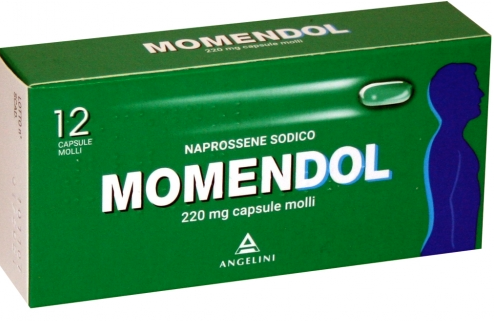
View compareMOMENDOL*12 SOFTGELS 220MG
MOMENDOL*12 SOFTGELS 220MG
Regular price
€8,69 EUR
Sale price
€8,69 EUR
Regular price
€10,60 EUR
Unit price
per
Tax included.
SKU
025829223In stock
Vendor
ANGELINI PHARMA ITALIA SpADelivery time: 48/72 hours
Free Shipping: Orders over €70
Description
MOMENDOL 220 mg soft capsules
Naproxen sodium
What it is and what it is used for
Momendol contains naproxen, a medicine that belongs to the class of analgesic-anti-inflammatory drugs, which are drugs that fight pain and inflammation.
Momendol is used in adults and adolescents aged 16 and over for the short-term treatment of:
- mild to moderate pain such as headaches, joint and muscle pain (e.g., back pain, stiff neck), toothaches, and menstrual pain;
- fever.
Consult your doctor if you do not feel better or if you feel worse.
Do not prolong treatment with Momendol for:
- more than 7 days for pain;
- more than 3 days for fever.
What you need to know before taking the medicine
Do not take Momendol
- if you are allergic to naproxen or any of the other ingredients of this medicine (listed in section 6);
- if you are allergic to substances closely related to naproxen from a chemical point of view;
- if you suffer from allergic diseases, such as asthma, hives, runny nose (rhinitis), nasal polyps, swelling of the skin and mucous membranes (angioedema);
- if you have had allergic reactions caused by acetylsalicylic acid, painkillers, anti-inflammatories or drugs used to treat rheumatism;
- if you have suffered from gastrointestinal or other bleeding, such as cerebrovascular;
- if you have had bleeding or perforation of the stomach or intestines in the past after taking medicines;
- if you have had two or more distinct episodes of stomach ulcer or bleeding in the past;
- if you have suffered from inflammation of the stomach lining (e.g., congestive gastropathy, atrophic gastritis);
- if you have an active stomach or duodenal ulcer;
- if you suffer from inflammatory bowel diseases (e.g., ulcerative colitis and Crohn's disease);
- if you are under 16 years of age;
- if you are pregnant or breastfeeding (see section Pregnancy and breastfeeding);
- if you have severe heart disease;
- if you have severe liver or kidney disease;
- if you are taking high doses of diuretics (medicines to treat high blood pressure) (see section Other medicines and Momendol);
- if you have ongoing bleeding or are taking anticoagulants (blood thinners) and are at risk of bleeding.
Warnings and precautions
In general, side effects can be minimized by using the lowest effective dose for the shortest possible duration of treatment needed to control symptoms, especially in elderly patients.
Consult your doctor or pharmacist before taking Momendol:
- if you are taking other anti-inflammatory medicines (including selective COX-2 inhibitors and some NSAIDs) because they could cause a modest increased risk of heart attack (myocardial infarction) or lack of blood supply to the brain (stroke) (see section Other medicines and Momendol);
- if you suffer from high blood pressure and/or have non-severe heart disease, as fluid retention, increased blood pressure, and swelling have been observed following treatment with NSAIDs;
- if you suspect you have an infection;
- if you are elderly, know you have non-severe kidney, liver or heart problems, or are using an anti-inflammatory medicine for a prolonged period; in these cases, your doctor will advise you to start treatment with the lowest dose and possibly the simultaneous use of stomach-protective drugs;
- if you habitually drink high doses of alcohol;
- if you want to take Momendol for stomach pain;
- if in the past you suffered from non-severe stomach and/or intestinal problems due to a medicine;
- if you are taking anti-inflammatory drugs (oral corticosteroids), blood thinners (anticoagulants such as warfarin) or antidepressants (selective serotonin reuptake inhibitors);
- if you are taking Aspirin/acetylsalicylic acid to prevent blood clots;
- severe skin reactions, including exfoliative dermatitis, Stevens-Johnson syndrome, toxic epidermal necrolysis, drug reaction with eosinophilia and systemic symptoms (DRESS), have been reported in association with Momendol. If you notice any of the symptoms related to these severe skin reactions, described in section 4, stop treatment with Momendol and contact your doctor immediately.
Stop treatment with Momendol and consult your doctor or pharmacist if, during the use of Momendol:
- visual disturbances appear;
- you have an infection or notice an worsening of an infection;
- in case of a wound, you notice a prolonged bleeding time;
- you experience sudden and intense abdominal pain;
- particularly in the first few days of treatment, any unusual symptoms in the stomach and/or intestines (especially bleeding) appear;
- particularly in the first month of treatment, changes in the skin or mucous membranes or any other sign of hypersensitivity appear, which could be signs of severe allergic reactions (exfoliative dermatitis, Stevens-Johnson syndrome, toxic epidermal necrolysis).
Your doctor will monitor your kidney function:
- if you are elderly;
- if you suffer from diseases that impair kidney function and diuresis (the process that allows urine formation);
- if you are taking diuretics (medicines used to treat high blood pressure and that increase the amount of urine);
- if you have recently undergone surgery involving hypovolemia (decrease in blood volume).
During treatment with Momendol, your doctor will monitor you carefully:
- if you have diseases that affect blood clotting;
- if you are taking medicines that can affect blood clotting.
Children and adolescents
Momendol can be used in adolescents aged 16 and over.
Possible side effects
Like all medicines, this medicine can cause side effects, although not everybody gets them.
The use of Momendol can cause side effects that are generally mild to moderate (nausea, vomiting, diarrhea, flatulence, constipation, dyspepsia (indigestion), abdominal pain), or more serious, allergic reactions.
If you develop an ulcer, or stomach bleeding with melena (black stools), hematemesis (vomiting blood) and/or intestinal bleeding, or skin and/or mucous membrane lesions, you should stop treatment with Momendol and contact your doctor.
Furthermore, if you experience any of the following symptoms, STOP using Momendol immediately and contact your doctor or the nearest hospital where you will undergo appropriate and specific treatment:
• skin rashes or lesions
• mucous membrane lesions
• signs of allergic reaction (erythema, itching, hives)
• peeling skin
• severe skin rash or skin exfoliation (toxic epidermal necrolysis, Stevens-Johnson syndrome)
• bleeding, ulcer and perforation of the stomach and intestines, which can be fatal, particularly in the elderly
• visual disturbances
• edema, hypertension and heart failure.
The risk of experiencing such symptoms is higher in the early stages of therapy. In most cases, the reaction occurs within the first month of treatment.
Side effects can be minimized by using the lowest effective dose for the shortest possible duration of treatment needed to control symptoms.
In addition, you may experience other side effects, listed below by frequency:
Common (may affect up to 1 in 10 people)
• nausea
• indigestion (dyspepsia)
• vomiting
• heartburn (pyrosis)
• stomach pain (gastralgia)
• gas (flatulence)
• headache (cephalalgia)
• drowsiness
• dizziness
• lightheadedness
Uncommon (may affect up to 1 in 100 people)
• diarrhea
• constipation
• sleep disorders, insomnia and somnolence
• excitement
• visual disturbances
• ringing in the ears (tinnitus)
• hearing disturbances
• allergic reactions with swelling and angioedema
• chills
• skin rash
• itching
• swelling (edema)
• bruising (ecchymosis)
• reduced kidney function
Rare (may affect up to 1 in 1,000 people)
• stomach or intestinal ulcer
• stomach or intestinal bleeding
• stomach or intestinal perforation
• blood in vomit (hematemesis)
• lesions inside the mouth (ulcerative stomatitis)
• worsening of colitis
• worsening of a chronic inflammatory bowel disease (Crohn's disease)
• kidney inflammation (glomerulonephritis)
• muscle weakness and pain (myalgia)
• fever
• increase and decrease in blood glucose
Very rare (may affect up to 1 in 10,000 people)
• inflammation inside the mouth (stomatitis), aphthous ulcers
• inflammatory disease of the colon and intestine (colitis), pancreas (pancreatitis) and esophagus (esophagitis)
• yellowish skin discoloration (jaundice)
• liver inflammation (hepatitis)
• reduced liver function
• decrease in hemoglobin, a substance that carries oxygen in the blood (aplastic or hemolytic anemia)
• reduction in the number of platelets in the blood (thrombocytopenia)
• decreased number of white blood cells (granulocytopenia, leukopenia) up to complete absence (agranulocytosis)
• increase in blood cells called eosinophils (eosinophilia)
• difficulty breathing (dyspnea, asthma), eosinophilic pneumonia, alveolitis
• sensitivity to light (photosensitivity)
• decrease in the amount of hair (alopecia)
• skin rash with blisters (vesicular eruption) or with nodules, pustules or reddish spots
• reddish cockade-like patches on the skin (erythema multiforme)
• redness and blisters (fixed erythema)
inflammatory reaction with the formation of small purplish papules (lichen planus)
• sweating
• systemic lupus erythematosus (chronic autoimmune disease)
• accelerated heartbeat (tachycardia)
• swelling (edema) and inflammation of the vessels (vasculitis)
• high blood pressure (hypertension)
• heart failure (severe heart disease)
• kidney failure
• inflammation or damage to the kidney with loss of protein and blood in the urine
• increase in blood potassium
• increase in blood creatinine
• symptoms such as fever, drowsiness, headache, sensitivity to light in patients with immune system diseases (meningitis-like symptoms) and convulsions
• cognitive disorders
• thirst and malaise
• depression and difficulty concentrating and thinking
• inflammation of the anterior part of the optic nerve (papillitis)
• inflammation of the posterior part of the optic nerve (retrobulbar optic neuritis)
• swelling of the papilla at the back of the eye (papilledema)
• hearing loss.
Not known: frequency cannot be estimated from the available data
Stop taking Momendol and contact your doctor immediately if you notice any of the following side effects:
-Extensive skin rash, high body temperature, increased liver enzymes, blood abnormalities (eosinophilia), enlarged lymph nodes and involvement of other organs (drug reaction with eosinophilia and systemic symptoms, also known as DRESS). See also section 2.
-A distinctive allergic skin reaction known as fixed drug eruption, which usually recurs in the same location(s) upon re-exposure to the medicine and may appear as round or oval patches with redness and skin swelling, rash with blisters (hives), itching sensation.
• stomach inflammation (gastritis)
Other side effects that have been reported with other medicines similar to Momendol and which therefore may also be potential side effects of Momendol:
• allergic reactions, including severe ones.
Characteristic symptoms of a severe allergic reaction are: severe and sudden low blood pressure, accelerated or slowed heartbeat, unusual tiredness or weakness, anxiety, agitation, loss of consciousness, difficulty breathing or swallowing, itching, hives with or without skin swelling, skin redness, nausea, vomiting, abdominal pain with cramps, diarrhea.
Medicines similar to Momendol may be associated with a modest increased risk of heart attack (myocardial infarction) or stroke.
Reporting of side effects
If you get any side effects, including any not listed in this leaflet, talk to your doctor or pharmacist. You can also report side effects directly via the national reporting system at: https://www.aifa.gov.it/content/segnalazionireazioni-avverse.
By reporting side effects, you can help provide more information on the safety of this medicine.
