

You will not be allowed to compare more than 4 products at a time
View compareMOMENT*36COATED TABS 200MG
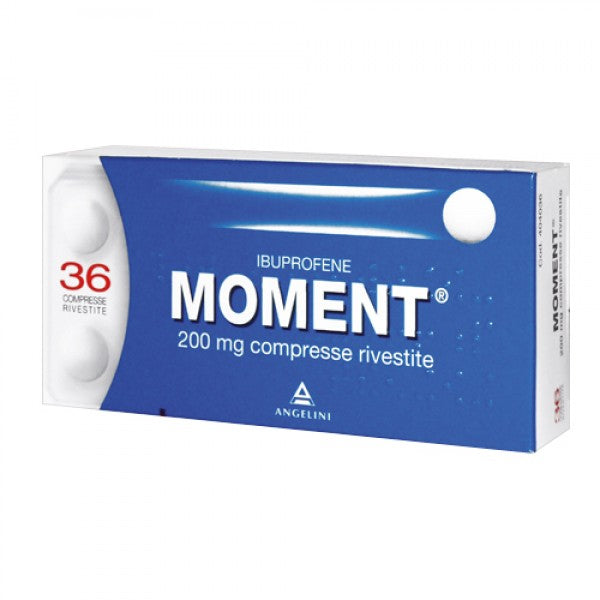
MOMENT*36COATED TABS 200MG
Regular price
€11,38 EUR
Sale price
€11,38 EUR
Regular price
€14,60 EUR
Unit price
per
Tax included.
SKU
025669185In stock
Vendor
ANGELINI PHARMA ITALIA SpADelivery time: 48/72 hours
Free Shipping: Orders over €70
Description
MOMENT 200 mg film-coated tablets
Ibuprofen
What it is and what it is used for
Moment contains ibuprofen, a medicine belonging to the class of analgesic-anti-inflammatory drugs, i.e., drugs that combat pain and inflammation.
Moment is used in adults and adolescents aged 12 years and over for: - treating pain of various origins and types (headache, toothache, neuralgia, osteoarticular and muscle pain, menstrual pain);
- reducing the symptoms of fever and flu-like conditions.
Consult your doctor if you do not feel better or if you feel worse after 3 days of treatment.
What you need to know before taking the medicine
Do not take Moment:
- if you are allergic to ibuprofen and/or any of the other ingredients of this medicine (listed in section 6);
- if you are allergic to other anti-rheumatic medicines (e.g., acetylsalicylic acid, etc.), medicines used for the treatment of joint or muscle pain (see section Other medicines and Moment);
- if the patient is a child under 12 years of age;
- if you are in the last 3 months of pregnancy or are breastfeeding (see section Pregnancy, breastfeeding and fertility);
- if you suffer from stomach and intestinal diseases (e.g., active or severe gastroduodenal ulcer);
- if you have previously had bleeding or perforation of the stomach or intestine after taking medicines;
- if you have previously had two or more distinct episodes of ulcer or stomach bleeding;
- in the presence of severe heart disease (severe heart failure);
- in the presence of severe liver or kidney disease;
- if you have lost a lot of fluids (severe dehydration) due to vomiting, diarrhea or insufficient fluid intake.
Warnings and precautions
Signs of an allergic reaction to this medicine have been reported with ibuprofen, including breathing problems, swelling of the face and neck area (angioedema), and chest pain. Stop Moment immediately and contact your doctor or emergency medical service immediately if you notice any of these signs.
Skin reactions
Severe skin reactions including exfoliative dermatitis, erythema multiforme, Stevens-Johnson syndrome, toxic epidermal necrolysis, drug reaction with eosinophilia and systemic symptoms (DRESS), acute generalized exanthematous pustulosis (AGEP) have been reported in association with ibuprofen treatment. Stop using Moment and contact your doctor immediately if you notice any of the symptoms related to these severe skin reactions described in section 4.
Talk to your doctor or pharmacist before taking Moment:
- if you have experienced difficulty breathing (bronchospasm) after using acetylsalicylic acid (aspirin) or other anti-inflammatory drugs;
- if you suffer from asthma, runny nose (chronic rhinitis), nasal polyps (nasal polyposis) or inflammation of the paranasal sinus mucosa (sinusitis) or suffer/have suffered from allergies, because you may experience difficulty breathing (bronchospasm), skin redness with itching (urticaria) or swelling of the skin and throat (angioedema), especially if you have already had allergic reactions after using other medicines used for the treatment of joint or muscle pain, fever or for the treatment of inflammation (NSAIDs);
- if you are taking other anti-inflammatory medicines, including selective COX-2 inhibitors (an enzyme involved in inflammatory processes), as in these cases the risk of ulcers and bleeding may increase (see section Other medicines and Moment);
- if you are elderly or have suffered from ulcers, especially if the ulcer has also manifested with bleeding or perforation (see section Do not take Moment), as the risk of bleeding, ulcer or perforation is higher, especially with higher doses of anti-inflammatory drugs. In these cases, you should start treatment with the lowest available dose, and possibly consult your doctor to have a medicine prescribed that protects the stomach (misoprostol or proton pump inhibitors). This possibility should also be considered if you take low doses of acetylsalicylic acid or medicines that may increase the risk of stomach and/or intestinal diseases (see section Other medicines and Moment);
- if you have suffered or suffer from chronic bowel diseases (ulcerative colitis, Crohn's disease) as they may worsen (see section 4 Possible side effects);
- if you have had stomach and intestinal diseases related to the use of medicines, and in particular if you are elderly, you must report any unusual intestinal symptoms (especially bleeding) to your doctor, particularly in the initial stages of treatment;
- if you are taking other medicines that increase the risk of stomach and/or intestinal ulcers or bleeding, such as oral corticosteroids (e.g., cortisone), anticoagulants (e.g., warfarin), antidepressants (selective serotonin reuptake inhibitors), or antiplatelet agents (e.g., acetylsalicylic acid). See also the section Other medicines and Moment. If gastrointestinal bleeding or ulceration occurs in patients taking Moment, treatment should be discontinued;
- if you have high blood pressure and the medicines you are taking are not able to lower it and/or you have heart disease or blood circulation problems in the brain or other body districts or you think you may be at risk for these diseases (for example if you suffer from high blood pressure, diabetes or high cholesterol or if you smoke);
- if you suffer from high blood pressure and/or have heart disease, as fluid retention, increased blood pressure, and swelling have been observed following treatment with NSAIDs. NSAIDs can reduce the action of medicines to lower blood pressure (see section Other medicines and Moment);
- if you have lost a significant amount of fluids, or if swelling, heart problems or high blood pressure appear;
- if you have decreased kidney function, heart or liver malfunction, or if you are elderly or undergoing treatment with medicines for high blood pressure, as you may be more prone to the onset of kidney problems. Furthermore, the habitual concomitant use of several painkillers may further increase this risk;
- if you suffer from a coagulation disorder or are taking medicines that slow down blood clotting (anticoagulants) (see section Other medicines and Moment);
- if you suffer from a disease that can affect various organs and tissues of the body (diffuse or systemic lupus erythematosus) or a connective tissue disease, present in many parts of the body, such as bones and cartilage, as in rare occasions, symptoms of aseptic meningitis have been observed in patients treated with ibuprofen. Although this is more likely to occur in patients with systemic lupus erythematosus and related connective tissue diseases, it has also been observed in patients who did not have concomitant chronic diseases;
- if you are taking medicines to treat pain, heart disease or high blood pressure (see section Other medicines and Moment);
- if you intend to become pregnant (see section Pregnancy, breastfeeding and fertility);
- if you have problems getting pregnant or are undergoing fertility investigations (see section Pregnancy, breastfeeding and fertility);
- if you have an infection - see the section Infections below.
Anti-inflammatory/painkiller medicines such as ibuprofen may be associated with a modest increased risk of heart attack or stroke, especially if administered in high doses. Do not exceed the recommended dose or duration of treatment.
You should discuss your therapy with your doctor or pharmacist before taking Moment if you have:
- heart problems including heart attack, angina (chest pain) or if you have a history of heart attack, coronary bypass surgery, peripheral arterial disease (poor circulation to the legs or feet due to narrowing or obstruction of the arteries) or any type of stroke (including mini-stroke or TIA, transient ischemic attack);
- high blood pressure, diabetes, high cholesterol, a family history of heart disease or stroke, or if you are a smoker.
Medicines like Moment can:
- be associated with the appearance of kidney diseases, even serious ones (such as renal papillary necrosis, analgesic nephropathy and renal failure), therefore your doctor will monitor your kidney function;
- cause eye disorders, therefore, in case of prolonged treatments, periodic eye checks are recommended. If visual disturbances occur, stop treatment with Moment.
Infections
Moment can mask the symptoms of infections such as fever and pain. Therefore, Moment may delay adequate treatment of the infection, which could increase the risk of complications. This has been observed in pneumonia caused by bacteria and in bacterial skin infections related to chickenpox. If you take this medicine while you have an infection and the symptoms of the infection persist or worsen, consult your doctor immediately.
Adolescents
If the adolescent is dehydrated, there is a risk of developing kidney disease.
Possible side effects
Like all medicines, Moment can cause side effects, although not everybody gets them.
The side effects of the medicine can be minimized if you use the lowest dose among those recommended, and if you use the medicine only for the period necessary to control your symptoms.
If you develop an ulcer, or stomach and/or intestinal bleeding, or skin and/or mucous membrane lesions, you must stop treatment with Moment and contact your doctor. These side effects are usually more common in the elderly.
The use of Moment can cause side effects that are generally mild or moderate, or more severe reactions, even allergic ones, although rarely.
If you experience any of the following symptoms, STOP using Moment immediately and contact your doctor or the nearest hospital immediately where you will be given appropriate and specific treatment:
• chest pain, which may be a sign of a potentially serious allergic reaction called Kounis syndrome;
• skin rashes or lesions;
• mucous membrane lesions;
• signs of an allergic reaction, even severe (erythema, itching, urticaria, asthma, swelling of the skin and mucous membranes, anaphylactic shock);
• peeling skin;
• reddish, non-raised, target-shaped or circular spots on the trunk, often with central blisters, peeling skin, ulcers of the mouth, throat, nose, genitals and eyes. These severe skin rashes may be preceded by fever and flu-like symptoms (exfoliative dermatitis, erythema multiforme, Stevens-Johnson syndrome, toxic epidermal necrolysis);
• widespread rash, high body temperature and enlarged lymph nodes (DRESS syndrome);
• widespread, red and scaly rash, with bumps under the skin and blisters, accompanied by fever. Symptoms usually appear at the beginning of treatment (acute generalized exanthematous pustulosis).
• visual disturbances;
• liver disease (hepatic dysfunction);
• bleeding, ulceration and perforation of the stomach and intestine, which can be fatal, particularly in the elderly.
If one of the allergic reactions described above occurs, go to the hospital as it is necessary to have immediate availability of equipment, medicines and personnel suitable for emergency treatment, since in rare cases, following the use of ibuprofen, serious side effects, sometimes fatal, have been reported, even in the absence of known allergy.
The risk of experiencing such symptoms is higher in the early stages of therapy: in most cases, the reaction occurs within the first month of treatment.
Furthermore, you may experience other side effects that have also been reported with other medicines similar to Moment and are listed below according to frequency:
common (may affect up to 1 in 10 people)
• dizziness;
• malaise;
• fatigue;
uncommon (may affect up to 1 in 100 people)
• inflammation of the stomach (gastritis);
• insomnia, anxiety;
• numbness of the limbs or other parts of the body (paresthesia), drowsiness;
• inflammation of the nasal mucosa (rhinitis);
• difficulty breathing (bronchospasm, dyspnea);
• momentary cessation of breathing (apnea);
• visual disturbances;
• hearing impairment;
• ringing in the ears (tinnitus);
• vertigo;
• liver disorders (altered liver function);
• liver inflammation (hepatitis);
• yellowing of the skin and eyes (jaundice);
• kidney diseases (renal function damage and toxic nephropathy in various forms, including interstitial nephritis, nephrotic syndrome and renal failure);
• hypersensitivity reactions such as rash, urticaria, itching, formation of red spots on the skin (purpura), swelling of the skin and mucous membranes (angioedema), difficulty breathing (bronchospasm or dyspnea), asthma attacks with possible drop in blood pressure;
• skin reactions to light (photosensitivity);
rare (may affect up to 1 in 1,000 people)
• reduction in the number of blood cells: reduction of white blood cells (leukopenia, neutropenia, agranulocytosis), red blood cells (hemolytic anemia, aplastic anemia), platelets (thrombocytopenia);
• reduced clotting ability;
• depression, confusional state, hallucinations;
• inflammation of the optic nerve (optic neuritis);
• inflammation of the meninges, the membranes covering the brain (aseptic meningitis, especially in patients with pre-existing autoimmune disorders, see section Warnings and precautions), with symptoms of neck stiffness, headache, nausea, vomiting, fever or disorientation;
• eye disorders with visual disturbances and optic nerve disease (toxic optic neuropathy);
• swelling due to fluid accumulation in the tissues;
• a disease that can affect various organs and tissues of the body (lupus erythematosus syndrome);
• worsening of inflammation caused by an existing infection (e.g., development of necrotizing fasciitis);
• high blood nitrogen levels;
• altered liver function tests (increased transaminases, increased alkaline phosphatase);
• abnormal blood tests (reduced hemoglobin, reduced hematocrit, prolonged bleeding time, decreased blood calcium, increased blood uric acid).
very rare (may affect up to 1 in 10,000 people)
• inflammation of the pancreas, a gland involved in digestive processes (pancreatitis);
• sensation of feeling one's own heartbeat (palpitations);
• heart disease (heart failure);
• heart attack (myocardial infarction);
• presence of fluid in the lungs (acute pulmonary edema);
• liver disease (hepatic insufficiency);
• hypertension;
• severe allergic reactions, which may include symptoms such as severe asthma, swelling of the face, tongue and throat making it difficult to breathe, fast heart rate, severe rapidly appearing allergic reaction that can cause death (anaphylaxis), severe skin rash or peeling skin (toxic epidermal necrolysis, Stevens-Johnson syndrome, erythema multiforme);
• severe skin infections and soft tissue disorders may occur during chickenpox infection.
not known (frequency cannot be estimated from the available data)
• feeling of heaviness in the stomach;
• nausea;
• vomiting;
• diarrhea;
• flatulence;
• constipation;
• difficulty digesting;
• abdominal pain;
• heartburn;
• blood in stools;
• blood in vomit;
• lesions inside the mouth;
• worsening of inflammatory colon and bowel diseases (colitis, Crohn's disease);
• increased risk of sudden reduction in brain blood circulation (stroke);
• allergic reactions, anaphylaxis;
• drug reaction with eosinophilia and systemic symptoms (DRESS syndrome): a severe skin reaction known as DRESS syndrome may occur. Symptoms of DRESS include: rash, fever, swollen lymph nodes and increased eosinophils (a type of white blood cell);
• a widespread, red and scaly rash, with pustules under the skin and blisters located mainly on skin lesions, on the trunk and upper limbs accompanied by fever at the beginning of treatment (acute generalized exanthematous pustulosis). Stop using Moment if you develop these symptoms and contact your doctor immediately. See also section 2.
Reporting side effects
If you get any side effects, including any not listed in this leaflet, tell your doctor or pharmacist. You can also report side effects directly via the national reporting system at: https://www.aifa.gov.it/content/segnalazionireazioni-avverse.
By reporting side effects, you can help provide more information on the safety of this medicine.
