

You will not be allowed to compare more than 4 products at a time
View compareMUSCORIDOL*5MED PLASTERS 180MG
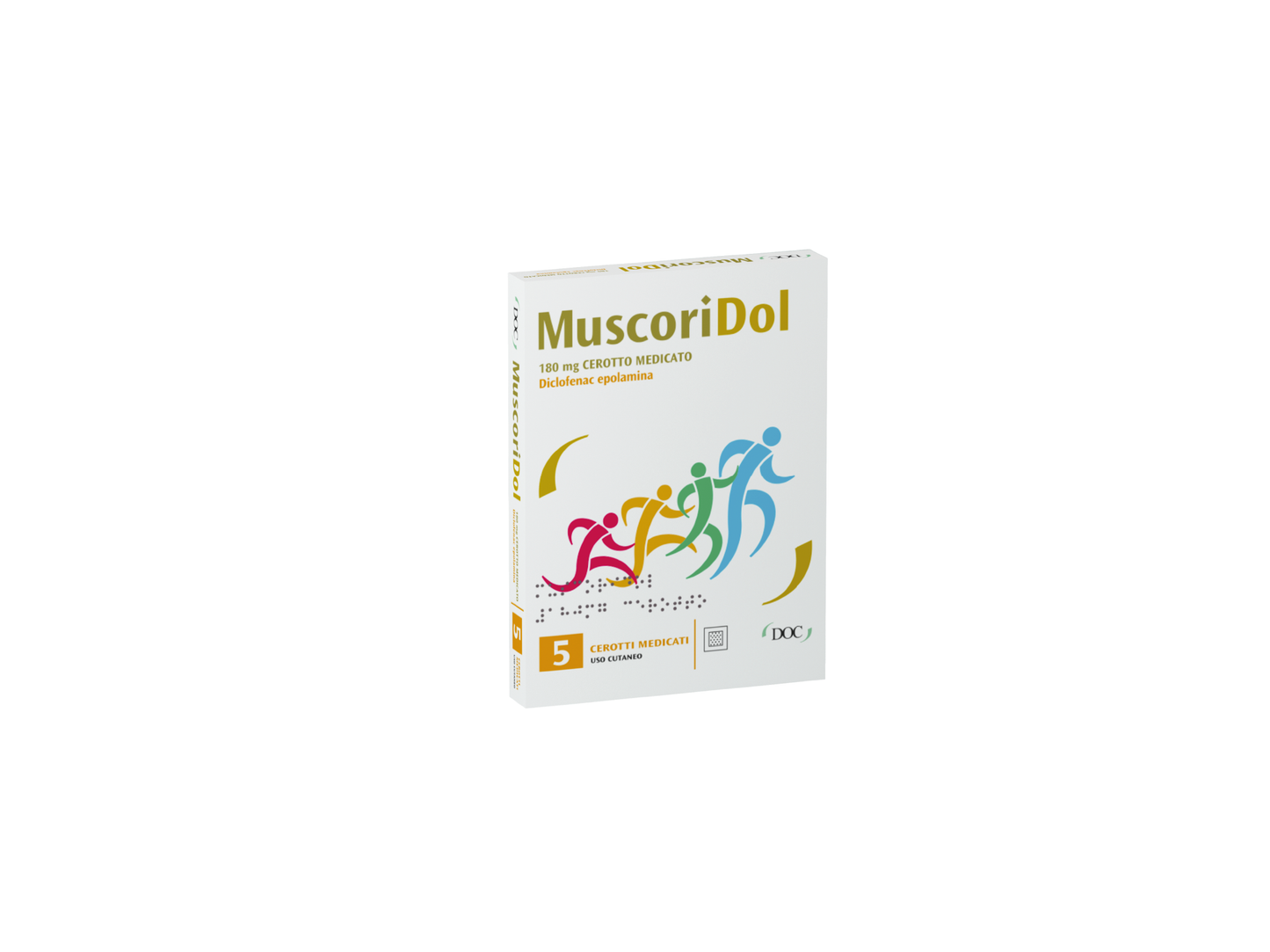
MUSCORIDOL*5MED PLASTERS 180MG
Regular price
€13,46 EUR
Sale price
€13,46 EUR
Regular price
€16,90 EUR
Unit price
per
Tax included.
SKU
045951011In stock
Vendor
MIAT SpADelivery time: 48/72 hours
Free Shipping: Orders over €70
Description
MUSCORIDOL 180 mg medicated plaster
Diclofenac epolamine
What it is and what it is used for
MUSCORIDOL belongs to a group of medicines called non-steroidal anti-inflammatory drugs (NSAIDs).
NSAIDs reduce pain and inflammation.
MUSCORIDOL is used to relieve pain and inflammation of rheumatic or traumatic origin in joints, muscles, tendons and ligaments.
Contact your doctor if you do not notice any improvement or if your symptoms worsen after a short period of treatment with MUSCORIDOL.
What you need to know before taking the medicine
Do not use MUSCORIDOL:
• if you are allergic to diclofenac, acetylsalicylic acid (aspirin), other painkillers, any other NSAID (non-steroidal anti-inflammatory drug), or any of the other ingredients of this medicine (listed in section 6);
• if you have had asthma, breathing problems, rash or runny nose after taking acetylsalicylic acid (aspirin) or other NSAIDs;
• if you are in the last three months of pregnancy (see section Pregnancy, and breastfeeding and fertility);
• if you currently suffer from stomach ulcers (peptic ulcer);
• if you have broken skin, including weeping or infected areas, eczema, burns or wounds;
• if the person to be treated is a child or adolescent under 16 years of age.
Inform your doctor or pharmacist if any of the above conditions apply to you
Warnings and precautions
Consult your doctor or pharmacist before using MUSCORIDOL if:
• you suffer from heart disease;
• you suffer from kidney disease;
• you suffer from liver disease;
• you have had stomach ulcers in the past;
• you have an inflammatory bowel disease such as Crohn's disease or ulcerative colitis or are prone to episodes of intestinal bleeding;
• you have asthma;
• you have had breathing problems, skin rashes or a runny nose after taking acetylsalicylic acid (aspirin) or other NSAIDs;
• you are taking diclofenac or other NSAIDs, as an oral or topical preparation;
• you regularly use tanning lamps or expose yourself to direct sunlight (also see section Other important information);
• you are elderly, as you are more susceptible to the onset of side effects.
Other important information
Always use the lowest effective dose of MUSCORIDOL for the shortest possible time to control symptoms.
MUSCORIDOL should be used with caution in elderly patients who may be more prone to experiencing side effects.
Side effects can be minimised by using the lowest effective dose for the minimum necessary duration. Do not exceed the dose of MUSCORIDOL, do not apply it to extensive areas of the skin and do not use it for long periods.
Do not expose yourself to direct sunlight or the light of sun lamps (tanning lamps) for at least one day after removing the plaster; this will reduce the risk of developing an adverse reaction to light (photosensitivity).
Like other medicines for local (topical) use, especially in case of prolonged therapy, MUSCORIDOL can cause redness and itching (sensitisation phenomena). Stop treatment and contact your doctor or pharmacist if skin reactions occur at the application site when using this plaster.
Children and adolescents
Do not apply the plaster to children and adolescents under 16 years of age.
Possible side effects
Like all medicines, this medicine can cause side effects, although not everyone gets them.
Common side effects (may affect up to 1 in 10 people)
• Rashes and redness of the skin (skin rash, eczema, erythema), inflammation of the skin (dermatitis, including allergic and contact dermatitis), itching or other reactions at the plaster application site.
Uncommon side effects (may affect up to 1 in 100 people)
• Small red or purple spots under the skin (petechiae);
• feeling of warmth.
Rare side effects (may affect up to 1 in 1,000 people)
• Inflammation of the skin with blister formation (bullous dermatitis);
• dry and flaky skin.
Very rare side effects (may affect up to 1 in 10,000 people)
• Inflammation of the skin with pus (pustular rash);
• symptoms of an allergic reaction (hypersensitivity and anaphylactic reaction), including hives, swelling of the face (angioedema), lips, eyes or tongue and difficulty breathing;
• asthma;
• skin rashes worsened by sunlight (photosensitivity reaction).
Side effects with unknown frequency (frequency cannot be estimated from the available data)
• Burning sensation at the application site.
Since MUSCORIDOL is applied to the skin over the affected area, there is a lower risk of experiencing side effects, such as stomach problems including pain, indigestion or any sign of bleeding in the stomach or intestines, which may occur when diclofenac is taken orally. However, if MUSCORIDOL is not used correctly, these side effects may occur.
The use of the medicine in combination with other medicines containing diclofenac should be avoided because if medicated plasters are used in combination with other medicines containing diclofenac, the likelihood of skin reactions, including those after sun exposure, such as blistering, erythema and eczema, increases. In rare cases, even severe reactions may occur, such as skin rashes with redness, blistering and exfoliation (e.g., Steven-Johnson Syndrome, Lyell's syndrome).
Reporting of side effects
If you get any side effects, including any not listed in this leaflet, talk to your doctor or pharmacist. You can also report side effects directly via the national reporting system at: https://www.aifa.gov.it/content/segnalazionireazioni-avverse.
By reporting side effects, you can help provide more information on the safety of this medicine.