

You will not be allowed to compare more than 4 products at a time
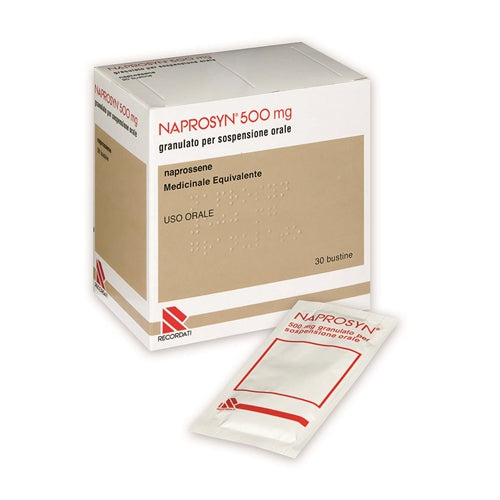
View compareNAPROSYN*OS 30SACHETS 250MG
NAPROSYN*OS 30SACHETS 250MG
Regular price
€8,73 EUR
Sale price
€8,73 EUR
Regular price
€9,40 EUR
Unit price
per
Tax included.
SKU
023177090Low stock
Vendor
RECORDATI SpADelivery time: 48/72 hours
Free Shipping: Orders over €70
Description
Naprosyn 250 mg granules for oral suspension
Naproxen
What it is and what it is used for
Naprosyn contains the active ingredient naproxen.
Naproxen belongs to a class of medicines called non-steroidal anti-inflammatory/antirheumatic drugs (NSAIDs) that perform numerous activities, with an important function in pain control.
Naprosyn is used for the treatment of symptoms of:
• an inflammatory joint disease (rheumatoid arthritis)
• a degenerative joint disease (osteoarthritis or degenerative arthritis)
• an inflammatory spinal disease (ankylosing spondylitis)
• a disease caused by the presence of uric acid crystals in the joints (gouty arthropathy)
• diseases affecting joints, bones, tendons (sciatica, myalgia, neuralgia, radicular syndromes, periarthritis, fibromyositis).
Contact your doctor if you do not feel better or if you feel worse after a short period of treatment.
What you need to know before taking the medicine
Do not take Naprosyn
• if you are allergic to naproxen or any of the other ingredients of this medicine (listed in paragraph 6);
• if you suffer from a stomach or duodenal wall lesion (gastroduodenal ulcer and active peptic ulcer);
• if you suffer from colon inflammation (ulcerative colitis);
• if you have a history of bleeding or perforation of the stomach or intestine due to previous treatments or a history of frequent bleeding/stomach wall lesion (peptic ulcer) (two or more distinct episodes);
• if you have severe heart problems (severe heart failure);
• if you have had allergic manifestations such as asthma, itching (urticaria), allergic rhinitis (rhinitis), severe and rapid general allergic reaction (anaphylactic or anaphylactoid reactions), presence of drop-shaped nodules inside the nose (nasal polyps), associated with the use of aspirin (acetylsalicylic acid) and/or other non-steroidal anti-inflammatory drugs (NSAIDs);
• if it is for a child under 2 years of age;
• if you are pregnant or breastfeeding;
• if you have severe kidney problems.
Warnings and precautions
Consult your doctor or pharmacist before taking Naprosyn.
In particular, inform your doctor:
• if you are taking other non-steroidal anti-inflammatory drugs (NSAIDs);
• if you have a history of stomach wall lesion with bleeding/perforation (gastrointestinal hemorrhage, ulceration or perforation);
• if you have or have ever had acute inflammation of the gastrointestinal tract or if you have had stomach or intestinal problems after using medicines for rheumatic diseases;
• if you have a history of stomach or intestinal toxicity: report any unusual symptoms to your doctor, especially at the beginning of treatment;
• if you are taking anti-inflammatory medicines (oral corticosteroids), blood thinning medicines (anticoagulants such as warfarin), medicines for depression (selective serotonin reuptake inhibitors) or medicines such as aspirin or similar (see Other medicines and Naprosyn);
• if you suffer from a chronic inflammatory disease of the stomach and intestine (ulcerative colitis or Crohn's disease);
• if you have heart problems;
• if you have liver problems;
• if you have kidney problems;
• if you suffer from high blood pressure and/or heart problems (heart failure), confirmed ischemic heart disease, peripheral arterial disease and/or cerebrovascular disease;
• if you have a history of swelling of the legs, arms, face, mouth or tongue (angioedema) or breathing difficulties (bronchospasm, asthma and rhinitis) and the presence of drop-shaped nodules inside the nose (nasal polyps);
• if you have severe and rapid general allergic reactions (anaphylactic or anaphylactoid reactions);
• if you have bleeding problems (hemostasis disorders);
• if you are planning a pregnancy;
• if you have fertility problems or are undergoing fertility investigations.
Severe skin reactions, including exfoliative dermatitis, Stevens-Johnson syndrome, toxic epidermal necrolysis, drug reaction with eosinophilia and systemic symptoms (DRESS), have been reported in association with Naprosyn. If you notice any of the symptoms related to these severe skin reactions, described in paragraph 4, discontinue treatment with Naprosyn and contact your doctor immediately.
If with the use of Naprosyn you notice the appearance of skin rashes (skin rash), mucosal lesions or any other sign of allergic reaction (hypersensitivity), immediately stop treatment and contact your doctor.
Medicines like Naprosyn may be associated with a modest increased risk of heart attack (myocardial infarction) or stroke. Any risk is more likely with high doses and prolonged treatments. Do not exceed the recommended dose or duration of treatment.
If you have heart problems or a history of stroke or think you may be at risk for these conditions (for example if you have high blood pressure, diabetes or high cholesterol or are a smoker) you should discuss the therapy with your doctor or pharmacist.
In the elderly and in patients with a history of ulcer, especially if complicated by bleeding or perforation (see paragraph Do not take Naprosyn), the risk of gastrointestinal bleeding, ulceration or perforation increases with increasing dose. These patients should start treatment with the lowest available dose.
If you use Naprosyn for prolonged treatments, you should undergo periodic eye examinations.
Children and adolescents
The use of the medicine is not intended for children. The doctor may prescribe Naprosyn only in cases of absolute necessity and in children over 2 years of age.
Elderly
If you are elderly, you have a higher probability of experiencing some of the side effects caused by Naprosyn such as bleeding/perforation of the stomach and intestine.
Possible side effects
Like all medicines, this medicine can cause side effects, although not everybody gets them.
Stop taking Naprosyn and contact your doctor immediately if you notice the appearance of any of the following side effects:
Not known: frequency cannot be estimated from the available data
- Widespread rash, high body temperature, increased liver enzymes, blood abnormalities (eosinophilia), enlarged lymph nodes and involvement of other organs (drug reaction with eosinophilia and systemic symptoms, also known as DRESS). See also paragraph 2;
- A distinctive allergic skin reaction known as fixed drug eruption, which usually recurs at the same site or sites upon re-exposure to the medicine and may appear as round or oval patches with redness and swelling of the skin, blistering rash (urticaria), itching sensation.
• The most commonly observed adverse events are gastrointestinal in nature. Injury, bleeding or perforation of the stomach and intestine (peptic ulcers, perforation or gastrointestinal hemorrhage) may occur, sometimes fatal, particularly in the elderly (see Warnings and precautions). After administration of Naprosyn, the following have been reported: nausea, vomiting, diarrhea, flatulence (passage of gas from the anus), constipation (constipation), indigestion (dyspepsia), abdominal and stomach pain, heartburn (gastric pyrosis), blood in the stools (melena), vomiting with blood (hematemesis), mouth inflammation (ulcerative stomatitis), worsening of a chronic inflammatory bowel disease (exacerbation of colitis and Crohn's disease), esophageal inflammation (esophagitis), pancreatic inflammation (pancreatitis). Less frequently, stomach inflammation (gastritis) has been observed.
Other side effects that may occur with the use of Naprosyn are:
• alteration of the concentration of certain types of cells present in the blood (thrombocytopenia, granulocytopenia, leukopenia, eosinophilia, aplastic or hemolytic anemia);
• severe and rapid general allergic reactions (anaphylactic or anaphylactoid reactions);
• high potassium concentration in the blood (hyperkalemia);
• abnormal dreams;
• depression;
• insomnia;
• dizziness;
• disorientation;
• convulsions;
• headache (cephalalgia);
• drowsiness;
• inflammation of the optic nerve (retrobulbar optic neuritis);
• cognitive dysfunctions;
• difficulty concentrating;
• inflammation of the membranes surrounding the brain (aseptic meningitis);
• visual disturbances (papillitis, papilledema, impaired vision, corneal opacity);
• hearing disturbances (impaired hearing, ringing in the ear, tinnitus, vertigo);
• irregular or strong heartbeat (palpitations);
• accelerated heartbeat (tachycardia);
• heart function problems (congestive heart failure, heart failure, myocardial infarction);
• brain vessel injury (stroke);
• high blood pressure (hypertension);
• inflammation of blood vessels (vasculitis);
• swelling (edema);
• breathing difficulties (dyspnea, asthma and bronchospasm);
• inflammation of the lungs (eosinophilic pneumonia);
• increased fluid in the lungs (pulmonary edema);
• throat swelling (laryngeal edema);
• yellow skin (jaundice);
• liver inflammation (hepatitis);
• skin rashes;
• itching;
• urticaria;
• bruises (ecchymosis);
• rapid swelling of legs, arms, face or tongue (angioedema);
• appearance of red and swollen nodules under the skin (erythema multiforme, erythema nodosum, lichen planus);
• red spots on the body (purpura);
• blistering reactions including a disease called Steven-Johnson syndrome with severe lesions to the skin, mouth and other parts of the body with high fever, vomiting, diarrhea and joint pain;
• skin death (toxic epidermal necrolysis);
• abnormal and exaggerated skin reaction to light (photosensitivity reactions);
• hair loss (alopecia);
• muscle pain (myalgia);
• muscle weakness;
• blood in the urine (hematuria);
• reduced kidney function, kidney damage (interstitial nephritis, nephrotic syndrome, kidney failure, renal papillary necrosis);
• female infertility;
• mild swelling of the extremities (peripheral edema);
• excessive thirst;
• fever and chills;
• malaise;
• alteration of the laboratory test to assess liver function;
• increased creatinine in the blood (hypercreatinemia).
Medicines like Naprosyn may be associated with a modest increased risk of heart attack (myocardial infarction) or stroke.
Reporting of side effects
If you get any side effects, including any not listed in this leaflet, talk to your doctor or pharmacist. You can also report side effects directly via the national reporting system at: https://www.aifa.gov.it/content/segnalazionireazioni-avverse.
By reporting side effects you can help provide more information on the safety of this medicine.
