

You will not be allowed to compare more than 4 products at a time
View compareNEXIUM CONTROL*14 gastro-resistant tablets 20mg
NEXIUM CONTROL*14 gastro-resistant tablets 20mg
Regular price
€11,22 EUR
Sale price
€11,22 EUR
Regular price
€13,00 EUR
Unit price
per
Tax included.
SKU
042922029Low stock
Vendor
HALEON ITALY SrlDelivery time: 48/72 hours
Free Shipping: Orders over €70
Description
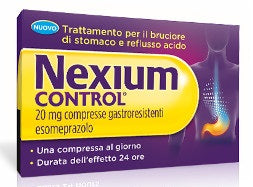
Nexium Control 20 mg gastro-resistant tablets
Esomeprazole
What it is and what it is used for
Nexium Control contains the active ingredient esomeprazole. It belongs to a group of medicines called 'proton pump inhibitors'. These work by reducing the amount of acid produced by the stomach.
This medicine is used in adults for the short-term treatment of reflux symptoms (e.g., heartburn and acid regurgitation).
Reflux is the return of acid from the stomach into the oesophagus ("food pipe"), which can become inflamed and painful. This can cause symptoms such as a painful sensation in the chest rising towards the throat (heartburn) and a sour taste in the mouth (acid regurgitation).
Nexium Control is not designed to provide immediate relief. It may be necessary to take the tablets for 2-3 consecutive days before feeling better. Consult your doctor if you do not feel better or if you feel worse after 14 days.
What you need to know before taking the medicine
Do not take Nexium Control
- If you are allergic to esomeprazole or any of the other ingredients of this medicine (listed in section 6).
- If you are allergic to medicines containing other proton pump inhibitors (e.g., pantoprazole, lansoprazole, rabeprazole, or omeprazole).
- If you are taking a medicine containing nelfinavir (used to treat HIV infections).
You must not take this medicine if any of the above apply to you. If in doubt, consult your doctor or pharmacist before taking this medicine.
Warnings and precautions
Consult your doctor before taking Nexium Control if:
• You have previously had a stomach ulcer or undergone stomach surgery.
• You have been receiving continuous treatment for reflux or heartburn for 4 or more weeks.
• You have jaundice (yellowing of the skin and eyes) or severe liver problems.
• You have severe kidney problems.
• You are over 55 years old and have new or recently changed reflux symptoms or need to take over-the-counter remedies for indigestion or heartburn daily.
• You have ever had a skin reaction after treatment with a medicine similar to Nexium Control that reduces stomach acid.
• You need to undergo an endoscopy or a urea breath test.
• You need to have a specific blood test (Chromogranin A).
Consult your doctor immediately before or after taking this medicine if you notice any of the following symptoms, which could be signs of a more serious illness.
• You are losing a lot of weight for no reason.
• You have difficulty or pain when swallowing.
• You experience stomach pain or signs of indigestion such as nausea, feeling full, bloating, especially after eating.
• You start vomiting food or blood, which may appear dark like coffee grounds in your vomit.
• Your stools are black (stools with blood spots).
• You have severe or persistent diarrhoea; esomeprazole has been associated with a slight increase in the risk of infectious diarrhoea.
• If you notice a skin rash, especially in areas exposed to sunlight, consult your doctor as soon as possible, as it may be necessary to stop treatment with Nexium Control. Remember to also report any other side effects such as joint pain.
Seek urgent medical advice if you experience chest pain accompanied by mental confusion, sweating, dizziness, or shoulder pain and shortness of breath. This could be a symptom of a serious heart problem.
If any of the above apply to you (or if you are in doubt), consult your doctor immediately.
Children and adolescents
This medicine should not be used in children and adolescents under 18 years of age.
Possible side effects
Like all medicines, this medicine can cause side effects, although not everyone experiences them.
If you notice any of the following serious side effects, stop taking Nexium Control and contact your doctor immediately:
• Sudden wheezing, swelling of the lips, tongue and throat, rash, fainting, or difficulty swallowing (severe allergic reaction, rarely observed).
• Reddening of the skin with blisters or peeling. Severe blistering and bleeding may also occur in the lips, eyes, mouth, nose, and genitals. This can be 'Stevens-Johnson syndrome' or 'toxic epidermal necrolysis', observed very rarely.
• Yellow skin, dark urine, and fatigue, which may be symptoms of liver problems, rarely observed.
Contact your doctor as soon as possible if you experience any of the following signs of infection:
This medicine very rarely affects white blood cells, leading to immunodeficiency. If you experience an infection with symptoms such as fever with a severe deterioration in general health or fever with symptoms of local infection such as pain in the neck, throat, or mouth, or difficulty urinating, you should consult your doctor as soon as possible to rule out a lack of white blood cells (agranulocytosis) by performing a blood test. In this case, it is important that you inform your doctor about the medicine you are taking.
Other side effects include:
Common (may affect up to 1 in 10 people)
• Headache.
• Effects on the stomach or intestines: diarrhoea, stomach ache, constipation, gas (flatulence).
• Feeling sick (nausea) or being sick (vomiting).
• Benign growths (polyps) in the stomach.
Uncommon (may affect up to 1 in 100 people)
• Swelling of the feet and ankles.
• Disturbed sleep (insomnia), drowsiness.
• Dizziness, tingling sensation like pins and needles.
• Sensation of spinning (vertigo).
• Dry mouth.
• Increased liver enzymes shown in blood tests that check how the liver is working.
• Rash, skin wheals (hives), and skin itching.
Rare (affect up to 1 in 1,000 people)
• Blood problems such as a reduced number of white blood cells or platelets. This can cause weakness, bruising, or make it easier to get infections.
• Low sodium levels in the blood. This can cause weakness, feeling sick (vomiting), and cramps.
• Feeling agitated, confused, or depressed.
• Taste disturbances.
• Vision problems such as blurred vision.
• Sudden wheezing or shortness of breath (bronchospasm).
• Inflammation inside the mouth.
• Infection called candidiasis that can affect the intestines and is caused by a fungus.
• Hair loss (alopecia).
• Rash on exposure to the sun.
• Joint pain (arthralgia) or muscle pain (myalgia).
• General feeling of being unwell and lack of strength.
• Increased sweating.
Very rare (affect up to 1 in 10,000 people)
• Low number of red blood cells, white blood cells, and platelets (a condition called pancytopenia).
• Aggression.
• Seeing, perceiving, or hearing non-existent things (hallucinations).
• Severe liver problems leading to liver failure and brain inflammation.
• Muscle weakness.
• Severe kidney problems.
• Breast enlargement in men.
Not known (frequency cannot be estimated from the available data)
• Low magnesium levels in the blood. This can cause fatigue, feeling sick (vomiting), involuntary muscle contractions, tremors, and changes in heart rhythm (arrhythmia). If you have very low magnesium levels, you may also experience low blood levels of calcium and/or potassium.
• Inflammation of the intestines (which can lead to diarrhoea).
• Rash, possible joint pain.
Reporting of side effects
If you get any side effects, including any not listed in this leaflet, tell your doctor or pharmacist. You can also report side effects directly via the national reporting system at: https://www.aifa.gov.it/content/segnalazionireazioni-avverse.
By reporting side effects you can help provide more information on the safety of this medicine.