

You will not be allowed to compare more than 4 products at a time
View compareSCREEN DRUG TEST COCAINE DRUG TEST WITH URINE CONTAINER
SCREEN DRUG TEST COCAINE DRUG TEST WITH URINE CONTAINER
Regular price
€8,05 EUR
Sale price
€8,05 EUR
Regular price
€12,00 EUR
Unit price
per
Tax included.
SKU
911151672Low stock
Vendor
SCREEN ITALIA SrlDelivery time: 48/72 hours
Free Shipping: Orders over €70
This product page, including its Product Information Leaflet, has been automatically translated.
Description
SCREEN
DRUG TEST
Cocaine
Instructions for use for each test combination of the following drugs: amphetamine, benzodiazepine, cocaine, marijuana, methylenedioxymethamphetamine, ketamine, opiates, synthetic marijuana k2/spice.
One-step test for the simultaneous qualitative determination of drugs and their metabolites in human urine.
Precautions
Product not intended for medical or diagnostic use.
Do not use beyond the expiration date.
Store the test strip panel in the sealed pouch until use.
All samples must be considered potentially hazardous and therefore handled with the precautions related to potentially infectious products.
After use, the panel must be disposed of according to local regulations in force.
Store in the sealed pouch at a temperature between 2° and 30°C.
The test strip panel is stable until the expiration date indicated on the pouch label.
The test strip panel must be stored in the sealed pouch until use.
Do not freeze.
Do not use beyond the expiration date.
Intended Use and Summary
Screening test for the simultaneous determination of several drugs.
The speed and sensitivity of immunoassays have made them considered the most accepted as screening tests in urine for the simultaneous detection of drugs of abuse.
The one-step test strip panel (Urine) is a rapid lateral flow immunochromatographic test for the qualitative determination of the following drugs without the aid of instruments:
This test provides only preliminary analytical data.
More specific chemical methods must be used to confirm the analytical result.
Gas chromatography and mass spectrometry (GC/MS) are considered preferential confirmatory methods.
Any result for the determination of the presence of drugs of abuse must be correlated with clinical considerations and professional judgment, particularly when the preliminary result is positive.
It is a rapid urine screening test that does not require the use of special instruments.
The test uses antibodies to selectively detect high levels of specific substances in human urine.
Retention times are approximate for each substance as they vary depending on frequency of use, body mass, age, health status, tolerance to narcotic substances, and urine pH.
The product detects the presence of narcotic substances in urine only after their metabolization.
COCAINE (COC)
Cocaine is a potent central nervous system stimulant and local anesthetic derived from the coca plant.
The substance is often self-administered by inhalation or intravenous injection, or by smoking the base substance.
AMPHETAMINE (AMP)
Amphetamine is a substance also used for therapeutic purposes.
The substance is often self-administered by inhalation or ingestion.
High doses produce enhanced central nervous system stimulation and induce euphoria, alertness, appetite reduction, a sense of increased energy and strength.
More acute reactions produce anxiety, paranoia, hallucinations, and psychotic behavior.
METHYLENEDIOXYMETHAMPHETAMINE (MDMA)
Ecstasy is not a stimulant, although it shares with amphetamines the ability to increase blood pressure and heart rate.
It produces some changes in perception such as increased light sensitivity, difficulty focusing, blurred vision.
The effect that occurs in almost everyone who takes this substance is jaw clenching.
MARIJUANA (THC)
Tetrahydrocannabinol is the active ingredient in cannabis.
When smoked or taken orally, THC produces euphoria.
Regular users experience short-term memory impairment and learning difficulties, and may also have transient episodes of confusion and anxiety.
Long-term relatively heavy use may be associated with behavioral disorders.
OPIATES (OPI)
The opiate class refers to any substance derived from the opium poppy, including natural compounds such as morphine, codeine, and semi-synthetic substances like heroin.
Opiates act on pain control by depressing the central nervous system.
Withdrawal symptoms may include sweating, tremors, nausea, and irritability.
Opiates can be taken orally or by intravenous, intramuscular, and subcutaneous injection.
Users may also take the substance intravenously or by inhalation.
BENZODIAZEPINE (BZO)
These are frequently prescribed medications for the symptomatic treatment of anxiety, sleep disorders, epileptic seizures, and alcohol withdrawal syndrome.
Abrupt discontinuation can induce symptoms such as sleep disturbances, gastrointestinal issues, loss of appetite, sweating, tremors, weakness, anxiety, and changes in perception.
KETAMINE (KET)
Ketamine is a dissociative anesthetic for human and veterinary use.
It is marketed in Italy under the names Ketalar, Ketanest, and Ketaset, and in human medicine it is classified as a Class H drug and should only be used in a hospital setting by an anesthesiologist-resuscitator.
Like all neuro- and psycholeptic drugs, it can be abused and used for recreational purposes, which is prohibited and penalized by law, as a narcotic substance.
SYNTHETIC MARIJUANA K2/SPICE (K2/SPICE)
Synthetic Marijuana or K2 is a psychoactive herb and a chemical product that, when consumed, mimics the effects of Marijuana.
Most commonly known by the trade names K2 and Spice, both widely used to refer to any synthetic Marijuana product.
Principle
The one-step test strip panel (Urine) is a rapid immunochromatographic test based on the principle of competitive binding.
Drugs that may be present in the urine sample compete with their respective conjugate for the same antibody binding sites.
During the test, a urine sample migrates by capillarity along the membrane.
A drug, if present in the urine sample at a concentration below its cut-off, will not be able to saturate all binding sites of the antibody-bound particles present on the strip.
The antibody-bound particles will be captured by the immobilized conjugate and a colored band will appear in the test band area of the respective strip.
The colored band will not form in the respective area if the drug level is above its cut-off, as all binding sites of the respective antibodies will be saturated.
A urine sample positive for the tested drug will not cause the formation of the colored band due to drug competition, while a urine sample negative for the tested drug or a sample containing a drug concentration below the cut-off will cause the formation of the colored band in the specific test area.
As a procedural control, a colored band will appear in the control area, indicating that a correct amount of sample was used and that membrane migration occurred.
Reagents
Each strip of the panel contains mouse monoclonal antibodies bound to particles and the corresponding.
The one-step test strip panel (Urine) is a rapid lateral flow immunochromatographic test conjugated for each drug.
Goat antibodies are used for the control band.
Sample Collection and Preparation
Collect the urine sample in a clean and dry container.
Urine samples collected at any time of day can be used.
Urine samples with obvious presence of precipitate must be centrifuged, filtered, or allowed to settle to obtain a clear sample for testing.
Urine samples can be stored at a temperature of 2-8°C for a maximum of 48 hours.
For prolonged storage, samples can be frozen and stored at a temperature below -20°C.
Before using frozen samples, they must be thawed and thoroughly homogenized.
Procedure for use
1. Before opening the pouch, bring it to room temperature. Remove the product from the pouch and use it as soon as possible.
2. Remove the cap from the strips. Immerse the product vertically, in the direction of the arrows, into the urine sample for at least 10/15 seconds. Immerse the product up to the wavy lines on the strips but not above them.
3. Replace the cap on the device and place the product horizontally on a flat, non-absorbent surface. Read the result after 5 minutes. Do not interpret the result after 10 minutes.
Interpretation of Results
Negative*: A colored band appears in the control region (C) and a second one in the test region (T) for each drug, indicating a negative result.
A negative result indicates that the concentration of the drug in question in the urine is below the detectable cut-off level for that specific drug.
*the color intensity in the test region (T) may vary, but any faint colored band should be considered negative.
Positive: A colored band appears in the control region (C) but not in the test region (T) for each drug, indicating a positive result.
A positive result indicates that the concentration of the drug in question in the urine is above the detectable cut-off level for that specific drug.
Invalid: No control band (C) appears.
The most plausible causes for the absence of the control band may be insufficient sample volume or incorrect analytical procedure.
Recheck the procedure and repeat the test using a new panel.
If the problem persists, immediately discontinue use of the kit and contact your local distributor.
If the test result is positive, avoid aggressive behavior and calmly seek dialogue with the person concerned.
Consult your doctor, a psychologist, or contact the relevant service in your area.
Quality Control
The test includes an internal control system consisting of the red band that appears in the control region (C).
The appearance of this band confirms that the test was performed correctly with a sufficient sample volume, that membrane absorption was adequate, and the procedure was correct.
Standard controls are not provided with the kit; however, it is recommended to test positive and negative controls, as good laboratory practice, to confirm the test procedure and verify its correct characteristics.
Limitations
1. The one-step test strip panel (Urine) provides only a preliminary qualitative analytical result. A second analytical method is required. Gas chromatography and mass spectrometry (GC/MS) are considered preferential confirmatory methods and are the recommended confirmatory methods if the test is positive.
2. It is possible that technical or procedural errors, as well as interfering substances present in the urine sample, may cause erroneous results.
3. It is possible that adulterants, such as bleach and/or alum present in the urine sample, may cause erroneous results regardless of the analytical method used. If the presence of such substances is suspected, the test should be repeated with another urine sample.
4. A positive result indicates the presence of the drug or its metabolites but not the level of intoxication, the route of administration, or the concentration in the urine.
5. A negative result does not necessarily mean that the urine sample is drug-free. A negative result can be obtained when the drug is present but at a concentration below the test's cut-off level.
6. The test is unable to distinguish between the drug and a medication containing the same substance; false positives may be caused by some medications.
Format
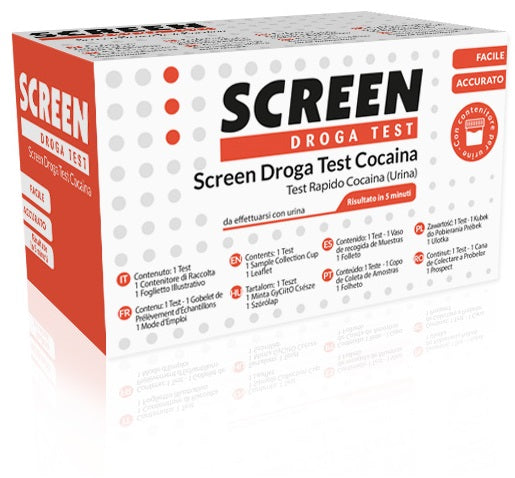
• 1 urine container.
• 1 Cocaine Drug Test.
• insert.
One-step test for the simultaneous qualitative determination of drugs and their metabolites in human urine.
Precautions
Product not intended for medical or diagnostic use.
Do not use beyond the expiration date.
Store the test strip panel in the sealed pouch until use.
All samples must be considered potentially hazardous and therefore handled with the precautions related to potentially infectious products.
After use, the panel must be disposed of according to local regulations in force.
Store in the sealed pouch at a temperature between 2° and 30°C.
The test strip panel is stable until the expiration date indicated on the pouch label.
The test strip panel must be stored in the sealed pouch until use.
Do not freeze.
Do not use beyond the expiration date.
Intended Use and Summary
Screening test for the simultaneous determination of several drugs.
The speed and sensitivity of immunoassays have made them considered the most accepted as screening tests in urine for the simultaneous detection of drugs of abuse.
The one-step test strip panel (Urine) is a rapid lateral flow immunochromatographic test for the qualitative determination of the following drugs without the aid of instruments:
| Test | Calibrator | Cut-off (ng/ml) |
| Cocaine (COC) Amphetamine (AMP) Methylenedioxymethamphetamine (MDMA) Marijuana (THC) Opiates (OPI) Benzodiazepine (BZO) Ketamine (KET) Synthetic Marijuana k2/spice |
Benzoylecgonine D-Amphetamine D,L-Methylenedioxymethamphetamine 11-nor-Δ9-THC-9 COOH Morphine Oxazepam Ketamine JWH-018 and JWH-073 |
300 1,000 500 50 2,000 300 1000 50 |
This test provides only preliminary analytical data.
More specific chemical methods must be used to confirm the analytical result.
Gas chromatography and mass spectrometry (GC/MS) are considered preferential confirmatory methods.
Any result for the determination of the presence of drugs of abuse must be correlated with clinical considerations and professional judgment, particularly when the preliminary result is positive.
It is a rapid urine screening test that does not require the use of special instruments.
The test uses antibodies to selectively detect high levels of specific substances in human urine.
Retention times are approximate for each substance as they vary depending on frequency of use, body mass, age, health status, tolerance to narcotic substances, and urine pH.
The product detects the presence of narcotic substances in urine only after their metabolization.
COCAINE (COC)
Cocaine is a potent central nervous system stimulant and local anesthetic derived from the coca plant.
The substance is often self-administered by inhalation or intravenous injection, or by smoking the base substance.
AMPHETAMINE (AMP)
Amphetamine is a substance also used for therapeutic purposes.
The substance is often self-administered by inhalation or ingestion.
High doses produce enhanced central nervous system stimulation and induce euphoria, alertness, appetite reduction, a sense of increased energy and strength.
More acute reactions produce anxiety, paranoia, hallucinations, and psychotic behavior.
METHYLENEDIOXYMETHAMPHETAMINE (MDMA)
Ecstasy is not a stimulant, although it shares with amphetamines the ability to increase blood pressure and heart rate.
It produces some changes in perception such as increased light sensitivity, difficulty focusing, blurred vision.
The effect that occurs in almost everyone who takes this substance is jaw clenching.
MARIJUANA (THC)
Tetrahydrocannabinol is the active ingredient in cannabis.
When smoked or taken orally, THC produces euphoria.
Regular users experience short-term memory impairment and learning difficulties, and may also have transient episodes of confusion and anxiety.
Long-term relatively heavy use may be associated with behavioral disorders.
OPIATES (OPI)
The opiate class refers to any substance derived from the opium poppy, including natural compounds such as morphine, codeine, and semi-synthetic substances like heroin.
Opiates act on pain control by depressing the central nervous system.
Withdrawal symptoms may include sweating, tremors, nausea, and irritability.
Opiates can be taken orally or by intravenous, intramuscular, and subcutaneous injection.
Users may also take the substance intravenously or by inhalation.
BENZODIAZEPINE (BZO)
These are frequently prescribed medications for the symptomatic treatment of anxiety, sleep disorders, epileptic seizures, and alcohol withdrawal syndrome.
Abrupt discontinuation can induce symptoms such as sleep disturbances, gastrointestinal issues, loss of appetite, sweating, tremors, weakness, anxiety, and changes in perception.
KETAMINE (KET)
Ketamine is a dissociative anesthetic for human and veterinary use.
It is marketed in Italy under the names Ketalar, Ketanest, and Ketaset, and in human medicine it is classified as a Class H drug and should only be used in a hospital setting by an anesthesiologist-resuscitator.
Like all neuro- and psycholeptic drugs, it can be abused and used for recreational purposes, which is prohibited and penalized by law, as a narcotic substance.
SYNTHETIC MARIJUANA K2/SPICE (K2/SPICE)
Synthetic Marijuana or K2 is a psychoactive herb and a chemical product that, when consumed, mimics the effects of Marijuana.
Most commonly known by the trade names K2 and Spice, both widely used to refer to any synthetic Marijuana product.
Principle
The one-step test strip panel (Urine) is a rapid immunochromatographic test based on the principle of competitive binding.
Drugs that may be present in the urine sample compete with their respective conjugate for the same antibody binding sites.
During the test, a urine sample migrates by capillarity along the membrane.
A drug, if present in the urine sample at a concentration below its cut-off, will not be able to saturate all binding sites of the antibody-bound particles present on the strip.
The antibody-bound particles will be captured by the immobilized conjugate and a colored band will appear in the test band area of the respective strip.
The colored band will not form in the respective area if the drug level is above its cut-off, as all binding sites of the respective antibodies will be saturated.
A urine sample positive for the tested drug will not cause the formation of the colored band due to drug competition, while a urine sample negative for the tested drug or a sample containing a drug concentration below the cut-off will cause the formation of the colored band in the specific test area.
As a procedural control, a colored band will appear in the control area, indicating that a correct amount of sample was used and that membrane migration occurred.
Reagents
Each strip of the panel contains mouse monoclonal antibodies bound to particles and the corresponding.
The one-step test strip panel (Urine) is a rapid lateral flow immunochromatographic test conjugated for each drug.
Goat antibodies are used for the control band.
Sample Collection and Preparation
Collect the urine sample in a clean and dry container.
Urine samples collected at any time of day can be used.
Urine samples with obvious presence of precipitate must be centrifuged, filtered, or allowed to settle to obtain a clear sample for testing.
Urine samples can be stored at a temperature of 2-8°C for a maximum of 48 hours.
For prolonged storage, samples can be frozen and stored at a temperature below -20°C.
Before using frozen samples, they must be thawed and thoroughly homogenized.
Procedure for use
1. Before opening the pouch, bring it to room temperature. Remove the product from the pouch and use it as soon as possible.
2. Remove the cap from the strips. Immerse the product vertically, in the direction of the arrows, into the urine sample for at least 10/15 seconds. Immerse the product up to the wavy lines on the strips but not above them.
3. Replace the cap on the device and place the product horizontally on a flat, non-absorbent surface. Read the result after 5 minutes. Do not interpret the result after 10 minutes.
Interpretation of Results
Negative*: A colored band appears in the control region (C) and a second one in the test region (T) for each drug, indicating a negative result.
A negative result indicates that the concentration of the drug in question in the urine is below the detectable cut-off level for that specific drug.
*the color intensity in the test region (T) may vary, but any faint colored band should be considered negative.
Positive: A colored band appears in the control region (C) but not in the test region (T) for each drug, indicating a positive result.
A positive result indicates that the concentration of the drug in question in the urine is above the detectable cut-off level for that specific drug.
Invalid: No control band (C) appears.
The most plausible causes for the absence of the control band may be insufficient sample volume or incorrect analytical procedure.
Recheck the procedure and repeat the test using a new panel.
If the problem persists, immediately discontinue use of the kit and contact your local distributor.
If the test result is positive, avoid aggressive behavior and calmly seek dialogue with the person concerned.
Consult your doctor, a psychologist, or contact the relevant service in your area.
Quality Control
The test includes an internal control system consisting of the red band that appears in the control region (C).
The appearance of this band confirms that the test was performed correctly with a sufficient sample volume, that membrane absorption was adequate, and the procedure was correct.
Standard controls are not provided with the kit; however, it is recommended to test positive and negative controls, as good laboratory practice, to confirm the test procedure and verify its correct characteristics.
Limitations
1. The one-step test strip panel (Urine) provides only a preliminary qualitative analytical result. A second analytical method is required. Gas chromatography and mass spectrometry (GC/MS) are considered preferential confirmatory methods and are the recommended confirmatory methods if the test is positive.
2. It is possible that technical or procedural errors, as well as interfering substances present in the urine sample, may cause erroneous results.
3. It is possible that adulterants, such as bleach and/or alum present in the urine sample, may cause erroneous results regardless of the analytical method used. If the presence of such substances is suspected, the test should be repeated with another urine sample.
4. A positive result indicates the presence of the drug or its metabolites but not the level of intoxication, the route of administration, or the concentration in the urine.
5. A negative result does not necessarily mean that the urine sample is drug-free. A negative result can be obtained when the drug is present but at a concentration below the test's cut-off level.
6. The test is unable to distinguish between the drug and a medication containing the same substance; false positives may be caused by some medications.
Format
• 1 urine container.
• 1 Cocaine Drug Test.
• insert.