

You will not be allowed to compare more than 4 products at a time
View compareRAPID SCREEN TEST FOR HELICOBACTER PYLORI ANTIGENS IN HUMAN STOOL
RAPID SCREEN TEST FOR HELICOBACTER PYLORI ANTIGENS IN HUMAN STOOL
Regular price
€10,93 EUR
Sale price
€10,93 EUR
Regular price
€16,00 EUR
Unit price
per
Tax included.
SKU
926819172In stock
Vendor
SCREEN ITALIA SrlDelivery time: 48/72 hours
Free Shipping: Orders over €70
This product page, including its Product Information Leaflet, has been automatically translated.
Description
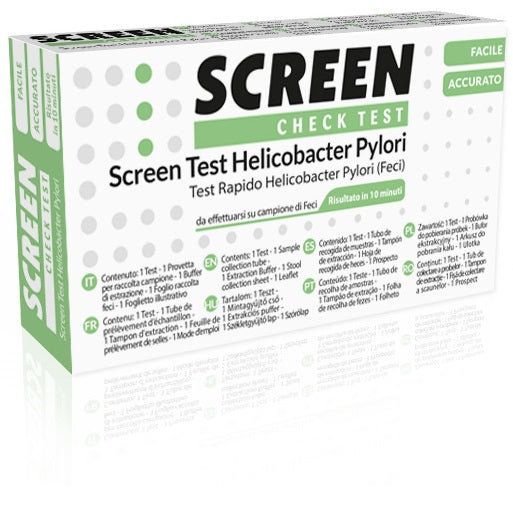
SCREEN
CHECK TEST
H. Pylori Antigen
Description
CE 0123 In vitro diagnostic medical device.
Rapid test for the qualitative detection of Helicobacter pylori (H. pylori) antigens in human faeces.
For in-vitro self-diagnostic use only.
Precautions
1. For in-vitro self-diagnostic use only.
2. Do not eat, drink, or smoke in the area where samples or kits are handled.
3. Store in a dry place at 2-30°C (36-86°F), avoiding areas with excessive humidity. If the sealed packaging is damaged or open, please do not use the test.
4. Use a clean container to collect the faecal sample.
5. Carefully observe the indicated times.
6. Use the test only once.
7. Do not disassemble or touch the test window on the stand.
8. The kit must not be frozen or used beyond the expiry date printed on the packaging.
9. After use, all components should be discarded with normal household waste.
10. Keep out of reach of children.
Instructions for use
1. Wash hands with soap and rinse with clean water.
2. For faecal sample collection: The faecal sample should be collected on the faecal collection sheet or in a clean container. Please use the faecal collection sheet, avoiding sample contamination by taking due precautions to ensure that the sample or the side of the paper containing the sample does not come into contact with other contaminating objects, including bathroom products.
3. To analyse faecal samples: Unscrew the cap of the sample collection tube, then randomly pierce the collected sample with the applicator into the faecal sample at at least 3 different points. Do not shake the faecal sample. Screw the cap back on and secure it onto the collection tube, then shake the sample collection tube vigorously to mix the sample and the extraction buffer.
4. Bring the package to room temperature before opening. Remove the test device from the sealed package and use it as soon as possible. Best results are obtained if the test is performed immediately after opening the package.
5. Open the cap on the sample collection tube and break off the tip. Invert the tube and dispense 2 full drops of the extracted sample into the sample well (S) on the test device, then start the timer. Avoid trapping air bubbles in the sample well (S).
6. Read the results at 10 minutes. Do not read the results after 20 minutes.
Reading results
POSITIVE*: Two lines appear. Both the T (Test) and C (Control) lines appear. This result indicates the presence of H. pylori antigen in the faeces and a doctor should be consulted.
NEGATIVE: A coloured line appears in the control region (C). No line appears in the test region (T). This result indicates that the presence of H. pylori antigen in the faeces could not be detected.
INVALID: The control line does not appear. The most likely reasons for the control line not appearing are insufficient sample volume or incorrect procedural techniques. Review the procedure and repeat the test with a new kit. If the problem persists, stop using the kit immediately and contact your local distributor.
*The colour intensity in the test region (T) varies depending on the concentration of H. pylori antigen present in the sample. Therefore, any shade of colour of the test line (T) should be considered positive.
Limitations
1. The H. pylori antigen (Faeces) test is for in-vitro diagnostic use only. The test should only be used for the detection of H. pylori antigens in faecal samples. This qualitative test does not allow for the determination of either the quantitative value or the growth rate of H. pylori antigen concentration.
2. The H. pylori antigen (Faeces) test will only indicate the presence of H. pylori in the sample and should not be used as the sole criterion to establish that H. pylori is the causative agent of peptic or duodenal ulcers.
3. As with all diagnostic tests, all results must be interpreted in conjunction with other clinical information available to the physician.
4. If the test result is negative and clinical symptoms persist, further testing using other clinical methods is recommended. A negative result does not in any way rule out the possibility of an H. pylori infection.
5. Following certain antibiotic treatments, the concentration of H. pylori antigens may fall below the minimum detection level of the test. Therefore, diagnosis during antibiotic treatment should be made with caution.
Storage
The kit can be stored at room temperature or refrigerated (2-30°C).
The test is stable until the expiry date printed on the sealed package.
The test must remain in the sealed package until use.
DO NOT FREEZE. Do not use beyond the expiry date.
Format
Pack containing 1 piece.
BIBLIOGRAPHY:
1. Marshall, BJ, McGechie, DB, Rogers, PAR and Glancy, RG. Pyloric Campylobacter infection and gastroduodenal disease. Med. J. Australia. (1985), 149: 439-44.
2. Soll, AH. Pathogenesis of peptic ulcer and implications for therapy. New England J. Med. (1990), 322: 909-16.
3. Hazell, SL, et al. Campylobacter pylori is and gastritis I: Detection of urease as a marker of bacterial colonization and gastritis. Amer. J. Gastroenterology. (1987), 82(4): 292-96.
4. Cutler AF. Testing for Helicobacter pylori in clinical practice. Am j. Med. 1996; 100:35S-41S.
5. Anand BS, Raed AK, Malaty HM, et al. Loe point prevalence of peptic ulcer in normal individual with Helicobacter pylori infection. Am J Gastroenterol. 1996,91:1112-1115.
CE 0123 In vitro diagnostic medical device.
Rapid test for the qualitative detection of Helicobacter pylori (H. pylori) antigens in human faeces.
For in-vitro self-diagnostic use only.
Precautions
1. For in-vitro self-diagnostic use only.
2. Do not eat, drink, or smoke in the area where samples or kits are handled.
3. Store in a dry place at 2-30°C (36-86°F), avoiding areas with excessive humidity. If the sealed packaging is damaged or open, please do not use the test.
4. Use a clean container to collect the faecal sample.
5. Carefully observe the indicated times.
6. Use the test only once.
7. Do not disassemble or touch the test window on the stand.
8. The kit must not be frozen or used beyond the expiry date printed on the packaging.
9. After use, all components should be discarded with normal household waste.
10. Keep out of reach of children.
Instructions for use
1. Wash hands with soap and rinse with clean water.
2. For faecal sample collection: The faecal sample should be collected on the faecal collection sheet or in a clean container. Please use the faecal collection sheet, avoiding sample contamination by taking due precautions to ensure that the sample or the side of the paper containing the sample does not come into contact with other contaminating objects, including bathroom products.
3. To analyse faecal samples: Unscrew the cap of the sample collection tube, then randomly pierce the collected sample with the applicator into the faecal sample at at least 3 different points. Do not shake the faecal sample. Screw the cap back on and secure it onto the collection tube, then shake the sample collection tube vigorously to mix the sample and the extraction buffer.
4. Bring the package to room temperature before opening. Remove the test device from the sealed package and use it as soon as possible. Best results are obtained if the test is performed immediately after opening the package.
5. Open the cap on the sample collection tube and break off the tip. Invert the tube and dispense 2 full drops of the extracted sample into the sample well (S) on the test device, then start the timer. Avoid trapping air bubbles in the sample well (S).
6. Read the results at 10 minutes. Do not read the results after 20 minutes.
Reading results
POSITIVE*: Two lines appear. Both the T (Test) and C (Control) lines appear. This result indicates the presence of H. pylori antigen in the faeces and a doctor should be consulted.
NEGATIVE: A coloured line appears in the control region (C). No line appears in the test region (T). This result indicates that the presence of H. pylori antigen in the faeces could not be detected.
INVALID: The control line does not appear. The most likely reasons for the control line not appearing are insufficient sample volume or incorrect procedural techniques. Review the procedure and repeat the test with a new kit. If the problem persists, stop using the kit immediately and contact your local distributor.
*The colour intensity in the test region (T) varies depending on the concentration of H. pylori antigen present in the sample. Therefore, any shade of colour of the test line (T) should be considered positive.
Limitations
1. The H. pylori antigen (Faeces) test is for in-vitro diagnostic use only. The test should only be used for the detection of H. pylori antigens in faecal samples. This qualitative test does not allow for the determination of either the quantitative value or the growth rate of H. pylori antigen concentration.
2. The H. pylori antigen (Faeces) test will only indicate the presence of H. pylori in the sample and should not be used as the sole criterion to establish that H. pylori is the causative agent of peptic or duodenal ulcers.
3. As with all diagnostic tests, all results must be interpreted in conjunction with other clinical information available to the physician.
4. If the test result is negative and clinical symptoms persist, further testing using other clinical methods is recommended. A negative result does not in any way rule out the possibility of an H. pylori infection.
5. Following certain antibiotic treatments, the concentration of H. pylori antigens may fall below the minimum detection level of the test. Therefore, diagnosis during antibiotic treatment should be made with caution.
Storage
The kit can be stored at room temperature or refrigerated (2-30°C).
The test is stable until the expiry date printed on the sealed package.
The test must remain in the sealed package until use.
DO NOT FREEZE. Do not use beyond the expiry date.
Format
Pack containing 1 piece.
BIBLIOGRAPHY:
1. Marshall, BJ, McGechie, DB, Rogers, PAR and Glancy, RG. Pyloric Campylobacter infection and gastroduodenal disease. Med. J. Australia. (1985), 149: 439-44.
2. Soll, AH. Pathogenesis of peptic ulcer and implications for therapy. New England J. Med. (1990), 322: 909-16.
3. Hazell, SL, et al. Campylobacter pylori is and gastritis I: Detection of urease as a marker of bacterial colonization and gastritis. Amer. J. Gastroenterology. (1987), 82(4): 292-96.
4. Cutler AF. Testing for Helicobacter pylori in clinical practice. Am j. Med. 1996; 100:35S-41S.
5. Anand BS, Raed AK, Malaty HM, et al. Loe point prevalence of peptic ulcer in normal individual with Helicobacter pylori infection. Am J Gastroenterol. 1996,91:1112-1115.