

You will not be allowed to compare more than 4 products at a time
View compareFSH/MENOPAUSE RAPID URINE SCREEN TEST 2 PIECES
FSH/MENOPAUSE RAPID URINE SCREEN TEST 2 PIECES
Regular price
€12,60 EUR
Sale price
€12,60 EUR
Regular price
€16,00 EUR
Unit price
per
Tax included.
SKU
912359256Low stock
Vendor
SCREEN ITALIA SrlDelivery time: 48/72 hours
Free Shipping: Orders over €70
This product page, including its Product Information Leaflet, has been automatically translated.
Description
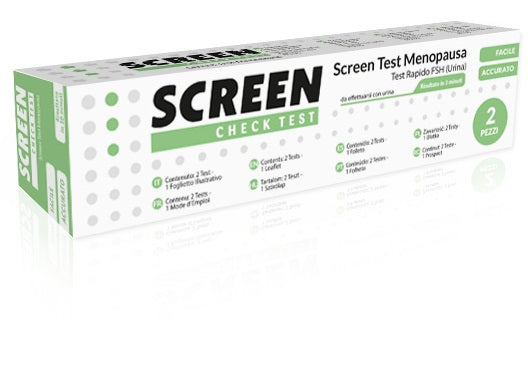
SCREEN
CHECK TEST
Menopause
Description
Rapid flow test for the qualitative detection of Follicle-Stimulating Hormone (FSH) in urine samples.
For in vitro self-diagnostic use only.
Precautions
- Do not use beyond the expiry date printed on the sealed packaging.
- The test must remain in its sealed packaging until use.
- Store in a dry place at 2-30°C or 36-86°F. Do not freeze.
- Do not use if the packaging is torn or damaged.
- For in vitro diagnostic use only.
- Keep out of reach of children.
- Do not open the test packaging until you are ready to start the test.
- Use only once.
- The used test must be disposed of according to local regulations.
When to perform the test
If you still have your period every month, perform the first test during the first week of your cycle (days 2-7, considering day 1 as the first day of menstruation). If the result is negative but symptoms persist, repeat the test one week later.
If you no longer have regular periods, perform the test at any time of the month and repeat it 1 week later.
How to use
Bring the test, urine sample, and/or controls to room temperature (15-30°C) before testing.
1. Determine the day to perform the test.
2. Bring the packaging to room temperature before opening. Remove the test device from the sealed packaging and use it immediately within one hour.
3. Remove the cap from the device and hold the test so that the absorbent tip is placed in the urine stream or place the absorbent tip (=2/3) in the urine sample in a clean container for at least 10-15 seconds.
4. Replace the cap on the test, then place it on a clean, stable surface with the test and control windows facing upwards, then immediately start the timer.
5. When the test starts to work, you may notice a slight color flowing through the results window.
Read the results after 3 minutes. If no result appears, wait another minute. Do not read the results after 10 minutes.
Reading the results
POSITIVE: two visible lines appear and the one in the test region (T) is of equal or greater intensity than the one in the control region (C). A positive result indicates that the FSH level is higher than normal. Record the results and compare them with the table to interpret the results.
NEGATIVE: two lines are visible, but the one in the test region (T) is lighter than the one in the control region (C) or there is no line in the test region (T). A negative result indicates that the FSH level is not elevated. Record the results and compare them with the table to interpret the results.
INVALID: no control line appears. The most probable causes for the absence of the control line are insufficient volume or incorrect procedural techniques. Review the procedure and repeat the test with a new device. If the problem persists, stop using the kit immediately and contact your local distributor.
Test interpretation
For women experiencing pre-menopause symptoms combined with irregular menstrual cycles:
For women experiencing pre-menopause symptoms WITHOUT a menstrual cycle in the previous 12 months:
Limitations
There is a possibility that this test may produce false positive or false negative results. Consult your doctor before making any medical decisions. Invalid results may be caused by not following the instructions carefully. Review the instructions and/or repeat the test with a new device. If the problem persists, stop using the kit immediately and contact your local distributor.
Format
Box containing 2 pieces.
BIBLIOGRAPHY:
1. Turkington CA. The Perimenopause Sourcebook. Contemporary Books, New York, NY. 1998.
2. Perry S, O’Hanlan K. Natural Menopause: The Complete Guide. Reading, MA, Addison-Wesley, 1997.
3. Stanford, JL, Weiss NS, et al. Combined Estrogen and Progestin Hormone Replacement Therapy in Relation to Risk of Breast Cancer, J. Am. Med. Assoc. 1995; 274(2): 137-142.
4. Speroff L, Glass RH, Kase NG, Clinical Gynecologic Endocrinology and Infertility 5th Ed, Williams and Wilkins, Baltimore, MD. 1994; 588.
5. Jacobs DS, Demott DR, Grady HJ, Horvat RT, Huestis DW, Kasten BL, Laboratory Test Handbook 4th Ed, Lippincott Williams and Wilkins, Baltimore, MD. 1996
Rapid flow test for the qualitative detection of Follicle-Stimulating Hormone (FSH) in urine samples.
For in vitro self-diagnostic use only.
Precautions
- Do not use beyond the expiry date printed on the sealed packaging.
- The test must remain in its sealed packaging until use.
- Store in a dry place at 2-30°C or 36-86°F. Do not freeze.
- Do not use if the packaging is torn or damaged.
- For in vitro diagnostic use only.
- Keep out of reach of children.
- Do not open the test packaging until you are ready to start the test.
- Use only once.
- The used test must be disposed of according to local regulations.
When to perform the test
If you still have your period every month, perform the first test during the first week of your cycle (days 2-7, considering day 1 as the first day of menstruation). If the result is negative but symptoms persist, repeat the test one week later.
If you no longer have regular periods, perform the test at any time of the month and repeat it 1 week later.
How to use
Bring the test, urine sample, and/or controls to room temperature (15-30°C) before testing.
1. Determine the day to perform the test.
2. Bring the packaging to room temperature before opening. Remove the test device from the sealed packaging and use it immediately within one hour.
3. Remove the cap from the device and hold the test so that the absorbent tip is placed in the urine stream or place the absorbent tip (=2/3) in the urine sample in a clean container for at least 10-15 seconds.
4. Replace the cap on the test, then place it on a clean, stable surface with the test and control windows facing upwards, then immediately start the timer.
5. When the test starts to work, you may notice a slight color flowing through the results window.
Read the results after 3 minutes. If no result appears, wait another minute. Do not read the results after 10 minutes.
Reading the results
POSITIVE: two visible lines appear and the one in the test region (T) is of equal or greater intensity than the one in the control region (C). A positive result indicates that the FSH level is higher than normal. Record the results and compare them with the table to interpret the results.
NEGATIVE: two lines are visible, but the one in the test region (T) is lighter than the one in the control region (C) or there is no line in the test region (T). A negative result indicates that the FSH level is not elevated. Record the results and compare them with the table to interpret the results.
INVALID: no control line appears. The most probable causes for the absence of the control line are insufficient volume or incorrect procedural techniques. Review the procedure and repeat the test with a new device. If the problem persists, stop using the kit immediately and contact your local distributor.
Test interpretation
For women experiencing pre-menopause symptoms combined with irregular menstrual cycles:
| 1st Test | 2nd Test | Interpretation |
| Positive | Positive | Probable perimenopause. Discuss methods and therapies to promote health after menopause with your doctor. DO NOT stop contraception immediately. |
| Positive or Negative |
Negative or Positive |
Probable early stage of perimenopause. DO NOT stop contraception immediately. |
| Negative | Negative | Probably not yet in perimenopause. If symptoms persist, repeat the test next month or investigate other possible causes for the symptoms. |
For women experiencing pre-menopause symptoms WITHOUT a menstrual cycle in the previous 12 months:
| 1st Test | Interpretation |
| Positive | Menopause almost certainly in progress. The test can be repeated. Discuss methods and therapies to promote health after menopause with your doctor. |
Limitations
There is a possibility that this test may produce false positive or false negative results. Consult your doctor before making any medical decisions. Invalid results may be caused by not following the instructions carefully. Review the instructions and/or repeat the test with a new device. If the problem persists, stop using the kit immediately and contact your local distributor.
Format
Box containing 2 pieces.
BIBLIOGRAPHY:
1. Turkington CA. The Perimenopause Sourcebook. Contemporary Books, New York, NY. 1998.
2. Perry S, O’Hanlan K. Natural Menopause: The Complete Guide. Reading, MA, Addison-Wesley, 1997.
3. Stanford, JL, Weiss NS, et al. Combined Estrogen and Progestin Hormone Replacement Therapy in Relation to Risk of Breast Cancer, J. Am. Med. Assoc. 1995; 274(2): 137-142.
4. Speroff L, Glass RH, Kase NG, Clinical Gynecologic Endocrinology and Infertility 5th Ed, Williams and Wilkins, Baltimore, MD. 1994; 588.
5. Jacobs DS, Demott DR, Grady HJ, Horvat RT, Huestis DW, Kasten BL, Laboratory Test Handbook 4th Ed, Lippincott Williams and Wilkins, Baltimore, MD. 1996