


You will not be allowed to compare more than 4 products at a time
View compareSUPARTZ INTRA-ARTICULAR PRE-FILLED SYRINGE HYALURONIC ACID 25 MG 2.5 ML 3 PIECES
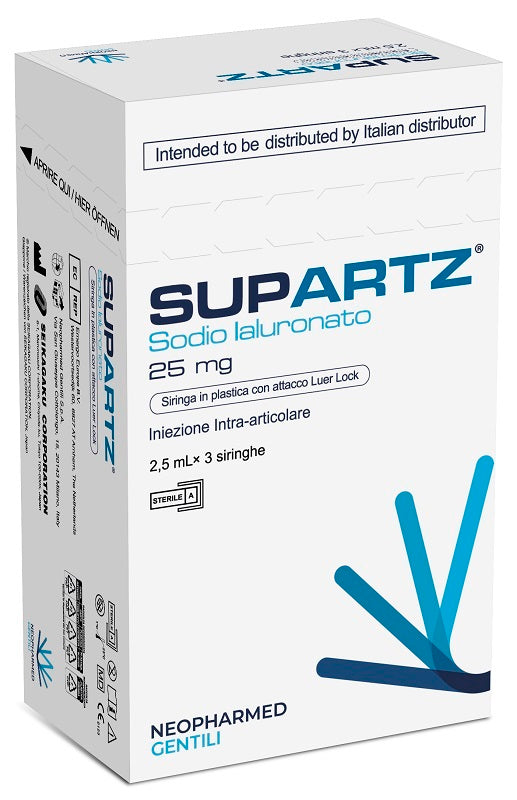
SUPARTZ INTRA-ARTICULAR PRE-FILLED SYRINGE HYALURONIC ACID 25 MG 2.5 ML 3 PIECES
Regular price
€84,23 EUR
Sale price
€84,23 EUR
Regular price
€114,00 EUR
Unit price
per
Tax included.
SKU
943008577In stock
Vendor
MDM SpADelivery time: 48/72 hours
Free Shipping: Orders over €70
This product page, including its Product Information Leaflet, has been automatically translated.
Description
Supartz
Description
SUPARTZ is a sterile, non-pyrogenic, highly purified, non-phlogistic, high molecular weight sodium hyaluronate solution extracted from bacterial fermentation. It is a polysaccharide containing repeating disaccharide units of D-glucuronic acid and N-acetyl-D-glucosamine.
Sodium hyaluronate is a common component of the extracellular matrix of connective tissues. It is found in many different species, including humans, but is chemically identical regardless of the species of origin.
The sodium hyaluronate used in the manufacture of SUPARTZ is of bacterial origin and is derived through fermentation and purification.
SUPARTZ is a clear, odorless solution with a pH of 6.8 to 7.8 and an osmotic pressure ratio of 1.0-1.2 to saline solution.
After injection into the joint, SUPARTZ is poorly metabolized in the synovial fluid but is incorporated into the synovial tissues where it is partially degraded into smaller molecules. Subsequently, SUPARTZ enters the bloodstream and is primarily metabolized in the liver. The metabolic products are non-toxic and are definitively eliminated from the body via the lungs, intestines, and urinary tract.
SUPARTZ is marketed as a sterile solution in a single-use pre-filled syringe to reduce the risk of contamination during aspiration of the solution.
SUPARTZ is indicated for the treatment of knee OA and shoulder periarthritis, and is intended to improve joint movement by supplementing the viscoelasticity of synovial fluid, and to reduce pain in knee OA and shoulder periarthritis.
Directions for use
The dosage is 2.5 mL (one syringe) per knee joint injected intra-articularly or into the shoulder joint (shoulder joint cavity, subacromial bursa, or long head biceps brachii tendon sheath).
The recommended treatment regimen for SUPARTZ in adults consists of five injections into the knee joint cavity or shoulder joint (joint cavity, subacromial bursa, or biceps tendon sheath), at weekly intervals. However, the timing of injections may be modified based on the patient's symptoms.
SUPARTZ should only be injected by authorized medical personnel or in accordance with local legislation.
No additional training is required.
Check the expiry date on the package.
Do not use after the expiry date.
Strictly observe aseptic administration techniques.
Aspirate any joint effusion using a 22-23 G needle before injecting SUPARTZ. Keep the needle in the joint while detaching the syringe used to reduce the joint effusion. Discard the syringe containing the aspirated joint effusion. Do not use the same syringe to aspirate effusion and inject SUPARTZ.
Subcutaneous lidocaine injection or similar local anesthetics may be performed before SUPARTZ injection.
Peel the Tyvek sheet from the blister and remove the syringe.
Carefully remove the syringe cap and aseptically attach a 22-23 G needle to the syringe. To ensure a tight seal and prevent leakage during administration (or injection), securely attach the needle by firmly holding the luer lock.
If effusion has been previously aspirated, connect the syringe to the needle already positioned in the joint.
Unscrew the cap before removing it to minimize product leakage.
Inject SUPARTZ into the knee joint or shoulder joint (shoulder joint cavity, subacromial bursa, or long head biceps brachii tendon sheath) through the needle using an aseptic injection technique.
Inject the entire content, 2.5 mL of SUPARTZ, into the knee or shoulder (shoulder joint cavity, subacromial bursa, or long head biceps brachii tendon sheath). If treatment is administered to both knees or shoulders, use a different SUPARTZ syringe for each knee or shoulder.
To perform injections into the knee joint cavity, insert the needle into the joint horizontally or slightly angled downwards, into the space between the patella and the femur. It is not unusual to feel some resistance as the needle penetrates the joint capsule.
In the scapulohumeral joint, the needle is usually easily inserted from the anterior side, but the posterior or lateral approach is also adopted.
For accurate administration of SUPARTZ into the peritendon of the biceps, insert the needle into the epidermis at 20-30 degrees and parallel to the groove. If it penetrates the tendon, there will be resistance to injection. If available, perform ultrasound-guided injection into the biceps sheath to more accurately identify the position.
Components
Sodium hyaluronate 25.0 mg, sodium chloride 21.25 mg, dibasic sodium phosphate dodecahydrate 1.343 mg, sodium dihydrogen phosphate dihydrate 0.04 mg, water for injections q.s. to 2.5 mL.
Warnings
- Do not administer SUPARTZ to patients with known hypersensitivity (allergy) to SUPARTZ or sodium hyaluronate preparations.
- Exercise extreme caution when administering SUPARTZ to patients with skin infections or lesions in the injection site area.
- Administer SUPARTZ with caution in patients with hypersensitivity to any medicine.
- Administer SUPARTZ with caution in patients with a medical history of hepatic dysfunction.
- Administer SUPARTZ with caution in patients with systemic coagulopathies.
- Administer SUPARTZ with caution in patients with lymphatic or venous stasis in the limb being injected.
- Do not use disinfectants containing quaternary ammonium salts (such as benzalkonium chloride) for skin preparation simultaneously, as sodium hyaluronate may precipitate in their presence. The use of disinfectants such as povidone-iodine is recommended.
- Do not inject SUPARTZ intravascularly.
- Strictly observe aseptic administration techniques.
- Aspirate any joint effusion before injecting SUPARTZ.
- The safety and performance of SUPARTZ have not been established in joints other than the knee or shoulder and for conditions other than OA.
- The safety and performance of SUPARTZ in conjunction with other intra-articular injectable solutions have not been established.
- The safety and performance of SUPARTZ in severely inflamed knee joints have not been established.
- Do not inject SUPARTZ extra-articularly or into the synovial membrane and capsule.
- STERILE CONTENTS. The pre-filled syringe is for single use. The contents of the syringe must be used immediately after opening the package. Discard unused SUPARTZ.
- Do not use SUPARTZ if the blister is open or damaged or if there are cracks or breaks in the pre-filled syringe.
- In osteoarthritic knees with severe inflammation, the inflammation should be reduced before injecting SUPARTZ, as the inflammation could worsen due to the injection.
- Use SUPARTZ within the expiry date indicated on the package.
- As with any invasive joint procedure, the patient is recommended to avoid any strenuous activity (such as jogging, tennis or other active sports, heavy lifting) and prolonged weight-bearing activities (such as standing for more than one hour) for 48 hours after treatment with intra-articular injection of SUPARTZ.
Storage
The expiry date is indicated on the label and on the outer packaging.
Store in the original packaging at a temperature of 1 °C-25 °C.
Do not freeze.
Shelf life when unopened: 36 months.
Format
3 pre-filled syringes 2.5 ml.
Code MD030751
SUPARTZ is a sterile, non-pyrogenic, highly purified, non-phlogistic, high molecular weight sodium hyaluronate solution extracted from bacterial fermentation. It is a polysaccharide containing repeating disaccharide units of D-glucuronic acid and N-acetyl-D-glucosamine.
Sodium hyaluronate is a common component of the extracellular matrix of connective tissues. It is found in many different species, including humans, but is chemically identical regardless of the species of origin.
The sodium hyaluronate used in the manufacture of SUPARTZ is of bacterial origin and is derived through fermentation and purification.
SUPARTZ is a clear, odorless solution with a pH of 6.8 to 7.8 and an osmotic pressure ratio of 1.0-1.2 to saline solution.
After injection into the joint, SUPARTZ is poorly metabolized in the synovial fluid but is incorporated into the synovial tissues where it is partially degraded into smaller molecules. Subsequently, SUPARTZ enters the bloodstream and is primarily metabolized in the liver. The metabolic products are non-toxic and are definitively eliminated from the body via the lungs, intestines, and urinary tract.
SUPARTZ is marketed as a sterile solution in a single-use pre-filled syringe to reduce the risk of contamination during aspiration of the solution.
SUPARTZ is indicated for the treatment of knee OA and shoulder periarthritis, and is intended to improve joint movement by supplementing the viscoelasticity of synovial fluid, and to reduce pain in knee OA and shoulder periarthritis.
Directions for use
The dosage is 2.5 mL (one syringe) per knee joint injected intra-articularly or into the shoulder joint (shoulder joint cavity, subacromial bursa, or long head biceps brachii tendon sheath).
The recommended treatment regimen for SUPARTZ in adults consists of five injections into the knee joint cavity or shoulder joint (joint cavity, subacromial bursa, or biceps tendon sheath), at weekly intervals. However, the timing of injections may be modified based on the patient's symptoms.
SUPARTZ should only be injected by authorized medical personnel or in accordance with local legislation.
No additional training is required.
Check the expiry date on the package.
Do not use after the expiry date.
Strictly observe aseptic administration techniques.
Aspirate any joint effusion using a 22-23 G needle before injecting SUPARTZ. Keep the needle in the joint while detaching the syringe used to reduce the joint effusion. Discard the syringe containing the aspirated joint effusion. Do not use the same syringe to aspirate effusion and inject SUPARTZ.
Subcutaneous lidocaine injection or similar local anesthetics may be performed before SUPARTZ injection.
Peel the Tyvek sheet from the blister and remove the syringe.
Carefully remove the syringe cap and aseptically attach a 22-23 G needle to the syringe. To ensure a tight seal and prevent leakage during administration (or injection), securely attach the needle by firmly holding the luer lock.
If effusion has been previously aspirated, connect the syringe to the needle already positioned in the joint.
Unscrew the cap before removing it to minimize product leakage.
Inject SUPARTZ into the knee joint or shoulder joint (shoulder joint cavity, subacromial bursa, or long head biceps brachii tendon sheath) through the needle using an aseptic injection technique.
Inject the entire content, 2.5 mL of SUPARTZ, into the knee or shoulder (shoulder joint cavity, subacromial bursa, or long head biceps brachii tendon sheath). If treatment is administered to both knees or shoulders, use a different SUPARTZ syringe for each knee or shoulder.
To perform injections into the knee joint cavity, insert the needle into the joint horizontally or slightly angled downwards, into the space between the patella and the femur. It is not unusual to feel some resistance as the needle penetrates the joint capsule.
In the scapulohumeral joint, the needle is usually easily inserted from the anterior side, but the posterior or lateral approach is also adopted.
For accurate administration of SUPARTZ into the peritendon of the biceps, insert the needle into the epidermis at 20-30 degrees and parallel to the groove. If it penetrates the tendon, there will be resistance to injection. If available, perform ultrasound-guided injection into the biceps sheath to more accurately identify the position.
Components
Sodium hyaluronate 25.0 mg, sodium chloride 21.25 mg, dibasic sodium phosphate dodecahydrate 1.343 mg, sodium dihydrogen phosphate dihydrate 0.04 mg, water for injections q.s. to 2.5 mL.
Warnings
- Do not administer SUPARTZ to patients with known hypersensitivity (allergy) to SUPARTZ or sodium hyaluronate preparations.
- Exercise extreme caution when administering SUPARTZ to patients with skin infections or lesions in the injection site area.
- Administer SUPARTZ with caution in patients with hypersensitivity to any medicine.
- Administer SUPARTZ with caution in patients with a medical history of hepatic dysfunction.
- Administer SUPARTZ with caution in patients with systemic coagulopathies.
- Administer SUPARTZ with caution in patients with lymphatic or venous stasis in the limb being injected.
- Do not use disinfectants containing quaternary ammonium salts (such as benzalkonium chloride) for skin preparation simultaneously, as sodium hyaluronate may precipitate in their presence. The use of disinfectants such as povidone-iodine is recommended.
- Do not inject SUPARTZ intravascularly.
- Strictly observe aseptic administration techniques.
- Aspirate any joint effusion before injecting SUPARTZ.
- The safety and performance of SUPARTZ have not been established in joints other than the knee or shoulder and for conditions other than OA.
- The safety and performance of SUPARTZ in conjunction with other intra-articular injectable solutions have not been established.
- The safety and performance of SUPARTZ in severely inflamed knee joints have not been established.
- Do not inject SUPARTZ extra-articularly or into the synovial membrane and capsule.
- STERILE CONTENTS. The pre-filled syringe is for single use. The contents of the syringe must be used immediately after opening the package. Discard unused SUPARTZ.
- Do not use SUPARTZ if the blister is open or damaged or if there are cracks or breaks in the pre-filled syringe.
- In osteoarthritic knees with severe inflammation, the inflammation should be reduced before injecting SUPARTZ, as the inflammation could worsen due to the injection.
- Use SUPARTZ within the expiry date indicated on the package.
- As with any invasive joint procedure, the patient is recommended to avoid any strenuous activity (such as jogging, tennis or other active sports, heavy lifting) and prolonged weight-bearing activities (such as standing for more than one hour) for 48 hours after treatment with intra-articular injection of SUPARTZ.
Storage
The expiry date is indicated on the label and on the outer packaging.
Store in the original packaging at a temperature of 1 °C-25 °C.
Do not freeze.
Shelf life when unopened: 36 months.
Format
3 pre-filled syringes 2.5 ml.
Code MD030751