

You will not be allowed to compare more than 4 products at a time
View compareTROSYD SEBORRHOEIC DERMATITIS*SH120ML2%
TROSYD SEBORRHOEIC DERMATITIS*SH120ML2%
Regular price
€14,88 EUR
Sale price
€14,88 EUR
Regular price
€20,90 EUR
Unit price
per
Tax included.
SKU
037087032Low stock
Vendor
GIULIANI SpADelivery time: 48/72 hours
Free Shipping: Orders over €70
This product page, including its Product Information Leaflet, has been automatically translated.
Description
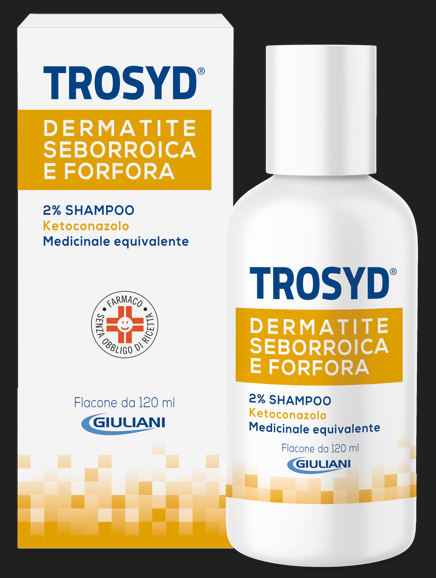
TROSYD SEBORRHEIC DERMATITIS AND DANDRUFF 2% Shampoo
Equivalent medicinal product
What it is and what it is used for
TROSYD SEBORRHEIC DERMATITIS AND DANDRUFF contains the antifungal substance ketoconazole, used to treat infections caused by fungi, including yeasts. Ketoconazole belongs to a group of antifungal drugs called imidazoles. It works by interfering with the synthesis of ergosterol, a component of fungal cell membranes.
TROSYD SEBORRHEIC DERMATITIS AND DANDRUFF is used to treat:
- seborrheic dermatitis (a skin condition affecting the scalp that causes flaking, itching, and redness of the skin);
- dandruff (Pityriasis capitis).
What you need to know before taking the medicine
DO NOT use TROSYD SEBORRHEIC DERMATITIS AND DANDRUFF
if you are allergic to ketoconazole or any of the other ingredients of this medicine (listed in section 6).
Warnings and precautions
Talk to your doctor or pharmacist before using TROSYD SEBORRHEIC DERMATITIS AND DANDRUFF.
If you are using a hair lotion or cream that contains a steroid, such as betamethasone or hydrocortisone:
• you should gradually stop the lotion or cream during the first 2 or 3 weeks of treatment with ketoconazole shampoo.
If you have any questions about how to stop steroid lotion or cream, talk to your doctor or pharmacist.
Seborrheic dermatitis and dandruff are often associated with hair loss. This has also been reported with TROSYD SEBORRHEIC DERMATITIS AND DANDRUFF, although rarely.
Avoid contact with eyes. If shampoo gets into the eyes, wash them immediately with plenty of water.
Children
TROSYD SEBORRHEIC DERMATITIS AND DANDRUFF is not recommended for use in infants and children.
Possible side effects
Like all medicines, this medicine can cause side effects, although not everybody gets them.
Stop using TROSYD SEBORRHEIC DERMATITIS AND DANDRUFF and tell your doctor immediately if you notice or suspect any of the following effects. You may need urgent medical attention.
• Allergic reaction (hypersensitivity), swelling of the face, lips, mouth, tongue or throat that may cause difficulty in swallowing or breathing (angioedema);
• severe irritation or redness of the skin in the treated area with the shampoo, or other signs of allergy during the first few days of treatment;
• dry skin or blisters.
The following side effects have also been reported:
Common (may affect up to 1 in 10 patients):
- local skin irritation;
- dry and brittle hair;
- hair loss.
Uncommon (may affect up to 1 in 100 patients):
- infection of hair follicles (folliculitis);
- increased tear production (increased lacrimation);
- dry skin, rash, burning sensation of the skin;
- redness of the skin, irritation and itching at the application site.
Rare (may affect up to 1 in 1000 patients):
- altered taste (dysgeusia);
- eye irritation;
- skin rash (acne);
- hair discoloration;
- skin flaking (exfoliation of the skin);
- contact allergy (e.g. itching, rash);
- allergic reaction at the administration site;
- pustules at the administration site.
Not known (frequency cannot be estimated from the available data):
- urticaria;
- swelling of the face, lips, mouth, tongue or throat that may cause difficulty in swallowing or breathing (angioedema).