


You will not be allowed to compare more than 4 products at a time
View compareARGOTONE*GTT RINO 20ML 1%+0.9%
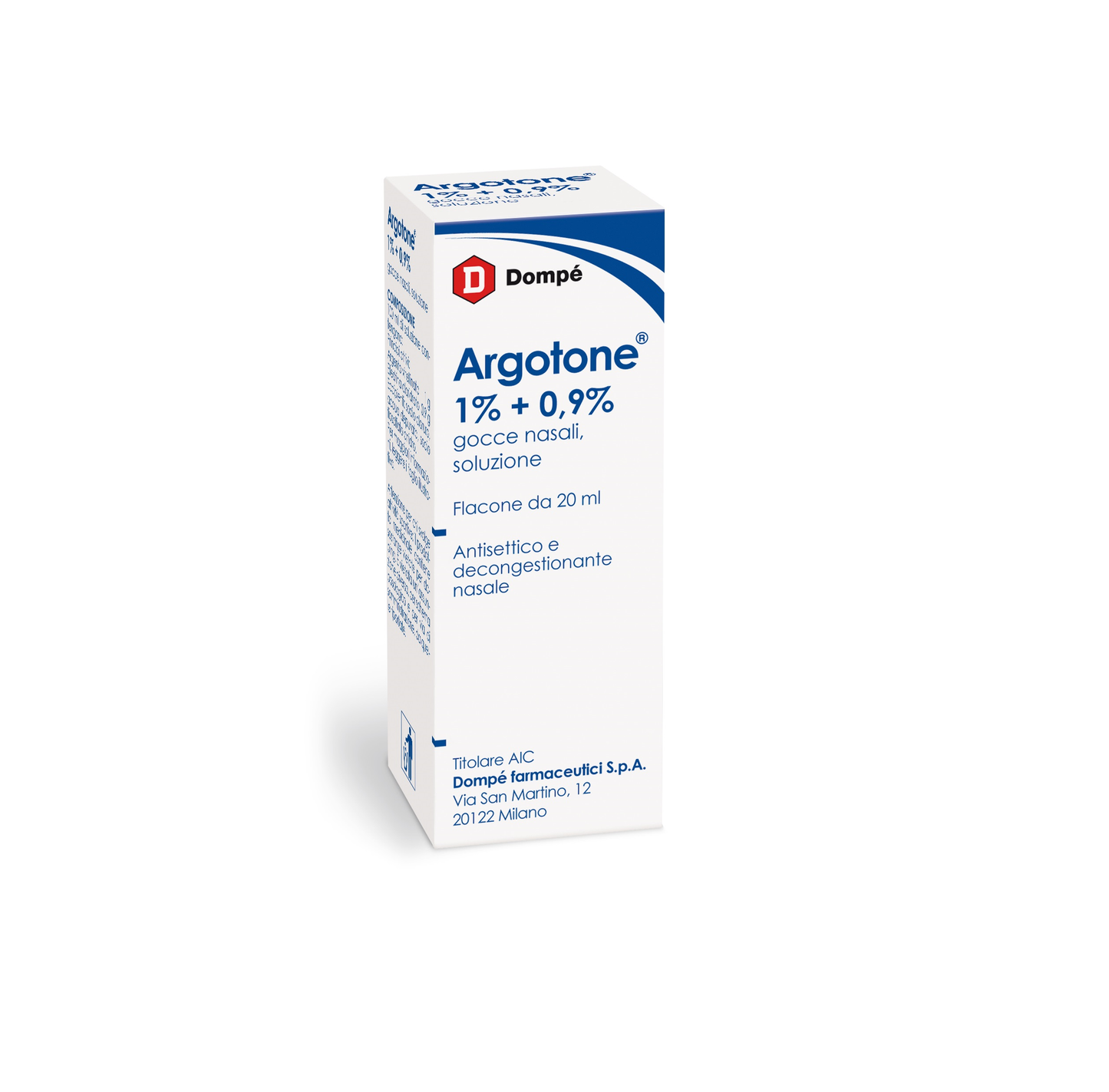
ARGOTONE*GTT RINO 20ML 1%+0.9%
Regular price
€9,50 EUR
Sale price
€9,50 EUR
Regular price
€9,00 EUR
Unit price
per
Tax included.
SKU
003950019Low stock
Vendor
DOMPE' FARMACEUTICI SpADelivery time: 48/72 hours
Free Shipping: Orders over €70
This product page, including its Product Information Leaflet, has been automatically translated.
Description
ARGOTONE 1%/0.9% nasal drops, solution
Vitellinated silver/Ephedrine hydrochloride
What it is and what it is used for
ARGOTONE contains the active ingredients vitellinated silver, responsible for the antiseptic action, and ephedrine hydrochloride, responsible for the nasal decongestant action, and belongs to the group of nasal decongestant medicines for topical (local) use.
ARGOTONE, therefore, acts as an antiseptic and nasal decongestant.
Consult your doctor if you do not feel better or if you feel worse.
What you need to know before taking the medicine
Do not use ARGOTONE
- if you are allergic to vitellinated silver, ephedrine hydrochloride, sympathomimetic amines in general, or any of the other ingredients of this medicine (listed in section 6).
- If the patient is a child under 12 years of age.
- If you suffer from heart disease and severe arterial hypertension.
- If you suffer from glaucoma (increased pressure inside the eye).
- If you suffer from prostatic hypertrophy (enlargement of the prostate).
- If you suffer from hyperthyroidism (increased thyroid function).
- If you suffer from pheochromocytoma (tumor of the adrenal gland).
Do not administer during or within two weeks after therapy with monoamine oxidase inhibitors (MAOIs), medicines used to treat depression.
Warnings and precautions
Consult your doctor or pharmacist before using ARGOTONE.
In patients with cardiovascular disease and in hypertensive patients, the use of nasal decongestants should always be evaluated by the doctor on a case-by-case basis.
Cardiovascular effects may be observed with the use of Argotone; rare cases of myocardial ischemia have been reported in association with the use of beta-agonists.
Prolonged use of vasoconstrictors, i.e., medicines capable of causing blood vessel constriction, with a consequent increase in blood pressure, can alter the normal function of the nasal and paranasal sinus mucosa, also leading to drug habituation. Repeating applications for periods longer than recommended can, therefore, be harmful.
Use with caution in diabetics and, due to the risk of urinary retention, in elderly subjects.
Consult your doctor if you experience symptoms such as chest pain and difficulty breathing.
The use, especially prolonged, of topical products can lead to sensitization phenomena; in this case, it is necessary to interrupt the treatment and, if necessary, institute appropriate therapy. In the absence of a complete therapeutic response within a few days, consult your doctor; in any case, treatment should not be prolonged for more than one week.
Strictly adhere to the recommended doses. The medicine, if accidentally ingested or used for a long period at excessive doses, can cause toxic phenomena.
The medicine must not be used orally.
Avoid contact of the liquid with the eyes.
Attention for those who engage in sports: this medicinal product contains substances prohibited for doping. Any intake differing in dosage regimen and route of administration from those reported is prohibited.
Ephedrine can be a substance subject to abuse.
Children and adolescents
The medicine cannot be taken by children under 12 years of age (see section Do not use Argotone).
Possible side effects
Like all medicines, this medicine can cause side effects, although not everybody gets them.
The medicine can locally cause sensitization phenomena or mucous membrane congestion, a rebound phenomenon, i.e., contrary to the desired effect.
The following side effects have been reported with the systemic use of ephedrine and could occur after the use of ephedrine-based nasal drops.
The following side effects have been reported in post-marketing experience. Frequencies are defined as follows: very common (≥1/10); common (≥1/100, <1/10); uncommon (≥1/1,000, <1/100); rare (≥1/10,000, <1/1,000); very rare (<1/10,000); not known (frequency cannot be estimated from the available data).
Nervous system disorders
Not known: Headache, restlessness, insomnia, tolerance
Cardiac disorders
Not known: Tachycardia (increased heart rate), palpitations, myocardial ischemia
Vascular disorders
Not known: Hypertension (increased blood pressure)
Respiratory, thoracic and mediastinal disorders
Not known: Dyspnea (difficulty breathing)
Renal and urinary disorders
Not known: Nocturia (frequent urination during the night) in patients with prostate hyperplasia (enlargement of the prostate gland), urinary retention (difficulty in passing urine)
Skin and subcutaneous tissue disorders
Not known: Hyperhidrosis (excessive sweating), rash (temporary skin eruption)
Immune system disorders
Not known: Hypersensitivity
Reporting of side effects
If you get any side effects, including any not listed in this leaflet, tell your doctor or pharmacist. You can also report side effects directly via the national reporting system at: https://www.aifa.gov.it/content/segnalazionireazioni-avverse.
By reporting side effects you can help provide more information on the safety of this medicine.
