


You will not be allowed to compare more than 4 products at a time
View compareTUSSEVAL MUCOLITIC*SYR 250ML
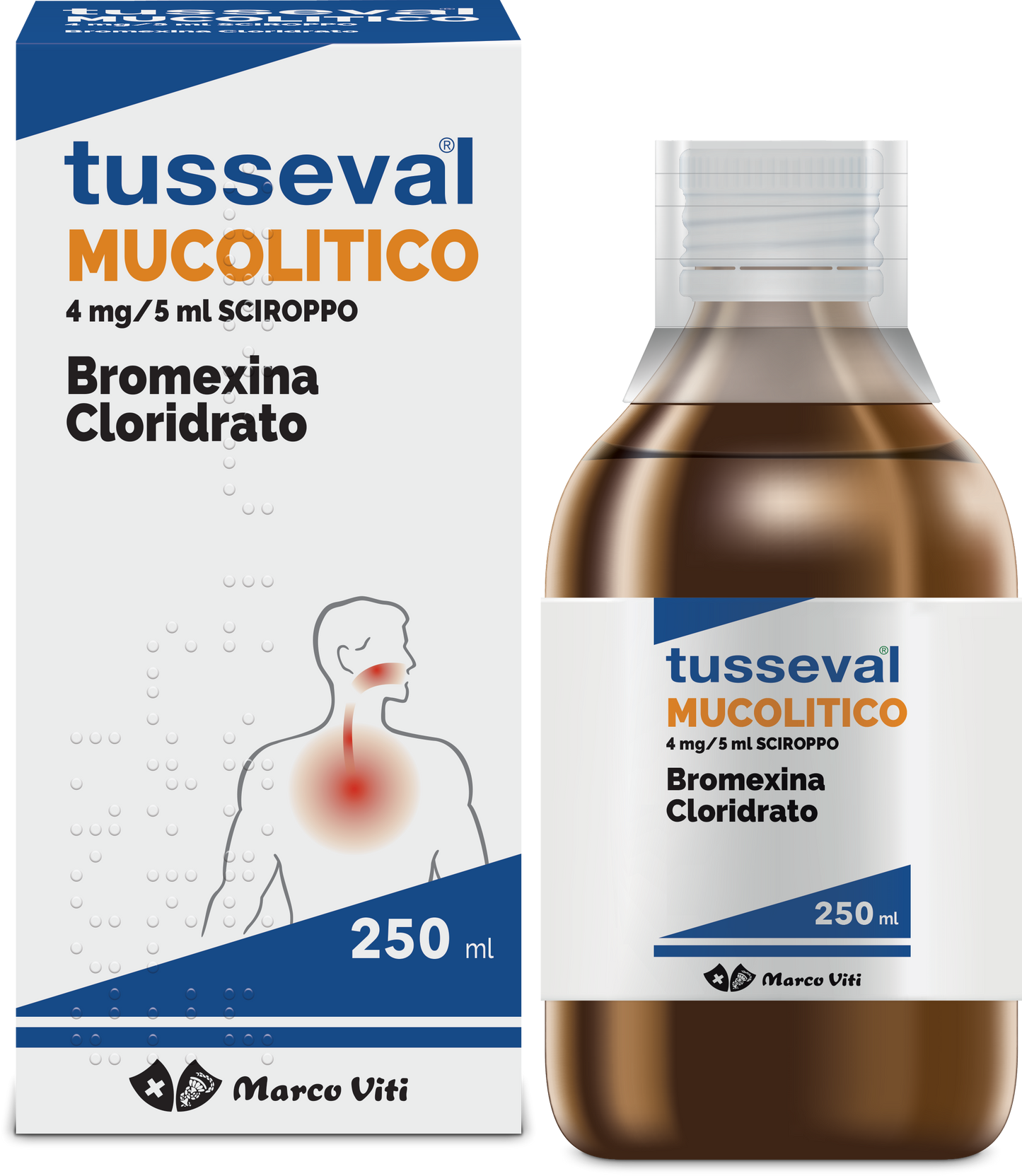
TUSSEVAL MUCOLITIC*SYR 250ML
Regular price
€6,82 EUR
Sale price
€6,82 EUR
Regular price
€10,90 EUR
Unit price
per
Tax included.
SKU
038868016In stock
Vendor
MARCO VITI FARMACEUTICI SpADelivery time: 48/72 hours
Free Shipping: Orders over €70
This product page, including its Product Information Leaflet, has been automatically translated.
Description
TUSSEVAL MUCOLITICO 4 mg/5 ml syrup
Bromhexine hydrochloride
What it is and what it is used for
TUSSEVAL MUCOLITICO contains the active ingredient bromhexine hydrochloride, which belongs to the group of mucolytic medicines and works by thinning the viscous mucus deposits in the respiratory tract, thus facilitating their elimination.
TUSSEVAL MUCOLITICO is used to treat changes in secretions (e.g., presence of cough and phlegm) in acute and chronic respiratory diseases in adults, adolescents, and children from 2 years of age.
Consult your doctor if you do not feel better or if you feel worse after a short period of treatment.
What you need to know before taking the medicine
Do not take/give TUSSEVAL MUCOLITICO to your child
- if you/your child are allergic to bromhexine or any of the other ingredients of this medicine (listed in paragraph 6).
- If breastfeeding (see paragraph 2 "Pregnancy and breastfeeding").
- For children under 2 years of age.
Warnings and precautions
Consult your doctor or pharmacist before taking/giving TUSSEVAL MUCOLITICO to your child:
- if you/your child suffer from a respiratory tract disease that arises and worsens in a relatively short period of time (acute respiratory conditions). Consult your doctor if symptoms do not improve or worsen during therapy;
- if you are pregnant (see paragraph 2. "Pregnancy, breastfeeding, and fertility");
- if you/your child have/have had stomach and/or intestinal lesions (gastroduodenal ulcer).
Cases of severe skin reactions associated with the administration of bromhexine hydrochloride have been reported. If you develop a skin rash (including lesions of mucous membranes such as the mouth, throat, nose, eyes, genitals), stop taking bromhexine hydrochloride and contact your doctor immediately.
Such reactions could be symptoms of serious skin diseases characterized by skin peeling and severe toxic skin reaction (Stevens-Johnson syndrome and Toxic Epidermal Necrolysis).
Most of these could be due to serious pre-existing diseases or the simultaneous use of other medicines. Furthermore, in the initial phase of Stevens-Johnson syndrome or toxic epidermal necrolysis (TEN), you may experience non-specific flu-like symptoms, such as fever, chills, runny nose (rhinitis), cough, and sore throat. Because of these misleading symptoms, you may undertake symptomatic treatment with a cough and cold therapy.
Treatment with TUSSEVAL MUCOLITICO syrup leads to an increase in bronchial secretions (this promotes expectoration). Do not use/give to children for prolonged treatments. After a short period of treatment without appreciable results, consult your doctor.
In patients with gastroduodenal ulcer, its use is recommended only after consulting a doctor.
It is also advisable to consult a doctor in cases where these disorders have occurred in the past.
Children
Do not give this medicine to children under 2 years of age (see paragraph "Do not use TUSSEVAL MUCOLITICO").
Mucolytics can cause bronchial obstruction in children under 2 years of age. In fact, the ability to drain bronchial mucus is limited in this age group, due to the physiological characteristics of the respiratory tract.
Possible side effects
Like all medicines, this medicine can cause side effects, although not everybody gets them.
The following side effects may occur after using TUSSEVAL MUCOLITICO:
Uncommon (may affect up to 1 in 100 people)
- nausea, vomiting, diarrhea, and upper abdominal pain;
Rare: may affect up to 1 in 1,000 people:
- Hypersensitivity reactions.
- Skin rash, urticaria (appearance of red spots on the skin);
Not known: frequency cannot be estimated from the available data
- Anaphylactic reactions, including anaphylactic shock, angioedema (rapidly developing swelling of the skin, subcutaneous tissues, mucosa, and submucous tissues) and itching.
- Severe cutaneous adverse reactions (including erythema multiforme, Stevens-Johnson syndrome/toxic epidermal necrolysis, and acute generalized exanthematous pustulosis).
- Narrowing of the bronchi that makes breathing difficult (bronchospasm).
In such cases, discontinue treatment. These side effects are generally temporary. However, if they occur, it is advisable to consult your doctor or pharmacist.
Reporting of side effects
If you get any side effects, including those not listed in this leaflet, talk to your doctor or pharmacist. You can also report side effects directly via the national reporting system at: https://www.aifa.gov.it/content/segnalazionireazioni-avverse.
By reporting side effects you can help provide more information on the safety of this medicine.