


You will not be allowed to compare more than 4 products at a time
View compareGLUCOJECT INSULIN PEN NEEDLE LENGTH 6 MM GAUGE 31 100 PIECES
GLUCOJECT INSULIN PEN NEEDLE LENGTH 6 MM GAUGE 31 100 PIECES
Regular price
€7,55 EUR
Sale price
€7,55 EUR
Regular price
€23,50 EUR
Unit price
per
Tax included.
SKU
934512625In stock
Vendor
A.MENARINI DIAGNOSTICSDelivery time: 48/72 hours
Free Shipping: Orders over €70
This product page, including its Product Information Leaflet, has been automatically translated.
Description
Glucoject
Pen Needles
Insulin pen needles
PRODUCT IDENTIFICATION DATA
PRODUCT COMPLIANCE WITH APPLICABLE DIRECTIVES
GENERAL CHARACTERISTICS
INFORMATION ON THE REFERENCE CLASS
Pen Needles
Insulin pen needles
PRODUCT IDENTIFICATION DATA
| Trade Name | Glucoject Pen Needles |
| Manufacturer | HTL-STREFA S.A., 95-035 Ozorkòw, 7 Adamòwek St., Poland. |
| Distributor | A.Menarini Diagnostics Firenze - Italia |
| Internal Codes | 44029-44030-44031-44032-44033-46789 |
| CND Code | A010199 - Insulin Pen Needles |
| Year of Market Launch | 2014 |
PRODUCT COMPLIANCE WITH APPLICABLE DIRECTIVES
| European Directive 93/42/EEC | Compliant - CE Medical Devices (annex V + VII) |
| Classification | Class IIa |
| Notified Body | DEKRA |
GENERAL CHARACTERISTICS
INFORMATION ON THE REFERENCE CLASS
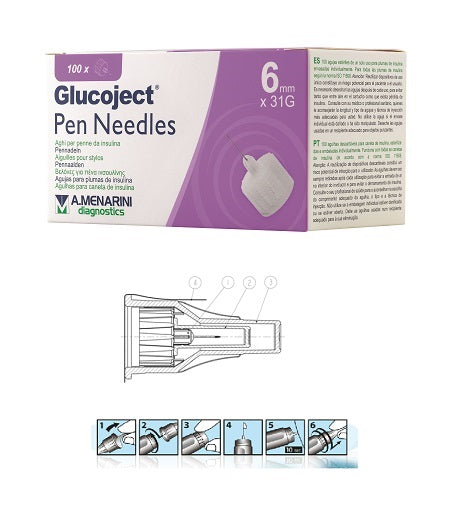
| General product description | Glucoject® Pen Needles are sterile, single-use devices intended for use with injection pens for the administration of medication into the body. Specifically: - High quality needles - Thin-wall technology - New lubrication method - Screw-on application - 100% sterile - Six different needle versions |
| Components | - Needle - Inner protective cap - Outer protective cap - Seal |
| Features | - Extremely sharp needle tip - Triple precision bevel - Special electropolishing - Super thin wall - Exclusive silicone lubrication |
| Technical drawing (figure 2) | 1) Needle assembly 2) Needle cover 3) Protective cap 4) Seal |
| Dimensions | Length: 29.1 mm Width: 16.5 mm Depth: 16.8 mm |
| Use | Glucoject® Pen Needles are sterile, single-use needles intended for use with injection pens for the administration of medication into the body (generally insulin). |
| Reuse | Glucoject® Pen Needles are sterile and single-use. Sterility is guaranteed if the needle seal is intact. Reuse may: - cause needle breakage; - lead to lipohypertrophy; - damage the sharpness or cause the tip to bend, leading to bleeding, bruising or scarring; - increase the risk of needle breakage in the skin; - increase the risk of infection as the needle is no longer sterile. |
| Method of use and mechanism of action (figure 3) | 1. Remove the seal from the needle. 2. Place the needle straight onto the pen and screw it on until it is firmly in place. Remove the outer protective cap and set it aside. It will be needed later to remove the needle from the pen. Pull off the inner protective cap. 3. Set the insulin dose. 4. Check the flow by performing an air shot to expel a minimal amount of liquid. A small drop should appear on the needle tip. 5. Perform the injection. 6. Replace the outer protective cap and remove the needle from the pen. |
| Insulin administration | - It is essential to choose an appropriate body site for insulin injection. - Insulin is absorbed at different rates depending on the injection site. - It is recommended to inject insulin in the same area for optimal therapy results, but rotation of injection sites is important to avoid side effects. The doctor or healthcare professional should advise on the most appropriate injection site. For example: - For rapid-acting analogues and regular short-acting insulins, the abdomen is the best site. - For long-acting analogues and regular NPH insulins, the thighs are the best site. - For premixed analogues and human mixed insulins, the abdomen and arm are the best sites. |
| Shelf life | Validity is associated with sterility duration. Based on tests performed by the manufacturer HTL-STREFA SA, whose data are archived in accordance with the Quality Management System procedures, as required by PN-EN ISO 13485, a guarantee of 3 years from the date of manufacture is ensured. |
| Recommendations | Strada Comunale S. Pantaleone 89060 San Pantaleone (RC)