

You will not be allowed to compare more than 4 products at a time
View compareGLUCOFIX TECH SENSOR BLOOD GLUCOSE TEST STRIPS 25 PIECES
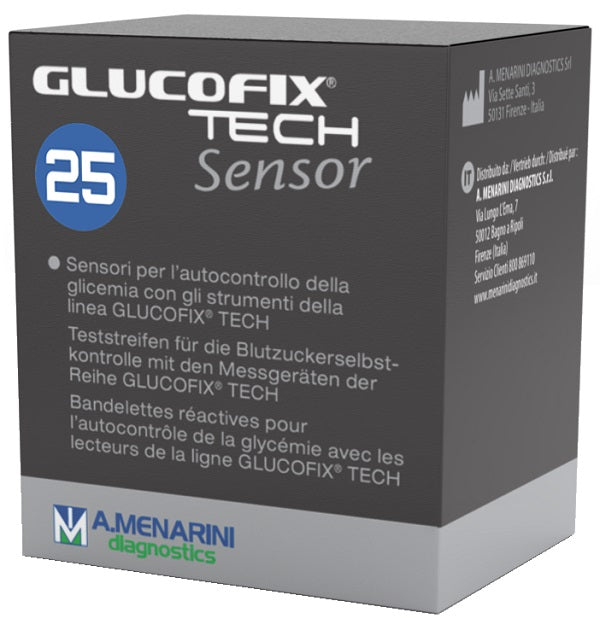
GLUCOFIX TECH SENSOR BLOOD GLUCOSE TEST STRIPS 25 PIECES
Regular price
€13,12 EUR
Sale price
€13,12 EUR
Regular price
€34,16 EUR
Unit price
per
Tax included.
SKU
938766793In stock
Vendor
A.MENARINI DIAGNOSTICSDelivery time: 48/72 hours
Free Shipping: Orders over €70
This product page, including its Product Information Leaflet, has been automatically translated.
Description
GLUCOFIX
Description
Blood glucose sensors.
Use GLUCOFIX TECH Sensors exclusively with GLUCOFIX TECH line devices for the quantitative determination of glucose levels in fresh capillary whole blood. The GLUCOFIX TECH line includes the following devices: GLUCOFIX TECH for blood glucose determination, GLUCOFIX TECH 2K and GLUCOFIX TECH GK for glucose and p-hydroxybutyrate (beta-ketone) determination.
GLUCOFIX TECH Sensors are in vitro medical diagnostic devices.
The sensors are designed for monitoring and self-monitoring of blood glucose levels in people with diabetes mellitus; they can also be used in a hospital setting by medical professionals. They are not intended for use in the diagnosis or screening of diabetes or for use in neonates. Do not change your treatment based on test results without first consulting your doctor or medical professional.
Glucose in the blood sample binds to the reagents on the sensor, and this reaction produces a slight electrical current whose intensity is proportional to the glucose concentration in the blood. The device measures this current and calculates the blood glucose values.
Instructions for use
For accurate test results, allow the sensors and device to acclimate to the ambient environment for at least 30 minutes before checking blood glucose. Operating conditions are: temperature 5-45 °C (41-113 °F); relative humidity 20-90%.
1. Remove 1 sensor from the vial with clean, dry hands.
- Sensors are for single use only. Do not use sensors if they are wet, damaged, or stored in a damaged vial.
- Close the vial cap tightly immediately after removing the sensor.
- Use the sensor immediately.
2. Insert a new sensor into the sensor port on the device. The drop symbol will begin to flash on the display.
3. Obtain a blood sample using a lancing device and a new lancet, following the respective instructions for use.
4. Bring the blood drop to the tip of the sensor until the confirmation window is full.
- Do not test blood that is running or spreading from the puncture site.
- Do not smear blood on the sensor.
- Do not press the sensor forcefully against the puncture site.
- Do not touch the sensor when the device has started the countdown.
5. The test result will appear on the screen once the test is completed.
6. Press the eject button to remove the sensor.
- Once used for blood glucose monitoring, sensors and lancets become biohazardous waste; they must therefore be disposed of in accordance with local regulations concerning biohazardous waste.
- If test results are inconsistent with your perceived state of health:
• Make sure you have performed the test correctly, as explained in the user manual. Then, perform a control test to verify that the system is working correctly. If blood was taken from the palm or forearm, repeat the test using a blood sample from the fingertip (do not use an alternate collection site). If the test result continues to be inconsistent with your perceived state of health, consult your doctor or medical professional.
Warnings
- Keep the device, sensors, and other components out of reach and sight of children. Small parts can pose a choking hazard.
- Handle the vial and sensors with clean, dry hands.
- Dispose of the used vial and sensors in accordance with local regulations.
- Handling blood can be dangerous. You or others could be infected by pathogenic microorganisms due to incorrect or imprecise procedures. Exercise extreme caution when handling blood, sensors, lancets, and the device.
Limitations
- Do not use plasma or serum samples.
- Do not analyze venous or arterial blood samples.
- Do not test samples taken from neonates.
- Test results are not affected by altitude up to 3150 m above sea level.
- Permissible hematocrit range: 10-70%.
- Cyclodextrin and its metabolites (maltose, maltotriose, and maltotetraose) do not significantly affect test results.
- Dopamine (>0.1 mg/dl), L-Dopa (>3 mg/dl), and acetaminophen (>15 mg/dl) may affect results.
- System results are not affected by a partial oxygen pressure (pO2) of the sample between 52-115 mmHg (6.9-15.3 kPa).
Below 52 mmHg (6.9 kPa), the system will overestimate glucose levels, while above 115 mmHg (15.3 kPa), the measurement taken by the system will be underestimated.
Storage
Store the sensor vial in a dry place (RH 20-90%), at a temperature of 4-30 °C (39.2-86 °F). Do not freeze. Avoid heat and direct sunlight.
Store all unused sensors in their original vial and, after removing one, close the cap tightly to preserve their quality. Do not transfer sensors to other containers.
Do not use sensors beyond the expiration date.
Validity after opening: 12 months.
Format
25 strips.
Code. 48585
Blood glucose sensors.
Use GLUCOFIX TECH Sensors exclusively with GLUCOFIX TECH line devices for the quantitative determination of glucose levels in fresh capillary whole blood. The GLUCOFIX TECH line includes the following devices: GLUCOFIX TECH for blood glucose determination, GLUCOFIX TECH 2K and GLUCOFIX TECH GK for glucose and p-hydroxybutyrate (beta-ketone) determination.
GLUCOFIX TECH Sensors are in vitro medical diagnostic devices.
The sensors are designed for monitoring and self-monitoring of blood glucose levels in people with diabetes mellitus; they can also be used in a hospital setting by medical professionals. They are not intended for use in the diagnosis or screening of diabetes or for use in neonates. Do not change your treatment based on test results without first consulting your doctor or medical professional.
Glucose in the blood sample binds to the reagents on the sensor, and this reaction produces a slight electrical current whose intensity is proportional to the glucose concentration in the blood. The device measures this current and calculates the blood glucose values.
Instructions for use
For accurate test results, allow the sensors and device to acclimate to the ambient environment for at least 30 minutes before checking blood glucose. Operating conditions are: temperature 5-45 °C (41-113 °F); relative humidity 20-90%.
1. Remove 1 sensor from the vial with clean, dry hands.
- Sensors are for single use only. Do not use sensors if they are wet, damaged, or stored in a damaged vial.
- Close the vial cap tightly immediately after removing the sensor.
- Use the sensor immediately.
2. Insert a new sensor into the sensor port on the device. The drop symbol will begin to flash on the display.
3. Obtain a blood sample using a lancing device and a new lancet, following the respective instructions for use.
4. Bring the blood drop to the tip of the sensor until the confirmation window is full.
- Do not test blood that is running or spreading from the puncture site.
- Do not smear blood on the sensor.
- Do not press the sensor forcefully against the puncture site.
- Do not touch the sensor when the device has started the countdown.
5. The test result will appear on the screen once the test is completed.
6. Press the eject button to remove the sensor.
- Once used for blood glucose monitoring, sensors and lancets become biohazardous waste; they must therefore be disposed of in accordance with local regulations concerning biohazardous waste.
- If test results are inconsistent with your perceived state of health:
• Make sure you have performed the test correctly, as explained in the user manual. Then, perform a control test to verify that the system is working correctly. If blood was taken from the palm or forearm, repeat the test using a blood sample from the fingertip (do not use an alternate collection site). If the test result continues to be inconsistent with your perceived state of health, consult your doctor or medical professional.
Warnings
- Keep the device, sensors, and other components out of reach and sight of children. Small parts can pose a choking hazard.
- Handle the vial and sensors with clean, dry hands.
- Dispose of the used vial and sensors in accordance with local regulations.
- Handling blood can be dangerous. You or others could be infected by pathogenic microorganisms due to incorrect or imprecise procedures. Exercise extreme caution when handling blood, sensors, lancets, and the device.
Limitations
- Do not use plasma or serum samples.
- Do not analyze venous or arterial blood samples.
- Do not test samples taken from neonates.
- Test results are not affected by altitude up to 3150 m above sea level.
- Permissible hematocrit range: 10-70%.
- Cyclodextrin and its metabolites (maltose, maltotriose, and maltotetraose) do not significantly affect test results.
- Dopamine (>0.1 mg/dl), L-Dopa (>3 mg/dl), and acetaminophen (>15 mg/dl) may affect results.
- System results are not affected by a partial oxygen pressure (pO2) of the sample between 52-115 mmHg (6.9-15.3 kPa).
Below 52 mmHg (6.9 kPa), the system will overestimate glucose levels, while above 115 mmHg (15.3 kPa), the measurement taken by the system will be underestimated.
Storage
Store the sensor vial in a dry place (RH 20-90%), at a temperature of 4-30 °C (39.2-86 °F). Do not freeze. Avoid heat and direct sunlight.
Store all unused sensors in their original vial and, after removing one, close the cap tightly to preserve their quality. Do not transfer sensors to other containers.
Do not use sensors beyond the expiration date.
Validity after opening: 12 months.
Format
25 strips.
Code. 48585