

You will not be allowed to compare more than 4 products at a time
View compareAIRTAL*CREAM 50G 1.5G/100G
AIRTAL*CREAM 50G 1.5G/100G
Regular price
€11,41 EUR
Sale price
€11,41 EUR
Regular price
€13,10 EUR
Unit price
per
Tax included.
SKU
032773057Low stock
Vendor
ALMIRALL SpADelivery time: 48/72 hours
Free Shipping: Orders over €70
This product page, including its Product Information Leaflet, has been automatically translated.
Description
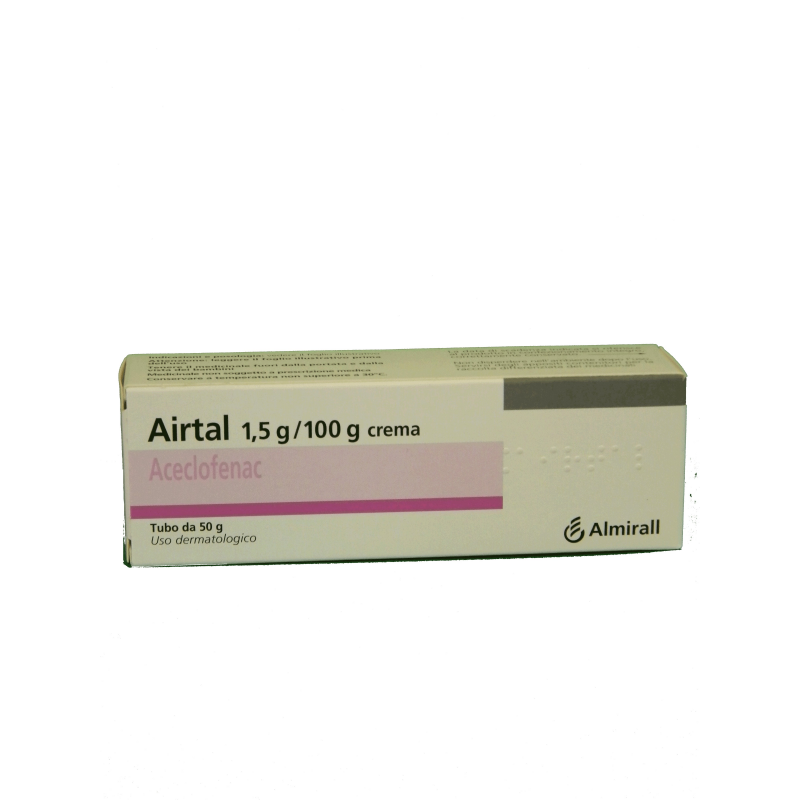
AIRTAL 1.5 g/100 g cream
Aceclofenac
What it is and what it is used for
AIRTAL contains the active ingredient aceclofenac, which belongs to the category of non-steroidal anti-inflammatory drugs (NSAIDs) and anti-rheumatic drugs (medicines used for bone, cartilage, and muscle disorders).
This medicine is indicated for the local treatment of painful and phlogistic (inflammatory) conditions of rheumatic or traumatic origin affecting joints, muscles, tendons, and ligaments, such as tendinitis (inflammation of the tendons), tenosynovitis (inflammation of the membrane covering the tendon), sprains, contusions, periarthritis (inflammatory diseases affecting the fibrous tissues surrounding a joint), dislocations (joint luxations), lumbago (back pain), torticollis, bursitis (inflammation of the fluid-filled sacs that cushion between bones and tendons and/or muscles surrounding a joint), strains, and post-traumatic conditions.
What you need to know before taking the medicine
Do not use AIRTAL
- If you are allergic to the active ingredient, other NSAIDs (including acetylsalicylic acid), or any of the other ingredients of this medicine (listed in section 6).
- If you have previously experienced an aggravation of asthmatic attacks, acute rhinitis (inflammation of the nasal mucosa), or urticaria (skin redness with intense itching) after taking acetylsalicylic acid or other NSAIDs.
- If you have or have previously experienced hypersensitivity (allergy) reactions to diclofenac, even if cross-allergenicity with this medicine has not been demonstrated.
- If you are in the last 3 months of pregnancy or during breastfeeding (see Pregnancy, breastfeeding, and fertility).
AIRTAL is contraindicated in children (see Children and adolescents).
Warnings and precautions
Talk to your doctor or pharmacist before using AIRTAL.
Use AIRTAL cream for external use only.
During treatment with AIRTAL, you should avoid:
- Inappropriate exposure of the treated area to sunlight without adequate protection to prevent photosensitivity reactions (immune system reaction to sunlight).
- Applying the cream to open sores or wounds.
- Contact with eyes, mucous membranes, or any other application site with existing skin lesions.
Discontinue treatment with AIRTAL and seek appropriate therapeutic treatment if you experience symptoms of local irritation.
Prolonged use of dermatological products may lead to sensitization (allergy) phenomena.
As with other NSAIDs, allergic reactions, including anaphylactic/anaphylactoid reactions (rapid onset allergic reactions), may also occur even without prior exposure to aceclofenac (see section 4 Possible side effects).
Severe skin reactions, some of which fatal, including exfoliative dermatitis (skin irritation with desquamation), Stevens-Johnson syndrome (lesions of the skin and mucous membranes), and epidermal necrolysis (severe skin disease in which the epidermis detaches in sheets), have been reported very rarely in association with the use of NSAIDs (see section 4 Possible side effects). The risk appears to be higher in the early stages of therapy, as the onset of the reaction occurs in most cases within the first month of treatment.
Stop taking AIRTAL at the first appearance of a skin rash, mucosal lesions, or any other sign of hypersensitivity (allergy).
Avoid the use of AIRTAL in case of chickenpox; in some cases, chickenpox can cause severe infectious complications of the skin and soft tissues, and the role of NSAIDs in aggravating these infections cannot be excluded (see section 4 Possible side effects).
Children and adolescents
Currently, there are no data available regarding the safety and efficacy of aceclofenac in children up to 14 years of age; therefore, its administration is not recommended (see Do not use AIRTAL).
Possible side effects
Like all medicines, this medicine can cause side effects, although not everybody gets them.
Possible side effects that may occur after taking AIRTAL are:
Mild or moderate skin irritation accompanied by redness and mild itching that disappears when treatment is discontinued.
Uncommon side effects (may affect up to 1 in 100 patients)
- Photosensitivity in cases where treated skin areas have been exposed to strong sunlight without adequate protection (see Warnings and precautions).
- Erythema (skin irritation).
- Itching.
Very rare side effects (may affect up to 1 in 10,000 patients)
Bullous eruption (including Stevens-Johnson Syndrome and Toxic Epidermal Necrolysis).
Exceptionally, during chickenpox, severe cutaneous and soft tissue infectious complications have been reported in conjunction with NSAID treatment (see Warnings and precautions).
Following the instructions in the package leaflet reduces the risk of side effects.
Reporting of side effects
If you get any side effects, including any not listed in this leaflet, talk to your doctor or pharmacist. You can also report side effects directly via the national reporting system at: https://www.aifa.gov.it/content/segnalazionireazioni-avverse.
By reporting side effects, you can help provide more information on the safety of this medicine.