

You will not be allowed to compare more than 4 products at a time
View compareVOLTADVANCE*ORAL POWDER 20SACHETS 25MG
VOLTADVANCE*ORAL POWDER 20SACHETS 25MG
Regular price
€11,65 EUR
Sale price
€11,65 EUR
Regular price
€12,30 EUR
Unit price
per
Tax included.
SKU
035500040In stock
Vendor
HALEON ITALY SrlDelivery time: 48/72 hours
Free Shipping: Orders over €70
This product page, including its Product Information Leaflet, has been automatically translated.
Description
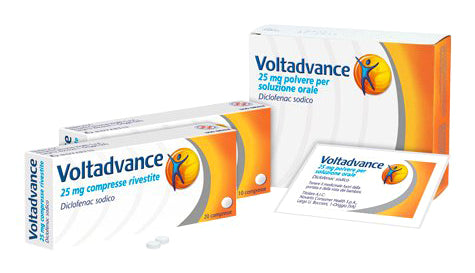
Voltadvance 25 mg film-coated tablets
Voltadvance 25 mg powder for oral solution
Diclofenac sodium
What it is and what it is used for
Voltadvance contains the active ingredient diclofenac sodium, which belongs to the class of medicines known as non-steroidal anti-inflammatory drugs (NSAIDs). Voltadvance works by reducing pain and inflammation.
Voltadvance is indicated for the treatment of pain of various origins and nature, such as:
• joint pain
• back pain (lumbago)
• muscle pain, including stiff neck
• headache
• toothache
• menstrual pain
Consult your doctor if you do not feel better or if you feel worse after 2-3 days of treatment.
What you need to know before taking the medicine
Do not take Voltadvance
• if you are allergic to diclofenac sodium, acetylsalicylic acid or any other non-steroidal anti-inflammatory drug (NSAID) or any of the other ingredients of this medicine (listed in section 6)
• if you have an ongoing ulcer, bleeding or perforation of the stomach or intestines
• if you have had stomach or intestinal bleeding (hemorrhage) or perforation after previous treatments with NSAIDs
• if you have had repeatedly occurring bleeding or ulcers (two or more distinct episodes of demonstrated ulceration or bleeding)
• if you have a severe form of liver or kidney failure
• if you suffer from established heart disease and/or cerebrovascular disease, e.g., you have had a heart attack, a stroke, a mini-stroke (TIA) or an obstruction of the blood vessels leading to the heart or brain or an operation to eliminate or avoid such obstructions
• if you suffer or have suffered from blood circulation problems (peripheral artery disease)
• if you think you are allergic to diclofenac sodium, acetylsalicylic acid, ibuprofen or any other NSAID or any other ingredient of this medicine. Signs of a hypersensitivity reaction include swelling of the face, lips, tongue and/or throat with difficulty swallowing (angioedema), breathing problems (difficulty breathing, asthma), chest pain, acute rhinitis (runny nose), skin rashes (urticaria) or any other type of allergic reaction
• if you have an alteration in blood cell production
• if you are taking high doses of medicines that increase urine production (diuretics) (see Other medicines and Voltadvance)
• if your stools are dark or contain blood
• if you are breastfeeding (see section Pregnancy, breastfeeding and fertility)
• if you are in the last three months of pregnancy (see section Pregnancy, breastfeeding and fertility)
• if you are under 14 years of age
Warnings and precautions
Consult your doctor or pharmacist before taking Voltadvance.
Before taking Voltadvance, make sure your doctor is aware:
• if you have asthma
• if you have seasonal allergic rhinitis (allergic rhinitis), swelling of the nasal mucosa (e.g., nasal polyps)
• if you have chronic obstructive pulmonary disease or chronic respiratory tract infections
• if you have liver or kidney problems, unless you have a severe form of liver or kidney failure, because in these latter cases you must not take Voltadvance (see paragraph 2 Do not take Voltadvance). If in doubt, consult your doctor.
• if you have hepatic porphyria
• if you have ulcerative colitis or Crohn's disease because these conditions could worsen
• if you are using medicines that increase urine production (diuretics) or other medicines that can affect kidney function
• if you have reduced body fluid volume (e.g., before or after major surgery)
• if you need to undergo or have undergone major surgery
• if you have blood clotting defects (hemostasis defects)
• if you have or have had heart problems
• if you smoke
• if you suffer from diabetes
• if you suffer from angina, blood clots, high blood pressure, increased cholesterol or increased triglycerides
• if signs or symptoms of heart or blood vessel problems occur, such as chest pain, shortness of breath, weakness or difficulty speaking, contact your doctor immediately
• if you have stomach or intestinal problems, unless you have one or more conditions for which you must not take Voltadvance (see section Do not take Voltadvance)
• if you are taking medicines that can increase the risk of bleeding, ulceration and perforation, such as acetylsalicylic acid (e.g., aspirin) and other NSAIDs, corticosteroids administered orally, by injection or rectally (e.g., cortisone), blood thinners (anticoagulants and antiplatelet agents), selective serotonin reuptake inhibitors (antidepressants) (see section Other medicines and Voltadvance)
• Tell your doctor if you have recently undergone or are about to undergo surgery on your stomach or intestinal tract before receiving/taking/using Voltadvance, as Voltadvance can sometimes worsen wound healing in the intestine after surgery
In these cases, your doctor will keep you under close observation and will periodically reassess the need for treatment with Voltadvance. In addition, your doctor may ask you to undergo periodic tests (such as monitoring kidney or liver function) to assess your condition during treatment with Voltadvance.
Stop treatment and inform your doctor if you develop during treatment with Voltadvance:
• gastrointestinal bleeding or ulceration
• skin reactions, because very rarely severe skin reactions, which can also be fatal, have been reported (see section 4.8)
• mucosal lesions or any other sign of an allergic reaction
• fluid retention and swelling due to fluid accumulation (edema)
• signs and symptoms of liver problems or if liver function parameters are not normal (visible from blood tests)
• unusual stomach and intestinal symptoms
• worsening of headaches because prolonged use of medicines to reduce headaches can, in some cases, worsen them
• symptoms of an infection (e.g., headache, fever) or if you notice the worsening of an infection, as Voltadvance can hide the signs and symptoms of infection.
In these cases, your doctor will assess whether to continue or stop treatment with Voltadvance.
Other important information:
• During treatment with NSAIDs, including diclofenac, gastrointestinal bleeding, ulceration or perforation may occur, which can also cause death. The risk of gastrointestinal bleeding is higher with high doses of NSAIDs and in patients who have had ulcers, especially if complicated by bleeding or perforation. You should take the lowest effective dose of diclofenac to reduce the risk of gastrointestinal toxicity, and your doctor may also prescribe medicines (e.g., misoprostol or proton pump inhibitors) to protect the gastrointestinal mucosa.
• Medicines like Voltadvance may be associated with a small increased risk of heart attack (myocardial infarction) or stroke. Any risk is more likely with high doses or prolonged treatment.
• Undesirable effects can be minimized by using the lowest effective dose for the shortest necessary duration (see section 3 How to take Voltadvance)
• Avoid the use of diclofenac during treatment with other NSAIDs administered orally, by injection and rectally, including selective cyclooxygenase-2 inhibitors, because it increases the possibility of you having undesirable effects.
Children and adolescents
Voltadvance is contraindicated in children and adolescents under 14 years of age.
Elderly patients
Elderly patients are more likely to experience adverse reactions, especially stomach or intestinal bleeding and perforation, which are generally more severe and can be fatal.
If you are elderly, you should take the lowest dosage of Voltadvance.
As a precaution, your doctor may have you check your kidney function and prescribe medicines that protect the gastrointestinal mucosa, such as misoprostol or proton pump inhibitors.
Inform your doctor of any unusual stomach and intestinal symptoms.
Possible side effects
Like all medicines, this medicine can cause side effects, although not everybody gets them.
If any of these effects appear during treatment with Voltadvance, it is advisable to stop the medicine and consult your doctor.
Side effects can be minimized by using the lowest effective dose for the shortest necessary duration.
Some side effects can be serious.
Stop taking Voltadvance and inform your doctor immediately if you notice:
• Mild abdominal cramps and tenderness occurring shortly after starting treatment with Voltadvance, followed by rectal bleeding or bloody diarrhea usually within 24 hours of the onset of abdominal pain (frequency not known, cannot be estimated from available data).
• Chest pain, which may be a sign of a potentially severe allergic reaction called Kounis syndrome.
Common side effects (may affect up to 1 in 10 people)
• headache, dizziness, vertigo
• nausea, vomiting
• diarrhea, gas (flatulence)
• indigestion (dyspepsia), abdominal pain
• loss or reduction of appetite (anorexia)
• changes in liver function tests (increase in transaminases)
• skin rash
Uncommon side effects (may affect up to 1 in 100 people)
These effects occurred after long-term treatment and with a high dose (150 mg per day).
• heart attack
• heart problems (heart failure)
• awareness of your own heartbeat (palpitations)
• chest pain
Rare side effects (may affect up to 1 in 1,000 people)
• allergic reactions, severe allergic reactions even after the first use of the medicine (anaphylactic and anaphylactoid reactions) including hypotension and collapse (shock)
• drowsiness
• asthma, difficulty breathing (dyspnea)
• inflammation of the stomach (gastritis), stomach or intestinal bleeding, vomiting blood (hematemesis), stomach or intestinal ulcer with or without bleeding and perforation (with possible inflammation of the peritoneum called peritonitis), gastrointestinal narrowing (stenosis)
• diarrhea accompanied by bleeding, dark stools with blood (melena)
• dry mouth and mucous membranes
• liver inflammation (hepatitis), yellowing of the skin, mucous membranes and eyes (jaundice), liver disorders
• urticaria
• swelling due to fluid accumulation (edema).
Very rare side effects (may affect up to 1 in 10,000 people)
• abnormal blood test values
- reduction in the number of platelets (thrombocytopenia)
- reduction in the number of white blood cells (leukopenia, agranulocytosis)
- anemia (including hemolytic and aplastic anemia)
• abnormal urine test values
- presence of blood in the urine (hematuria)
- presence of protein in the urine (proteinuria)
• swelling of the skin and mucous membranes (angioedema) including facial edema
• disorientation, depression, insomnia, nightmares, irritability, severe mental changes (psychotic reactions)
• worsening of memory, seizures, anxiety, tremors
• alteration of sensation in the limbs or other parts of the body (paresthesia)
• altered taste
• inflammation of the membranes lining the brain and spinal cord (aseptic meningitis), damage to the blood vessels of the brain (cerebrovascular accidents)
• visual disturbances, blurred vision, double vision (diplopia)
• ringing or buzzing in the ears (tinnitus), worsening of hearing
• high blood pressure (hypertension)
• inflammation of blood vessels (vasculitis)
• pneumonia
• inflammation of the colon (colitis) including colitis accompanied by bleeding and worsening of ulcerative rectocolitis or Crohn's disease
• constipation
• inflammation of the oral mucosa (stomatitis) including stomatitis with ulcers
• inflammation of the tongue (glossitis)
• esophageal problems, intestinal narrowing (intestinal diaphragm disease)
• inflammation of the pancreas (pancreatitis)
• very severe and sudden form of hepatitis (fulminant hepatitis), liver necrosis, impaired liver function (hepatic insufficiency)
• various types of skin reactions from mild to potentially fatal (bullous eruptions, eczema, erythema, erythema multiforme, Stevens-Johnson syndrome, toxic epidermal necrolysis (Lyell's syndrome), exfoliative dermatitis)
• appearance of reddish-brown spots on the skin (purpura), Henoch-Schonlein purpura, itching
• hair loss
• appearance of spots or redness on the skin after exposure to sunlight or sunlamps
• impaired kidney function (acute renal failure), nephrotic syndrome, interstitial nephritis, renal papillary necrosis.
Side effects with unknown frequency (frequency cannot be estimated from the available data):
• sudden and oppressive chest pain that may be a symptom of a severe allergic reaction (Kounis syndrome). Medicines like Voltadvance may be associated with a modest increased risk of heart attack (myocardial infarction) or stroke (see Warnings and precautions above).
Reporting of side effects
If you get any side effects, including any not listed in this leaflet, talk to your doctor or pharmacist. You can also report side effects directly via the national reporting system at: https://www.aifa.gov.it/content/segnalazionireazioni-avverse.
By reporting side effects you can help provide more information on the safety of this medicine.
