


You will not be allowed to compare more than 4 products at a time
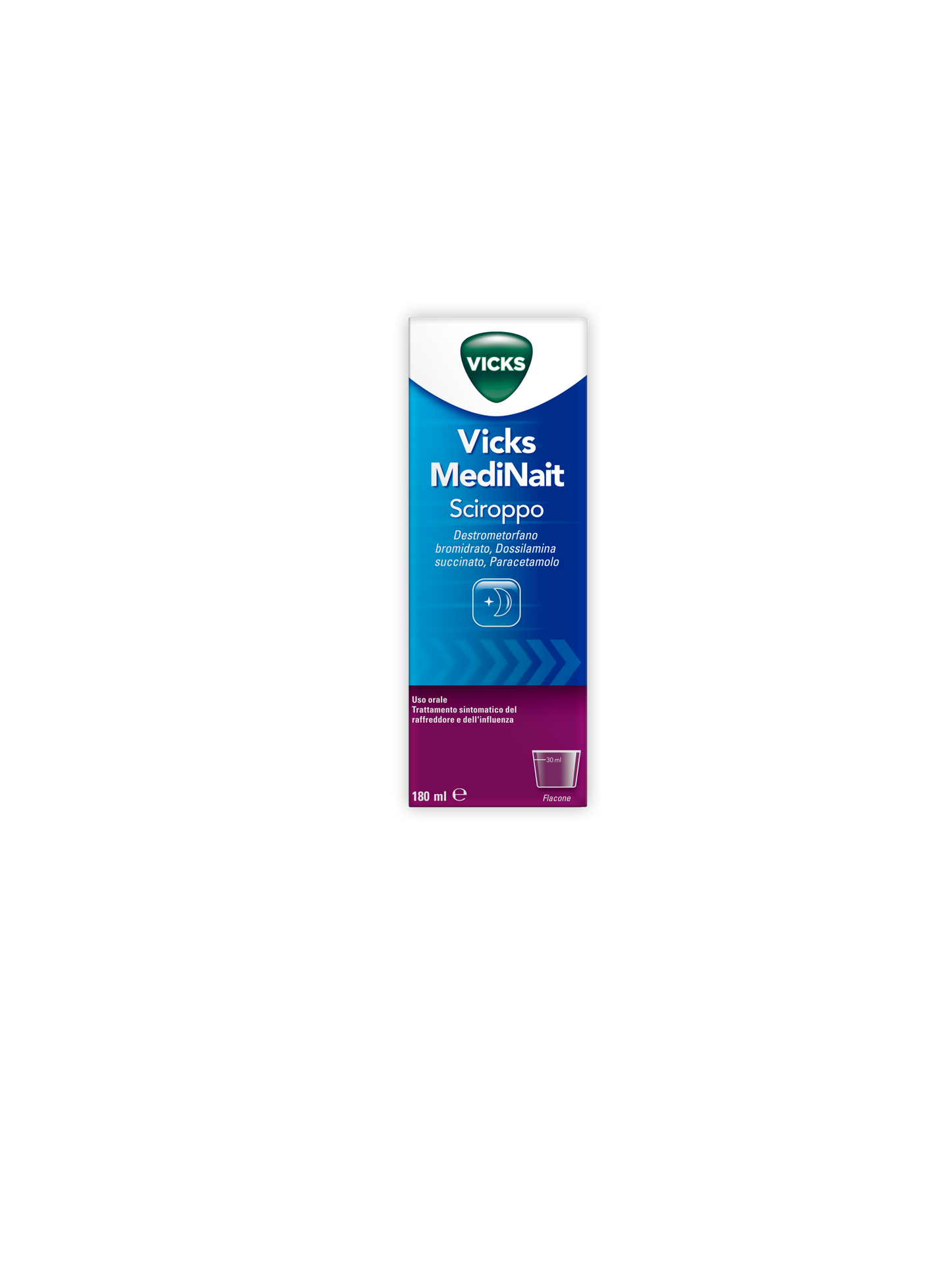
View compareVICKS MEDINAIT*SYRUP 180ML
VICKS MEDINAIT*SYRUP 180ML
Regular price
€10,93 EUR
Sale price
€10,93 EUR
Regular price
€9,57 EUR
Unit price
per
Tax included.
SKU
024449062In stock
Vendor
PROCTER & GAMBLE SRLDelivery time: 48/72 hours
Free Shipping: Orders over €70
This product page, including its Product Information Leaflet, has been automatically translated.
Description
Vicks MediNait 0.5 mg/ml + 0.25 mg/ml + 20 mg/ml syrup
dextromethorphan hydrobromide, doxylamine succinate, paracetamol
What it is and what it is used for
Vicks MediNait is used to treat the symptoms of colds and flu.
Vicks MediNait contains:
- dextromethorphan hydrobromide: a substance that calms cough symptoms;
- doxylamine succinate: an antihistamine substance that acts on some cold symptoms, such as runny nose and sneezing;
- paracetamol: a substance with pain-relieving and antipyretic action, capable of lowering fever
. Consult your doctor if you do not feel better or if you feel worse after 3 days.
What you need to know before taking the medicine
Do not use Vicks MediNait
- if you are allergic to the active ingredients or any of the other ingredients of this medicine (listed in paragraph 6);
- if the person to be treated is a child or adolescent under 12 years of age;
- if you suffer or have suffered from asthma (a disease that causes narrowing and inflammation of the bronchi);
- if you have diabetes, a disease that causes an increase in blood sugar levels (amount of sugar in the blood);
- if you suffer from glaucoma (a disease that causes an increase in pressure in the eye and vision problems);
- if you have an enlarged prostate (prostatic hypertrophy);
- if you suffer from a narrowing of the stomach or intestines or of the urinary or genital tracts; - if you suffer or have suffered from epilepsy (a disease that causes loss of consciousness and violent involuntary muscle contractions);
- if you have severe liver or kidney problems;
- if you have a deficiency of an enzyme called glucose-6-phosphate dehydrogenase;
- if you suffer from hemolytic anemia (a disease that causes the breakdown of red blood cells);
- if you have previously suffered from bleeding or perforation of the stomach or intestines due to treatments with anti-inflammatory, antipyretic and pain-relieving medicines or recurrent (two or more episodes of demonstrated ulcer or bleeding);
- if you have severe heart failure (a condition in which the body is unable to balance the reduction in the heart's contractile activity);
- if you are already taking medicines belonging to the class of monoamine oxidase inhibitors (MAOIs), used as antidepressants or in the treatment of Parkinson's disease (a disease that causes tremor, rigidity and slowness of movements), or if you have stopped them less than two weeks ago;
Warnings and precautions
Talk to your doctor or pharmacist before taking Vicks MediNait.
This medicine can lead to abuse and dependence. Therefore, treatment should be short-term.
Side effects can be minimized with the shortest possible treatment duration needed to control symptoms.
Elderly people are more susceptible to the onset of side effects.
Concomitant use of Vicks MediNait with anti-inflammatory, antipyretic and pain-relieving medicines should be avoided.
Talk to your doctor if:
- if you have a chronic or persistent cough (due, for example, to smoking and certain respiratory diseases such as emphysema/asthma);
- if your cough is irritating with abundant mucus production;
- if you suffer from liver or kidney problems;
- if you suffer from a liver disease due to alcohol abuse;
- if you have an intestinal disease (ulcerative colitis, Crohn's disease);
- if you are taking antibiotics (medicines used to treat infections caused by bacteria), because Vicks MediNait can delay the perception of hearing damage caused by some antibiotics;
- if you have heart disease;
- if you suffer from high blood pressure;
- if you suffer from hyperthyroidism (a thyroid disease caused by increased activity);
- if you suffer from high blood pressure not sufficiently controlled with medicines;
- if you suffer from congestive heart failure (a disease in which the heart is unable to pump blood efficiently);
- if you have confirmed ischemic heart disease (heart suffering due to reduced oxygen supply);
- if you have peripheral arterial disease and/or cerebrovascular disease (arterial and brain vessel disease), as you should only use Vicks MediNait after careful medical evaluation;
- if you have a history of drug or substance abuse (psychoactive substances capable of altering the psychophysical state);
- if the person to be treated is an adolescent or young adult.
The concomitant use of Vicks MediNait with sedative medicines such as benzodiazepines or similar medicines increases the risk of drowsiness, breathing difficulties (respiratory depression), coma (deep unconscious state) and can be life-threatening. For this reason, concomitant use should only be considered when other treatment options are not possible. However, if your doctor prescribes Vicks MediNait together with sedative medicines, the dose and duration of concomitant treatment must be limited by your doctor. Inform your doctor about all sedative medicines you are taking and carefully follow their dosage recommendations. It may be helpful to inform friends or family so that they are aware of the signs and symptoms described above. If you experience these symptoms, contact your doctor. During treatment with all anti-inflammatory, antipyretic and pain-relieving medicines, such as Vicks MediNait, at any time, with or without warning symptoms or a previous history of serious gastrointestinal events, gastrointestinal bleeding, ulceration and perforation have been reported, which can be fatal. Patients who have previously suffered from these conditions have a higher risk (see "Do not take Vicks MediNait"). Report any abdominal signs or symptoms (including gastrointestinal bleeding) even at the beginning of treatment.
Inform your doctor if you are taking medicines that may increase the risk of ulceration or bleeding, such as oral corticosteroids (medicines used to treat inflammatory conditions), anticoagulants (medicines that slow down blood clotting), such as warfarin, selective serotonin reuptake inhibitors (medicines used to treat depression), or antiplatelet agents (medicines that prevent platelet aggregation) such as acetylsalicylic acid (see "Other medicines and Vicks MediNait").
Elderly people are more exposed to the risk of developing adverse reactions to anti-inflammatory, antipyretic and pain-relieving medicines, especially gastrointestinal bleeding and perforations, which can be fatal.
Report any abdominal signs or symptoms (including gastrointestinal bleeding) even at the beginning of treatment.
Immediately stop treatment with Vicks MediNait at the first signs of gastrointestinal bleeding or ulceration.
Severe skin reactions (of the skin), some of which fatal, such as exfoliative dermatitis, Stevens-Johnson syndrome and toxic epidermal necrolysis, have been reported very rarely in association with the use of anti-inflammatory, antipyretic and pain-relieving medicines (see "Possible side effects"). The reaction occurs in most cases in the early stages of treatment. Stop using Vicks MediNait if a rash, mucosal lesions or any other sign of hypersensitivity (allergic reaction) appears.
- if you are taking medicines such as some antidepressants or antipsychotics: Vicks MediNait can interact with these medicines and mental status changes (e.g., agitation, hallucinations, coma) and other effects such as body temperature above 38°C, increased heart rate, unstable blood pressure, exaggerated reflexes, muscle stiffness, lack of coordination and/or gastrointestinal symptoms (e.g., nausea, vomiting, diarrhea) may occur.
Laboratory tests
Paracetamol, contained in Vicks MediNait, can interfere with the determination of uric acid or glucose levels in the blood (uricemia and glycemia).
Possible side effects
Like all medicines, this medicine can cause side effects, although not everyone gets them.
- Stop treatment and inform your doctor immediately if you experience the following symptoms: skin rashes and itching;
- severe allergic reaction (anaphylaxis);
- narrowing of the bronchi causing difficulty breathing (bronchospasm);
- swelling of the throat due to fluid accumulation (laryngeal edema), swelling of the face, lips, mouth, tongue and throat that can cause breathing and swallowing problems (angioedema).
- These may be signs of severe allergic reactions (anaphylactic shock) whose signs may include difficulty breathing, chest pain or chest tightness and/or dizziness/fainting, skin itching or raised bumps on the skin, swelling of the face, lips, tongue and/or throat and which can be potentially life-threatening; skin irritation, hives;
- formation of widespread red papules or blisters and peeling, especially on the legs, arms, hands and feet, which can extend to the face, lips and mucous membranes, occasionally accompanied by fever. These may be signs of severe skin diseases such as Erythema Multiforme, Toxic Epidermal Necrolysis and Stevens-Johnson Syndrome;
- nosebleed (epistaxis);
- increased tendency for wounds to bleed.
Other reported side effects are:
Common (may affect up to 1 in 10 people):
- drowsiness;
- headache;
- blurred vision;
- psychomotor impairment;
- dry mouth;
- constipation;
- stomach acid reflux causing heartburn (gastric reflux).
Rare (may affect up to 1 in 1,000 people):
- nausea;
- vomiting;
- abdominal pain;
- diarrhea;
- allergies (hypersensitivity);
- skin redness (erythema);
- hives;
- sensation of rotational, oscillatory or swaying movement (vertigo);
- altered quantity and quality of sleep (insomnia).
Very rare (may affect up to 1 in 10,000 people)
- reduction in the number of platelets (thrombocytopenia);
- reduction in the number of all blood cells (pancytopenia);
- reduction in the number of a type of white blood cells called granulocytes (agranulocytosis);
- reduction in the number of a type of white blood cells called neutrophils (neutropenia);
- reduction in the number of white blood cells (leukopenia);
- reduction of hemoglobin (substance that carries oxygen in the blood), caused by the destruction of red blood cells (hemolytic anemia);
- skin redness with blisters and vesicles (fixed drug eruption).
Not known (frequency cannot be estimated from the available data):
- excessive gas production in the intestine (flatulence);
- difficult digestion (dyspepsia);
- presence of digested blood in the stools (melena);
- vomiting blood (hematemesis);
- inflammation of the mouth (ulcerative stomatitis);
- worsening of intestinal inflammation characterized by episodes of diarrhea and abdominal swelling (colitis);
- worsening of severe intestinal inflammation (Crohn's disease), see Warnings and precautions;
- increase in blood proteins that increase in case of liver damage (GOT and GPT);
- yellowing of the skin and the whites of the eyes (jaundice);
- liver inflammation (hepatitis) up to liver death (hepatic necrosis);
- inflammation and lesions of the stomach (gastritis, peptic ulcers), sometimes fatal and especially in the elderly;
- perforation or bleeding of the stomach and/or intestines (gastrointestinal hemorrhage), see Warnings and precautions;
- inability to empty the bladder (urinary retention) and difficulty urinating (dysuria); - lack of urine production (anuria);
- presence of blood in the urine (hematuria);
- alterations in kidney function (acute renal failure, interstitial nephritis);
- weakness (asthenia);
- sensitivity reaction to sunlight or UV lamps (photosensitivity);
- involuntary, abrupt and uncontrolled muscle movements (convulsions);
- breathing difficulties due to increased secretions in the bronchi;
- alterations in heart rate, especially in the elderly [irregular beats (extrasystoles) and increased number of beats per minute (tachycardia)];
- low blood pressure (hypotension), especially in the elderly;
- fluid accumulation in the body (edema);
- high blood pressure (hypertension);
- alteration of the heart's pumping function (heart failure);
- psychomotor hyperactivity, especially in children.
Reporting of side effects
If you get any side effects, including any not listed in this leaflet, tell your doctor or pharmacist. You can also report side effects directly via the national reporting system at: https://www.aifa.gov.it/content/segnalazionireazioni-avverse.
By reporting side effects you can help provide more information on the safety of this medicine.