

You will not be allowed to compare more than 4 products at a time
View compareXOOLAM REFLUX*12TAB 20MG
XOOLAM REFLUX*12TAB 20MG
Regular price
€5,45 EUR
Sale price
€5,45 EUR
Regular price
€6,00 EUR
Unit price
per
Tax included.
SKU
044867012In stock
Vendor
LABORATORI ALTER SrlDelivery time: 48/72 hours
Free Shipping: Orders over €70
This product page, including its Product Information Leaflet, has been automatically translated.
Description
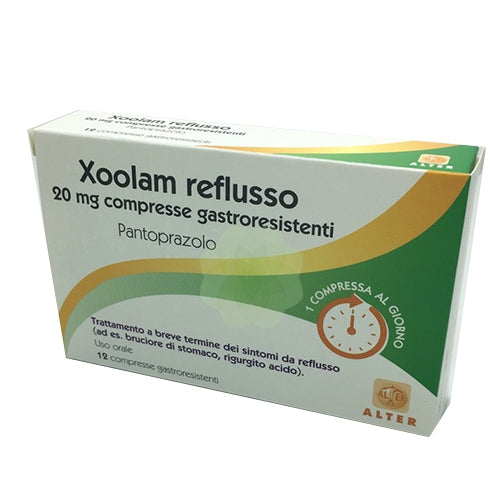
Xoolam reflusso 20 mg gastro-resistant tablets
What it is and what it is used for
Xoolam reflusso contains the active ingredient pantoprazole. Xoolam reflusso is a selective "proton pump inhibitor", a medicine that reduces the amount of acid produced in the stomach. Xoolam reflusso is used for the short-term treatment of reflux symptoms (e.g., heartburn, acid regurgitation).
What you need to know before taking the medicine
Do not take Xoolam reflusso
- If you are allergic to the active substance or any of the other ingredients of this medicine (listed in section 6)
- If you are allergic to medicines containing other proton pump inhibitors
Warnings and precautions
Talk to your doctor, pharmacist, or nurse before taking Xoolam reflusso. In particular:
- If you have severe liver problems. Inform your doctor if you have had liver problems in the past. Your doctor will arrange more frequent monitoring of your liver enzymes, especially if you are taking Xoolam reflusso for long-term therapy. In case of increased liver enzymes, treatment should be discontinued.
- If you need continuous NSAID treatment and are taking Xoolam reflusso because you have an increased risk of developing gastric and intestinal complications. Any increased risk will be assessed based on your personal risk factors such as age (65 years and older), a history of gastric or duodenal ulcers, or gastric or intestinal bleeding.
- If you have reduced body reserves or risk factors for reduced vitamin B12 and are undergoing long-term treatment with pantoprazole. As with all acid-reducing agents, pantoprazole may lead to reduced vitamin B12 absorption.
- If you are concurrently taking HIV protease inhibitors such as atazanavir with pantoprazole (for the treatment of HIV infection), ask your doctor for specific advice.
- If you take multiple daily doses of proton pump inhibitors for a long period of time (one year or more), you may have an increased risk of hip, wrist, or spine fractures. Inform your doctor if you have osteoporosis or are taking corticosteroids (which can increase the risk of osteoporosis).
- If you have been taking Xoolam reflusso for more than 3 months, your blood magnesium levels may decrease. Low magnesium levels can cause fatigue, involuntary muscle contractions, disorientation, convulsions, dizziness, increased heart rate. Inform your doctor immediately if you experience any of these symptoms. Low magnesium levels can also lead to a reduction in blood potassium or calcium levels. Your doctor may decide to perform regular blood tests to monitor your magnesium levels.
- If you have ever had a skin reaction after treatment with a medicine similar to Xoolam reflusso that reduces stomach acidity.
- If you notice a skin rash, especially in areas exposed to sunlight, contact your doctor as soon as possible, as it may be necessary to stop Xoolam reflusso therapy. Remember to also report any other side effects such as joint pain.
- If you need to undergo a specific blood test (Chromogranin A).
Inform your doctor immediately before or after taking this medicine if you notice any of the following symptoms, which may be a sign of another more serious illness:
- unintentional weight loss
- recurrent vomiting
- presence of blood in vomit, which may appear as dark coffee grounds in vomit
- appears pale and feels weak (anemia)
- presence of blood in stools that may appear dark or tarry
- difficulty swallowing or pain on swallowing
- chest pain
- stomach pain
- severe and/or persistent diarrhea, as this medicine has been associated with a modest increase in infectious diarrhea.
Your doctor may decide that you need to undergo some tests to rule out a malignant disease as pantoprazole also alleviates cancer symptoms and could cause a delay in diagnosis. If your symptoms persist despite treatment, further investigations should be considered.
If you take Xoolam reflusso for long-term treatment (more than 1 year), your doctor will probably keep you under regular review. You should report any new or unusual symptoms and circumstances whenever you see your doctor.
Children
The use of Xoolam reflusso is not recommended in children.
Possible side effects
Like all medicines, this medicine can cause side effects, although not everybody gets them.
If you experience any of the following side effects, stop treatment with these tablets and consult your doctor immediately, or contact the nearest hospital emergency room:
- Serious allergic reactions (rare frequency: may affect up to 1 in 1,000 people): swelling of the tongue and/or throat, difficulty swallowing, hives, difficulty breathing, allergic swelling of the face (Quincke's edema/angioedema), severe dizziness with very fast heartbeat and heavy sweating.
- Serious skin conditions (unknown frequency: frequency cannot be estimated from available data): appearance of skin blisters and rapid deterioration of your general condition, erosion (including mild bleeding) of the eyes, nose, mouth/lips or genitals (Stevens-Johnson syndrome, Lyell's syndrome, erythema multiforme) and sensitivity to light.
-Other serious conditions (unknown frequency: frequency cannot be estimated from available data): yellowing of the skin or whites of the eyes (severe liver cell damage, jaundice) or fever, skin rash, and enlarged kidneys sometimes with pain on urination or lower back pain (severe kidney inflammation) which may lead to possible kidney failure.
Other side effects are:
- Uncommon (may affect up to 1 in 100 people)
headache; dizziness; diarrhea; nausea, vomiting; swelling and flatulence (wind); constipation; dry mouth; abdominal pain and feeling unwell; skin rash, exanthema, rash; itching; feeling of weakness, exhaustion or general malaise; sleep disturbances, hip, wrist, or spine fractures.
- Common (may affect up to 1 in 10 people):
benign polyps in the stomach.
- Rare (may affect up to 1 in 1,000 people)
visual disturbances such as blurred vision; altered or complete lack of taste; hives; joint pain; muscle pain; weight changes; increased body temperature; swelling of the extremities (peripheral edema); allergic reactions; depression; breast enlargement in men.
- Very Rare (may affect up to 1 in 10,000 people)
disorientation.
- Unknown (frequency cannot be estimated from available data)
hallucinations, confusion (especially in patients with a history of these symptoms); decreased sodium levels in the blood, decreased magnesium levels in the blood (see section 2), tingling sensation, pins and needles, burning sensation or numbness, erythema, possible joint pain, inflammation of the large intestine causing persistent watery diarrhea.
Side effects identified through blood tests:
- Uncommon (may affect up to 1 in 100 people)
an increase in liver enzymes.
- Rare (may affect up to 1 in 1,000 people)
an increase in bilirubin; increased fats in the blood; drastic decrease in circulating granulocytes, associated with high fever.
- Very Rare (may affect up to 1 in 10,000 people)
a reduction in the number of platelets, which can cause bleeding or bruising more than usual; a reduction in the number of white blood cells, which can lead to more frequent infections; coexisting abnormal reduction in the number of red and white blood cells, as well as platelets.
Reporting of side effects
If you get any side effects, including those not listed in this leaflet, talk to your doctor or pharmacist. You can also report side effects directly via the national reporting system at: https://www.aifa.gov.it/content/segnalazionireazioni-avverse.
By reporting side effects you can help provide more information on the safety of this medicine.