


You will not be allowed to compare more than 4 products at a time
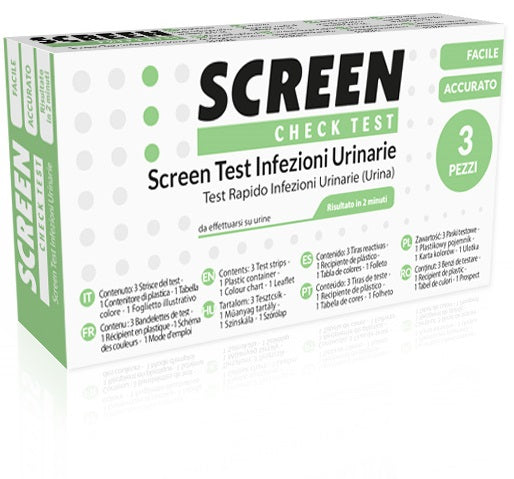
View compareBLOOD LEUKOCYTE SCREEN TEST URINE NITRITE AND PROTEIN URINARY TRACT INFECTION SCREEN TEST 3 PIECES
BLOOD LEUKOCYTE SCREEN TEST URINE NITRITE AND PROTEIN URINARY TRACT INFECTION SCREEN TEST 3 PIECES
Regular price
€8,89 EUR
Sale price
€8,89 EUR
Regular price
€13,83 EUR
Unit price
per
Tax included.
SKU
926819184In stock
Vendor
SCREEN ITALIA SrlDelivery time: 48/72 hours
Free Shipping: Orders over €70
This product page, including its Product Information Leaflet, has been automatically translated.
Description
SCREEN
CHECK TEST
Urinary Tract Infections
Description
CE 0123 In vitro diagnostic medical device.
Rapid test for the qualitative rapid detection of Leukocytes, Blood, Nitrite and Protein in human urine.
For in vitro self-diagnostic use only.
Precautions
1. For in vitro self-diagnostic use only.
2. Store in a dry place at 2-30°C (36-86°F), avoiding excessively humid areas. Do not use if the sealed package is damaged or open.
3. Keep out of reach of children.
4. Do not use after the expiry date or if the package is damaged.
5. Strictly follow the indicated timings.
6. Use the test only once. Do not disassemble or touch the reactive areas on the test strip.
7. For external use only.
8. The used test must be disposed of according to local regulations.
9. In case of difficulty in identifying colors (such as color blindness), seek help for reading the test.
Instructions for use
It is advisable to collect a urine sample for the test early in the morning as it is the most concentrated. The urine used for the test should not come into contact with toilet water or any disinfectant or cleaning product.
For women only: the test should not be performed during or within three days after the menstrual cycle. The urine sample should not be contaminated with vaginal fluids as they may produce misleading results.
Do not make important medical decisions without first consulting your doctor.
URINE COLLECTION: collect part of the urine in the provided plastic container or use a clean container free of detergent residues. Make sure to fill the container with urine.
PERFORMING THE TEST:
1) open the sealed package and remove the test strip. Do not touch the test fields. Once the package is opened, it is advisable to perform the test immediately;
2) immerse the test strip in the urine sample. CAUTION: make sure that all four test fields are immersed for at least 1-2 seconds.
3) remove the test strip and remove excess urine by wiping it on the edge of the container or using absorbent material (e.g. a paper tissue) to avoid mixing chemicals from adjacent areas. Wait 2 minutes (do not read the results after 3 minutes).
Reading the results
Color variations on the edges of the test pads or beyond 3 minutes should be ignored.
NEGATIVE:
- the LEUKOCYTE test field remained whitish;
- the BLOOD test field remained yellow-orange;
- the NITRITE test field remained white;
- the PROTEIN test field remained yellowish.
POSITIVE RESULT FOR LEUKOCYTES: if the color of the corresponding area has turned lilac, it means that leukocytes are present in the urine.
POSITIVE RESULT FOR BLOOD: if the color of the corresponding area has turned green (or green dots have appeared at the bottom), it means that blood is present in the urine.
POSITIVE RESULT FOR NITRITE: if the color of the corresponding area has turned pink, it means that nitrites are present in the urine.
POSITIVE RESULT FOR PROTEIN: if the color of the corresponding area has turned green, it means that proteins are present in the urine.
Limitations
The urinary tract infection test (Urine) can be affected by substances that cause abnormal urine color such as medications containing azo dyes, nitrofurantoin, and riboflavin1. Color development on the test pad may be masked or the colored reaction may be interpreted as a false result.
Leukocytes: the result should be read at 2 minutes to allow for full color development. The intensity of the color that develops is proportional to the number of leukocytes present in the urine sample. Highly proteinaceous urine can lower the intensity of the color reaction. This test does not react with erythrocytes or common bacteria in urine.
Blood: a uniform green color indicates the presence of myoglobin, hemoglobin, or hemolyzed erythrocytes1. Scattered or compact green dots indicate intact erythrocytes. To improve accuracy, separate color scales are provided for hemoglobin and erythrocytes. Positive test results are often observed in the urine of women during menstruation. It has been reported that high pH urine reduces sensitivity, while a moderate to high concentration of ascorbic acid can inhibit color formation.
Microbial peroxidase, associated with urinary tract infections, can cause false positives. The test is slightly more sensitive to free hemoglobin and myoglobin than to intact erythrocytes.
Nitrite: the test is specific for nitrite and will not react with any other substance normally excreted in urine. Any degree of uniform pink or red should be interpreted as a positive result, suggesting the presence of nitrite. The intensity of the color is not proportional to the number of bacteria present in the urine sample. Pink dots or edges should not be considered a positive result. Comparing the test with a white background can help detect low levels of nitrite that might otherwise not be detected. The sensitivity of this test is reduced for urine samples with highly buffered alkaline urine with high specific gravity. A negative result in no way rules out the possibility of bacteriuria. Negative results can be obtained with urinary tract infections caused by organisms that do not contain reductase that converts nitrate to nitrite; nitrate does not convert to nitrite when urine has not remained sufficiently in the bladder (at least 4 hours); when undergoing antibiotic therapy or when nitrate is absent from the diet.
Protein: any shade of green indicates the presence of protein in the urine. This test is highly sensitive to albumin and less sensitive to hemoglobin, globulin, and mucoprotein. A negative result does not exclude the presence of these or other proteins. False positives can be obtained with alkaline or highly buffered urine. Contamination of urine samples with quaternary ammonium compounds or body soaps containing chlorhexidine can produce false positive results. Urine samples with high specific gravity can give false negatives.
Storage
Store in the package at room temperature (2-30°C).
The test is stable until the expiry date printed on the sealed package. The test should remain in the sealed package until use.
DO NOT FREEZE.
Do not use after the expiry date.
Format
Pack containing 3 pieces.
BIBLIOGRAPHY:
1. Henry JB, et al. Clinical Diagnosis and Management by Laboratory Methods, 20th Ed. Philadelphia. Saunders. 371-372, 375, 379, 382, 385, 2001.
CE 0123 In vitro diagnostic medical device.
Rapid test for the qualitative rapid detection of Leukocytes, Blood, Nitrite and Protein in human urine.
For in vitro self-diagnostic use only.
Precautions
1. For in vitro self-diagnostic use only.
2. Store in a dry place at 2-30°C (36-86°F), avoiding excessively humid areas. Do not use if the sealed package is damaged or open.
3. Keep out of reach of children.
4. Do not use after the expiry date or if the package is damaged.
5. Strictly follow the indicated timings.
6. Use the test only once. Do not disassemble or touch the reactive areas on the test strip.
7. For external use only.
8. The used test must be disposed of according to local regulations.
9. In case of difficulty in identifying colors (such as color blindness), seek help for reading the test.
Instructions for use
It is advisable to collect a urine sample for the test early in the morning as it is the most concentrated. The urine used for the test should not come into contact with toilet water or any disinfectant or cleaning product.
For women only: the test should not be performed during or within three days after the menstrual cycle. The urine sample should not be contaminated with vaginal fluids as they may produce misleading results.
Do not make important medical decisions without first consulting your doctor.
URINE COLLECTION: collect part of the urine in the provided plastic container or use a clean container free of detergent residues. Make sure to fill the container with urine.
PERFORMING THE TEST:
1) open the sealed package and remove the test strip. Do not touch the test fields. Once the package is opened, it is advisable to perform the test immediately;
2) immerse the test strip in the urine sample. CAUTION: make sure that all four test fields are immersed for at least 1-2 seconds.
3) remove the test strip and remove excess urine by wiping it on the edge of the container or using absorbent material (e.g. a paper tissue) to avoid mixing chemicals from adjacent areas. Wait 2 minutes (do not read the results after 3 minutes).
Reading the results
Color variations on the edges of the test pads or beyond 3 minutes should be ignored.
NEGATIVE:
- the LEUKOCYTE test field remained whitish;
- the BLOOD test field remained yellow-orange;
- the NITRITE test field remained white;
- the PROTEIN test field remained yellowish.
POSITIVE RESULT FOR LEUKOCYTES: if the color of the corresponding area has turned lilac, it means that leukocytes are present in the urine.
POSITIVE RESULT FOR BLOOD: if the color of the corresponding area has turned green (or green dots have appeared at the bottom), it means that blood is present in the urine.
POSITIVE RESULT FOR NITRITE: if the color of the corresponding area has turned pink, it means that nitrites are present in the urine.
POSITIVE RESULT FOR PROTEIN: if the color of the corresponding area has turned green, it means that proteins are present in the urine.
Limitations
The urinary tract infection test (Urine) can be affected by substances that cause abnormal urine color such as medications containing azo dyes, nitrofurantoin, and riboflavin1. Color development on the test pad may be masked or the colored reaction may be interpreted as a false result.
Leukocytes: the result should be read at 2 minutes to allow for full color development. The intensity of the color that develops is proportional to the number of leukocytes present in the urine sample. Highly proteinaceous urine can lower the intensity of the color reaction. This test does not react with erythrocytes or common bacteria in urine.
Blood: a uniform green color indicates the presence of myoglobin, hemoglobin, or hemolyzed erythrocytes1. Scattered or compact green dots indicate intact erythrocytes. To improve accuracy, separate color scales are provided for hemoglobin and erythrocytes. Positive test results are often observed in the urine of women during menstruation. It has been reported that high pH urine reduces sensitivity, while a moderate to high concentration of ascorbic acid can inhibit color formation.
Microbial peroxidase, associated with urinary tract infections, can cause false positives. The test is slightly more sensitive to free hemoglobin and myoglobin than to intact erythrocytes.
Nitrite: the test is specific for nitrite and will not react with any other substance normally excreted in urine. Any degree of uniform pink or red should be interpreted as a positive result, suggesting the presence of nitrite. The intensity of the color is not proportional to the number of bacteria present in the urine sample. Pink dots or edges should not be considered a positive result. Comparing the test with a white background can help detect low levels of nitrite that might otherwise not be detected. The sensitivity of this test is reduced for urine samples with highly buffered alkaline urine with high specific gravity. A negative result in no way rules out the possibility of bacteriuria. Negative results can be obtained with urinary tract infections caused by organisms that do not contain reductase that converts nitrate to nitrite; nitrate does not convert to nitrite when urine has not remained sufficiently in the bladder (at least 4 hours); when undergoing antibiotic therapy or when nitrate is absent from the diet.
Protein: any shade of green indicates the presence of protein in the urine. This test is highly sensitive to albumin and less sensitive to hemoglobin, globulin, and mucoprotein. A negative result does not exclude the presence of these or other proteins. False positives can be obtained with alkaline or highly buffered urine. Contamination of urine samples with quaternary ammonium compounds or body soaps containing chlorhexidine can produce false positive results. Urine samples with high specific gravity can give false negatives.
Storage
Store in the package at room temperature (2-30°C).
The test is stable until the expiry date printed on the sealed package. The test should remain in the sealed package until use.
DO NOT FREEZE.
Do not use after the expiry date.
Format
Pack containing 3 pieces.
BIBLIOGRAPHY:
1. Henry JB, et al. Clinical Diagnosis and Management by Laboratory Methods, 20th Ed. Philadelphia. Saunders. 371-372, 375, 379, 382, 385, 2001.