


You will not be allowed to compare more than 4 products at a time
View compareBETADINE*GEL 30G 10%
BETADINE*GEL 30G 10%
Regular price
€3,63 EUR
Sale price
€3,63 EUR
Regular price
€9,40 EUR
Unit price
per
Tax included.
SKU
023907126In stock
Vendor
VIATRIS HEALTHCARE LIMITEDDelivery time: 48/72 hours
Free Shipping: Orders over €70
This product page, including its Product Information Leaflet, has been automatically translated.
Description
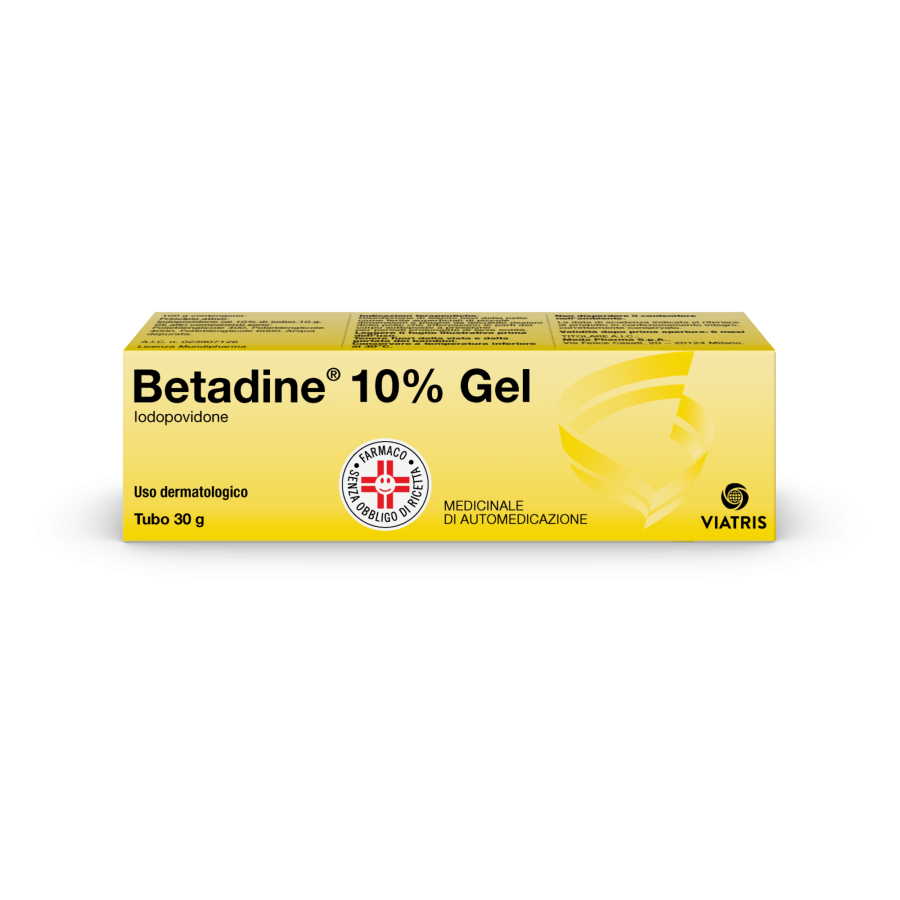
BETADINE 10% Gel
Iodopovidone
What it is and what it is used for
Betadine 10% Gel contains iodopovidone, a disinfectant for topical use.
Betadine 10% Gel is indicated for the disinfection of minor skin lesions such as small superficial wounds and mild pressure sores (skin lesions affecting body parts subjected to prolonged pressure) in adults and children over 6 months of age.
What you need to know before taking the medicine
Do not use Betadine 10% Gel
- If you are allergic to iodopovidone, or any of the other ingredients of this medicine (listed in section 6).
- If you suffer from hyperthyroidism.
- If the child is under 6 months of age.
Warnings and precautions
Talk to your doctor or pharmacist before using Betadine 10% Gel. Betadine 10% Gel is for external use only and should not be applied to severely damaged skin or large areas.
Accidental ingestion or inhalation of some disinfectants can have serious, sometimes fatal, consequences.
Avoid contact with eyes.
Do not use this medicine for prolonged treatments: use, especially if prolonged, of products for topical use may give rise to allergic reactions (see paragraph "Possible side effects"). In this case, stop the treatment and consult your doctor, who will institute appropriate therapy.
Particular caution should be used in patients with pre-existing renal insufficiency who require regular applications of Betadine to damaged skin.
Talk to your doctor if you suffer from thyroid disorders (a gland located at the base of the neck). In this case, your doctor may prescribe specific tests (including scintigraphy) to check thyroid function.
In the case of goiter, thyroid nodules or other acute and non-acute thyroid diseases, hyperthyroidism (hyperfunction of the thyroid) may develop following the administration of large quantities of iodine. Stop treatment at least 10 days before performing a scintigraphy or after scintigraphy with marked iodine (thyroid function test) or in the treatment with radioactive iodine for thyroid carcinoma.
Children and adolescents
In children and adolescents, the use of iodopovidone should be minimized, due to the higher risk of developing thyroid alterations.
Use only if strictly necessary and under medical supervision
Possible side effects
Like all medicines, this medicine can cause side effects, although not everybody gets them.
Side effects are classified according to their frequency:
Very common (> 1/10)
Common (> 1/100 to < 1/10)
Uncommon (> 1/1,000 to < 1/100)
Rare (> 1/10,000 to < 1/1,000)
Very rare (< 1/10,000)
Not known (frequency cannot be estimated from the available data)
| Immune System Disorders | |
| Rare | Hypersensitivity |
| Very rare | Anaphylactic reaction |
| Endocrine disorders | |
| Very rare | Hyperthyroidism* (sometimes with symptoms such as tachycardia or agitation) |
| Not known | Hypothyroidism *** |
| Metabolism and nutrition disorders | |
| Not known | Electrolyte imbalance ** Metabolic acidosis ** |
| Skin and subcutaneous tissue disorders | |
| Rare | Contact dermatitis (with symptoms such as erythema, microvesicles and itching) |
| Very rare | Angioedema |
| Not known | Exfoliative dermatitis |
| Renal and urinary disorders | |
| Not known | Acute renal failure ** Abnormal blood osmolarity ** |
*In patients with a history of thyroid diseases (see section "Warnings and precautions") following high iodine uptake, for example after long-term use of iodopovidone solution for the treatment of wounds and burns on extensive skin areas.
**May occur following the uptake of high quantities of iodopovidone (e.g. in the treatment of burns).
***Hypothyroidism following prolonged or extensive use of iodopovidone.
Reporting of side effects
If you get any side effects, including any not listed in this leaflet, talk to your doctor or pharmacist. You can also report side effects directly via the national reporting system at: https://www.aifa.gov.it/content/segnalazionireazioni-avverse.
By reporting side effects you can help provide more information on the safety of this medicine.