


You will not be allowed to compare more than 4 products at a time
View compareBRUFEN DOLORE*OS 24SACHETS 40MG
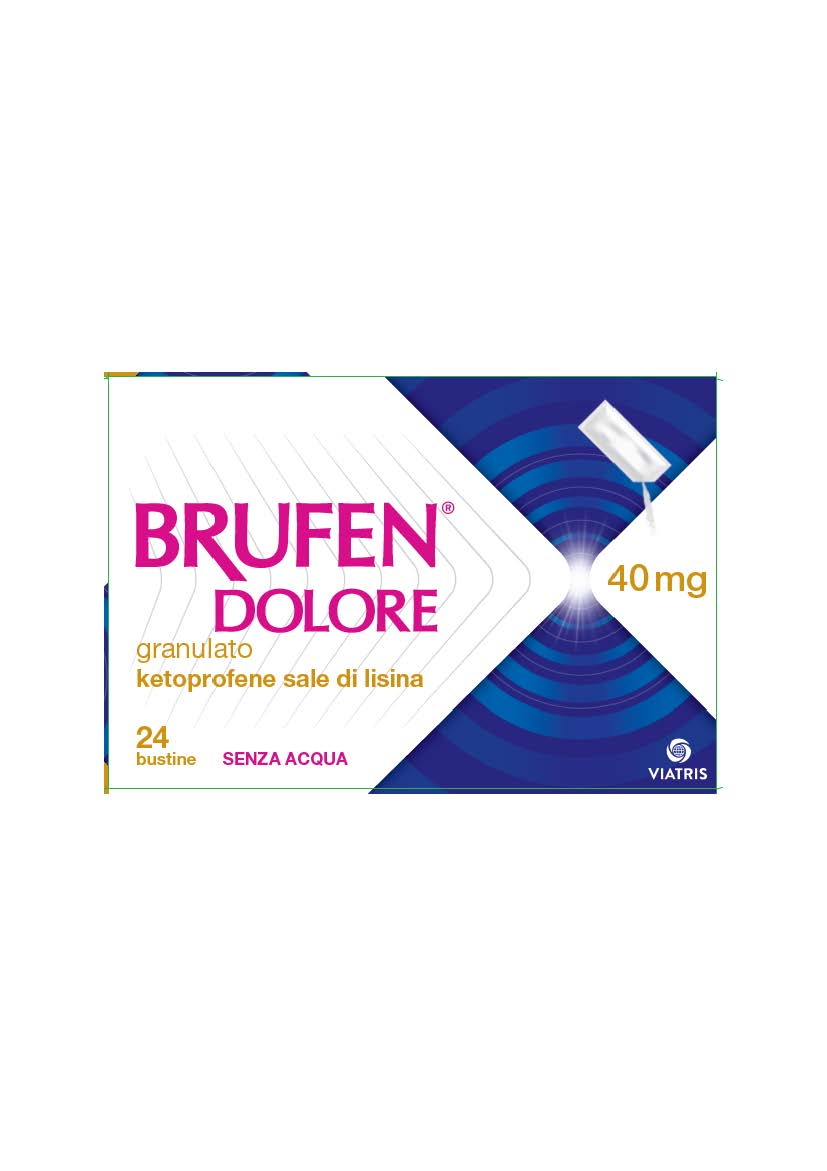
BRUFEN DOLORE*OS 24SACHETS 40MG
Regular price
€4,70 EUR
Sale price
€4,70 EUR
Regular price
€11,40 EUR
Unit price
per
Tax included.
SKU
044356020Low stock
Vendor
MYLAN SpADelivery time: 48/72 hours
Free Shipping: Orders over €70
This product page, including its Product Information Leaflet, has been automatically translated.
Description
BRUFEN DOLORE 40 mg granules
Ketoprofen Lysine Salt
What it is and what it is used for
BRUFEN DOLORE contains the active ingredient ketoprofen, which belongs to a group of medicines called non-steroidal anti-inflammatory drugs ("NSAIDs"), used to relieve pain and inflammation.
BRUFEN DOLORE is indicated in adults and adolescents over 15 years of age for the treatment of mild to moderate acute pain.
What you need to know before taking the medicine
Do not take BRUFEN DOLORE
- if you are allergic to ketoprofen, other non-steroidal anti-inflammatory drugs (NSAIDs) or any of the other ingredients of this medicine (listed in section 6);
- if taking medicines such as acetylsalicylic acid or other non-steroidal anti-inflammatory drugs (NSAIDs) has previously caused you problems such as asthma (asthma attacks), breathing difficulties due to temporary narrowing of the bronchi (bronchospasm) or the presence of polyps inside the nose (nasal polyps), rhinitis (acute rhinitis), allergic skin reactions such as hives or swelling of the face, lips, mouth, tongue or throat which may cause difficulty in swallowing and breathing (angioedema). In this case, a sudden allergic reaction, which can be life-threatening, may occur;
- if you suffer or have suffered from a stomach or intestinal problem (active or recurrent peptic ulcer), or digestive disorders;
- if you suffer or have suffered from bleeding or perforation of the stomach and intestine, including as a result of taking non-steroidal anti-inflammatory drugs (NSAIDs);
- if you have severe heart problems (heart failure);
- if you have severe liver or kidney problems (hepatic or renal insufficiency);
- if you have a predisposition to bleeding (hemorrhagic diathesis) or a problem due to a blood clotting defect or are taking medicines to improve blood fluidity (anticoagulants);
- if you are in the last three months of pregnancy or are breastfeeding (see section "Pregnancy, breastfeeding and fertility");
- if the person who needs to take the medicine is a child or adolescent under 15 years of age.
Warnings and precautions
Talk to your doctor or pharmacist before taking BRUFEN DOLORE.
Take special care with BRUFEN DOLORE if:
- you are taking other non-steroidal anti-inflammatory drugs (NSAIDs), such as aspirin, even at low doses (see section "Other medicines and BRUFEN DOLORE");
- you are elderly, as this increases the possibility of life-threatening lesions or bleeding in the stomach or intestine;
- you suffer or have suffered in the past from stomach and/or intestinal problems (e.g. peptic ulcers, perforation or bleeding from the stomach and intestine). In this case, your doctor may decide to keep you under close observation and treat you with additional medicine to protect your stomach (for example, misoprostol or medicines that block acid production in the stomach);
- you suffer from a disease called systemic lupus erythematosus or a mixed connective tissue disease (immune system disorders affecting connective tissue);
- you suffer from allergies or have had allergic problems in the past;
- you have kidney, liver or heart problems and in the presence of fluid retention, or have suffered from any of these conditions in the past. In these cases, your doctor will need to keep you under close observation;
- you have hepatic porphyria (a rare blood disorder characterized by altered activity of one of the liver enzymes), as the medicine could trigger an attack;
- you have previously suffered from chronic inflammatory bowel disease (ulcerative colitis, Crohn's disease);
- you are taking medicines that may increase the risk of peptic ulcer or bleeding, for example oral corticosteroids, certain antidepressants (selective serotonin reuptake inhibitors) or agents that prevent blood clots from forming such as aspirin or anticoagulants such as warfarin (see section "Other medicines and BRUFEN DOLORE"). In these cases, talk to your doctor before taking BRUFEN DOLORE as you may need to take additional medicine to protect your stomach (for example, misoprostol or medicines that block acid production in the stomach);
- you are a woman with fertility problems and are planning a pregnancy, as this medicine may interfere with your fertility;
- you have heart problems such as heart failure, ischemic heart disease, peripheral arterial disease, previous stroke or think you may be at risk for these conditions (for example, if you have high blood pressure, suffer from diabetes, have high cholesterol levels in your blood or are a smoker). BRUFEN DOLORE may be associated with a slight increase in the risk of heart attack and stroke. This risk is more likely at high doses and for prolonged periods. You should not exceed the recommended dose and duration of treatment;
- you suffer from asthma associated with chronic allergic rhinitis and/or nasal polyps;
- you have an infection - see section
As with other anti-inflammatory drugs, ketoprofen may cause small transient increases in some liver tests and also increases in transaminases; in case of significant increases, discontinue treatment and consult your doctor.
Infections
BRUFEN DOLORE may hide the symptoms of infections such as fever and pain. It is therefore possible that BRUFEN DOLORE may delay adequate treatment of the infection, which could increase the risk of complications. This has been observed in pneumonia caused by bacteria and in bacterial skin infections related to chickenpox. If you take this medicine while you have an infection and the symptoms of the infection persist or worsen, contact your doctor immediately.
Avoid exposure to the sun during treatment with this medicine as your skin may become more sensitive.
Take this medicine at the lowest doses and for short periods of time to reduce the occurrence of side effects.
Stop treatment with this medicine and contact your doctor immediately if
- you experience skin rashes, mucosal lesions or any other sign of hypersensitivity;
- you experience a severe, potentially fatal skin reaction (exfoliative dermatitis, Stevens-Johnson syndrome and toxic epidermal necrolysis);
- you experience eye problems (such as blurred vision);
- you have burning, bleeding or stomach pain.
Children and adolescents
BRUFEN DOLORE should not be administered to children and adolescents under 15 years of age.
Possible side effects
Like all medicines, this medicine can cause side effects, although not everybody gets them.
The most commonly observed side effects are gastrointestinal in nature. Stomach or bowel problems may occur (peptic ulcers, perforation or bleeding from the stomach or intestine which can be life-threatening, particularly in elderly patients).
Tell your doctor immediately if you notice the appearance of side effects in the stomach and/or intestine (stomach pain, burning, bleeding), especially if you are an elderly patient.
Stop taking BRUFEN DOLORE immediately and contact your doctor as soon as you notice the appearance of a skin rash, any lesion inside the mouth or on the genitals or any sign of an allergic reaction.
Side effects that may occur with BRUFEN DOLORE are:
Common (may affect up to 1 in 10 patients)
Nausea, vomiting, indigestion (dyspepsia), abdominal pain/discomfort.
Uncommon (may affect up to 1 in 100 patients)
Headache, dizziness, drowsiness, diarrhea, excessive gas production in the gastrointestinal tract (flatulence), constipation, inflammation of the stomach lining (gastritis), skin rash, itching, swelling due to fluid accumulation (edema), fatigue.
Rare (may affect up to 1 in 1,000 patients)
Reduction in the number of red blood cells due to bleeding (hemorrhagic anemia), tingling and numbness of hands and feet (paresthesia), blurred vision, ringing in the ear (tinnitus), asthma, inflammation of the mouth (ulcerative stomatitis), stomach or intestinal problems (peptic ulcer), liver problems (hepatitis, increased levels of transaminases and bilirubin in the blood), yellowing of the skin and whites of the eyes (jaundice), weight gain.
Frequency not known (frequency cannot be estimated from the available data)
Inflammation of the membranes lining the brain and spinal cord (aseptic meningitis), inflammation of the lymphatic vessels (lymphangitis), reduction in the number of platelets (thrombocytopenia), reduction in the number of white blood cells (agranulocytosis), increase in the number of white blood cells (leukocytosis), reduction in the number of white blood cells (leukopenia), reduction in the number of neutrophils, a type of white blood cell (neutropenia), formation of numerous hemorrhagic spots on the skin due to a reduction in the number of platelets (thrombocytopenic purpura), reduced bone marrow activity (marrow aplasia), destruction of red blood cells (hemolytic anemia), reduced production of red blood cells (aplastic anemia), sudden potentially fatal allergic reaction (including anaphylactic shock), depression, seeing and hearing things that do not exist (hallucinations), mood alteration, hyperexcitability, insomnia, transient loss of consciousness (syncope), convulsions, altered taste (dysgeusia), tremor, involuntary and uncoordinated movements (hyperkinesia), movement disorders (dyskinesia), vertigo, swelling around the eyes due to fluid accumulation (periorbital edema), heart problems (heart failure), awareness of one's own heartbeat (palpitations), accelerated heartbeat (tachycardia), high blood pressure (hypertension), low blood pressure (hypotension), vasodilation, inflammation of the blood vessels (vasculitis), swelling of the larynx, difficulty breathing (bronchospasm), rhinitis (rinitis), shortness of breath (dyspnea), difficulty breathing due to laryngeal contraction (laryngospasm), acute respiratory failure, skin rash (exanthema, maculopapular exanthema), skin inflammation (erythema, dermatitis), excessive sensitivity to light (photosensitivity), hair loss (alopecia), hives, swelling of the face, lips, mouth, tongue or throat that may cause difficulty in breathing and swallowing (angioedema), rare skin condition with blisters and bleeding of the lips, eyes, mouth, nose and genitals (Stevens-Johnson syndrome), severe skin disease (Lyell's syndrome, toxic epidermal necrolysis), worsening of colitis and Crohn's disease (chronic inflammatory bowel diseases), hemorrhage and perforation of the stomach and intestine, stomach or duodenal ulcer, heartburn, stomach ache, damage to the stomach lining without perforation leading to bleeding (erosive gastritis), swelling of the mouth or tongue, pancreatitis, blood in the stools (melena), blood in the vomit (hematemesis), kidney problems such as blood in the urine (hematuria), acute renal failure, tubulointerstitial nephritis, nephritic syndrome, nephrotic syndrome, glomerular nephritis, acute tubular necrosis, renal papillary necrosis, abnormal renal function tests, fluid retention, decreased urine production (oliguria), difficulty urinating (dysuria), chills, fatigue (asthenia), swelling of the extremities (peripheral edema), swelling of the face (facial edema).
Reporting of side effects
If you get any side effects, including any not listed in this leaflet, talk to your doctor or pharmacist. You can also report side effects directly via the national reporting system at: https://www.aifa.gov.it/content/segnalazionireazioni-avverse.
By reporting side effects you can help provide more information on the safety of this medicine.