


You will not be allowed to compare more than 4 products at a time
View compareCELIAC TEST KIT 1 PIECE
CELIAC TEST KIT 1 PIECE
Regular price
€4,00 EUR
Sale price
€4,00 EUR
Regular price
€17,70 EUR
Unit price
per
Tax included.
SKU
942423688Low stock
Delivery time: 48/72 hours
Free Shipping: Orders over €70
This product page, including its Product Information Leaflet, has been automatically translated.
Description
My
Test
Celiac Disease
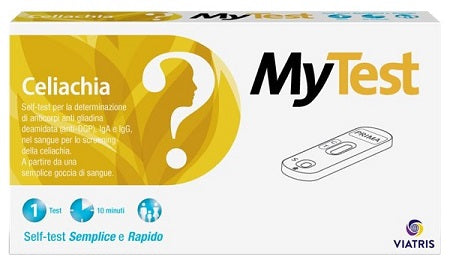
DescriptionRapid immunochromatographic test for the detection of anti-DGP antibodies of both IgA and IgG classes in whole blood for celiac disease screening.
Instructions for use
1) Wash hands with warm water and soap, rinse with clean water and dry, or use the provided cleansing wipe. Note: using warm water facilitates capillary blood collection as it induces vasodilation.
2) Prepare the necessary materials as follows: open the aluminum pouch, take out only the cassette and discard the desiccant sachet. Open the plastic bag containing the pipette. Open the vial by unscrewing the white cap, being careful not to drop it.
3) Carefully rotate the protective cap of the lancing device 360° without pulling it. Remove and discard the released cap.
4) Gently massage the chosen finger phalanx for the puncture (the side of the ring finger is recommended). It is important to massage from the palm of the hand towards the phalanx to improve blood flow. Press the lancing device, from the side where the cap was removed, against the fingertip.
The tip of the lancing device automatically retracts safely after use. If the lancing device does not work correctly, use the second one provided. If the latter is not needed, it can be disposed of without special precautions.
5) Keeping your hand pointing downwards, massage your finger until a large drop of blood forms. It is important to massage from the palm of the hand towards the phalanx to improve blood flow.
6) Take the pipette without pressing the bulb. Two collection methods are suggested:
– hold the pipette horizontally without pressing the bulb and bring it into contact with the drop of blood; the blood will enter automatically by capillarity. Remove the pipette when it reaches the black line. If there is not enough blood, continue massaging the finger until it reaches that line;
- place the pipette on a clean, flat surface with the tip protruding, then bring the drop of blood into contact with the pipette; the blood will enter automatically by capillarity. Remove the finger when it reaches the black line. If there is not enough blood, continue massaging the finger until it reaches that line. Avoid, as much as possible, interrupting contact between the blood and the pipette to prevent air bubbles from forming.
7) Take the previously opened vial and immediately deposit the blood collected with the pipette into it. Press the pipette bulb 2 or 3 times and ensure all the blood has gone into the diluent solution. Then reposition the screw cap on the vial and mix well for at least 10 seconds.
8) Unscrew the blue cap from the dropper bottle (leave the white cap tightly screwed on).
Deposit 3 drops into the well indicated on the cassette.
9) Wait 10 minutes and interpret the results.
Negative result: only one colored line appears under the C (Control) mark. This result indicates that there are no anti-DGP antibodies in the blood or that their level is below the detectable limit of the test.
Positive result: two colored lines appear in the reading window at the T (Test) and C (Control) marks. The intensity of the T line may be less than the C line. The test should therefore be considered positive regardless of the intensity of the T test band. This result indicates the presence of anti-DGP antibodies in the blood and therefore probable celiac disease. You should consult your doctor to continue the diagnostic process.
Invalid result: no lines appear, or only one line appears under the T (Test) mark and not under the C (Control) mark. In this case, it is not possible to interpret the test result, which must be considered invalid; it is recommended to perform a new test.
Warnings
1) Keep the test out of the reach of children.
2) Do not use the test after the expiration date shown on the package or if it is damaged.
3) Follow the procedure exactly, respecting the indicated quantities of blood and diluent.
4) Do not freeze.
5) Use the test and the lancing device only once.
6) The test is for external use only. Do not ingest.
7) In vitro diagnostic device for individual use.
8) Not recommended for use by people taking blood-thinning medications (anticoagulants) or people with hemophilia.
9) After use, dispose of all components according to current local regulations; ask your pharmacist for advice.
Storage
Store the test components at a temperature between +4°C and +30°C.
Format
Hermetically sealed aluminum protective pouch containing: 1 celiac test device and 1 desiccant sachet; 2 sterile lancing devices for self-puncture for blood collection; 1 dropper bottle containing enough celiac test diluent for 1 test; 1 plastic bag containing 1 pipette for blood collection; 1 antiseptic cleansing wipe for the skin and 1 instruction leaflet.