

You will not be allowed to compare more than 4 products at a time
View compareBUSCOPAN COMPOSITUM*20FC TABS
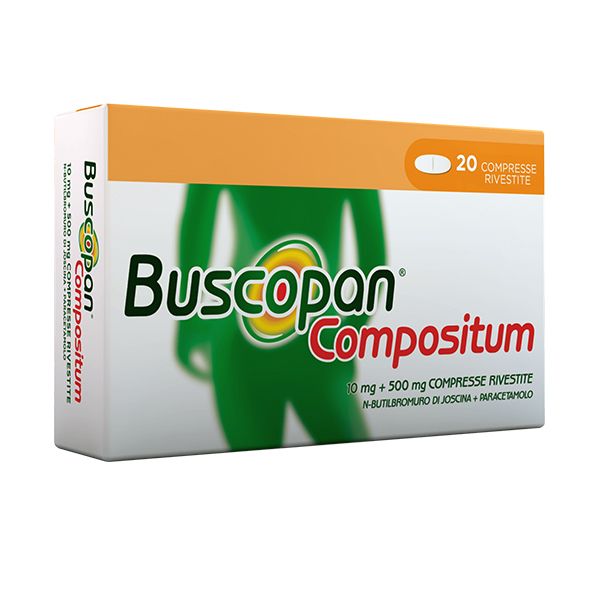
BUSCOPAN COMPOSITUM*20FC TABS
Regular price
€12,38 EUR
Sale price
€12,38 EUR
Regular price
€13,90 EUR
Unit price
per
Tax included.
SKU
029454042In stock
Vendor
OPELLA HEALTHCARE ITALY SrlDelivery time: 48/72 hours
Free Shipping: Orders over €70
This product page, including its Product Information Leaflet, has been automatically translated.
Description
Buscopan Compositum 10 mg + 500 mg film-coated tablets
Hyoscine N-butylbromide + Paracetamol
What it is and what it is used for
Buscopan Compositum contains two active ingredients: hyoscine N-butylbromide (an active ingredient used for motility disorders of the stomach and intestines, or bile ducts) and paracetamol (an active ingredient used to relieve pain).
Buscopan Compositum is indicated for adults and children over 10 years of age in cases of:
• pain and spasms in the stomach and intestines;
• pain due to obstructions in the flow of the bile ducts (where bile, a substance involved in some digestive processes, flows).
Consult your doctor if you do not feel better or if you feel worse after 3 days.
What you need to know before taking the medicine
Do not take Buscopan Compositum
• If you are allergic to hyoscine N-butylbromide or paracetamol or NSAIDs (Non-Steroidal Anti-Inflammatory Drugs, medicines for pain and inflammation) or any of the other ingredients of this medicine (listed in section 6);
• if you suffer from acute angle glaucoma (a severe form of glaucoma, i.e. an eye disease caused by an increase in the pressure of the fluid contained within the eye);
• if you suffer from prostatic hypertrophy (enlargement of the prostate);
• if you suffer from urinary retention (inability of the bladder to empty completely);
• if you suffer from pyloric stenosis (narrowing of the pylorus, the terminal portion of the stomach) or stenosis of other parts of the gastrointestinal tract (narrowing of other areas of the stomach and intestine);
• if you have an intestinal obstruction or suspect you have an intestinal obstruction; if you suffer from intestinal diseases associated with disorders of intestinal movements such as paralytic or obstructive ileus (intestinal obstruction). Symptoms include severe abdominal pain and absence of stool production and/or nausea/vomiting;
• if you suffer from megacolon (dilation of the colon);
• if you suffer from ulcerative colitis (chronic inflammatory bowel disease);
• if you suffer from reflux oesophagitis (a disorder caused by frequent regurgitation of stomach contents into the oesophagus, the tube that carries food to the stomach);
• if you are elderly or if your physical condition is weak and you suffer from intestinal atony (lack of intestinal movements causing intestinal obstruction);
• if you suffer from myasthenia gravis (muscle weakness);
• if you are under 10 years of age;
• if your body does not produce an enzyme called glucose-6-phosphate dehydrogenase (a disease known as favism, which causes the destruction of certain blood cells, red blood cells);
• if you suffer from severe haemolytic anaemia (a disease due to the destruction of red blood cells);
• if you suffer from severe hepatocellular insufficiency (impaired liver function associated with the destruction of liver cells);
• in case of rare hereditary conditions that may be incompatible with an excipient of the product (see Warnings and precautions).
Warnings and precautions
Consult your doctor or pharmacist before taking this medicine.
Contact your doctor immediately if you experience severe abdominal pain that does not go away or worsens or is accompanied by symptoms such as fever, nausea, vomiting, changes in bowel movements, abdominal bloating, decreased blood pressure, fainting, or blood in the stools.
To avoid taking an excessive dose of paracetamol, one of the active ingredients of Buscopan Compositum, you must ensure that you do not take other medicines containing paracetamol at the same time, as taking high doses of paracetamol can lead to serious side effects, see section If you take more Buscopan Compositum than you should.
Do not exceed the recommended doses (see section 3 How to take Buscopan Compositum), as liver damage may occur (see section If you take more Buscopan Compositum than you should).
Buscopan Compositum should be used with caution:
• if your body does not produce sufficient glucose-6-phosphate dehydrogenase (a disease known as favism, which causes the destruction of red blood cells);
• if you suffer from liver diseases such as hepatitis (inflammation of the liver), Gilbert's syndrome (a disease characterised by an excessive increase in bilirubin in the blood), mild or moderate hepatocellular insufficiency (impaired liver function associated with the destruction of liver cells);
• if you have low glutathione reserves;
• if you are currently or have recently been a regular heavy drinker;
• if your kidneys are not functioning well;
• if you are susceptible to closed-angle glaucoma (a severe form of glaucoma, i.e. an eye disease caused by an increase in the pressure of the fluid contained within the eye);
• if you are predisposed to obstructions of the intestinal or urinary tracts;
• if you are predisposed to tachycardia (increased heart rate);
• if you have high blood pressure;
• if you suffer from congestive heart failure (a heart condition);
• if you are prone to hyperthyroidism (exaggerated thyroid functional activity, with high levels of thyroid hormones in circulation);
• if you suffer from chronic obstructive respiratory diseases.
Buscopan Compositum should only be used under medical supervision:
• if you suffer from kidney failure (severe kidney disease);
• if you suffer from liver failure (severe liver disease).
In these conditions, if necessary, your doctor will reduce the dose or prolong the interval between individual administrations.
Severe skin reactions: potentially fatal reactions such as Stevens-Johnson syndrome, toxic epidermal necrolysis, and acute generalized exanthematous pustulosis have been reported with the use of paracetamol. If symptoms or signs of Stevens-Johnson syndrome (SJS), toxic epidermal necrolysis (TEN) or acute generalized exanthematous pustulosis occur (e.g. progressive skin reddening associated with blisters or mucosal lesions), immediately stop treatment with Buscopan Compositum and go to the nearest hospital.
Even if you take paracetamol at the prescribed doses after a short course of treatment and in patients without a previous liver disease, liver damage (hepatotoxicity) may occur (see section Possible side effects).
If you need to take Buscopan Compositum for a prolonged period, you will also need to have the necessary tests to check your blood values and the function of your kidneys and liver, as determined by your doctor.
If you often use pain relievers (analgesics), especially at high doses, you may experience headaches. In this case, you should not increase the dose of the analgesic to treat it.
If you experience allergic reactions after taking Buscopan Compositum (observed very rarely, see section Possible side effects), stop treatment with Buscopan Compositum at the first signs of the allergic reaction and consult your doctor immediately.
Do not take Buscopan Compositum for more than 3 days unless otherwise prescribed by your doctor. If the pain does not go away or worsens, if you experience new symptoms, or if you have redness or swelling, consult your doctor as these could be symptoms of a serious condition.
In addition, consult your doctor before taking any other medicines. See also section Other medicines and Buscopan Compositum.
Children
Buscopan Compositum should not be used in children under 10 years of age.
Possible side effects
Like all medicines, this medicine can cause side effects, although not everybody gets them.
The possible side effects are listed below according to the following frequency:
Uncommon (may affect up to 1 in 100 people)
• skin reactions (skin redness);
• abnormal sweating;
• itching;
• nausea;
• dry mouth.
Rare (may affect up to 1 in 1,000 people)
• shock (decrease in blood pressure with severe reduction in heart function);
• tachycardia (increased heart rate);
• erythema (skin irritation).
Very rare (may affect up to 1 in 10,000 people)
• Stevens-Johnson syndrome and toxic epidermal necrolysis (severe skin diseases characterised by erythema, blistering lesions with areas of skin detachment);
• generalised exanthematous pustulosis (characterised by the appearance of numerous small pustules, burning sensation, widespread itching and high fever);
• skin inflammations (urticaria, skin rash, exanthema).
Frequency not known (frequency cannot be estimated from the available data)
• pancytopenia (reduction in the number of all types of blood cells);
• agranulocytosis (reduction in the number of blood granulocytes, a type of white blood cell);
• thrombocytopenia (reduction in the number of platelets in the blood);
• neutropenia (reduction in the number of neutrophils in the blood, a type of white blood cell);
• leukopenia (reduction in the number of white blood cells in the blood);
• anaemia (reduction of haemoglobin in the blood, a substance that carries oxygen in the blood);
• haemolytic anaemia (excessive destruction of red blood cells);
• increased transaminases in the blood (substances present in the liver whose increase may indicate the presence of liver damage);
• allergic reactions, including severe ones (anaphylactic shock, anaphylactic reactions, drug-induced skin reaction, hypersensitivity), laryngeal oedema (swelling of the larynx, the voice-producing organ in the throat), angioedema (allergic reaction with symptoms such as swelling of the face, tongue or throat, difficulty swallowing, itching, difficulty breathing);
• various types and severity of skin reactions including cases of erythema multiforme (a condition characterised by the appearance of red spots on the skin with a bull's-eye appearance associated with itching) and fixed drug eruption;
• difficulty breathing;
• spasms of the bronchial muscles (especially in those suffering from asthma or allergies);
• urinary retention (inability of the bladder to empty completely);
• kidney disorders: acute kidney failure (rapid reduction in kidney function), interstitial nephritis (inflammation of the kidneys), haematuria (presence of blood in the urine), anuria (cessation or reduction of urine production);
• difficulty urinating;
• sweating;
• mydriasis (pupil dilation);
• visual disturbances (accommodation disorders, i.e. difficulty focusing images, increased ocular tone, i.e. increased pressure of the internal fluid of the eye);
• constipation;
• stomach and intestinal reactions;
• liver disorders (such as hepatitis that can lead to acute liver failure or impaired liver function);
• drowsiness;
• dizziness;
• excess acid in the blood due to too much pyroglutamic acid as a result of low glutathione levels.
Reporting of side effects
If you get any side effects, including any not listed in this leaflet, talk to your doctor or pharmacist. You can also report side effects directly via the national reporting system at: https://www.aifa.gov.it/content/segnalazionireazioni-avverse.
By reporting side effects you can help provide more information on the safety of this medicine.
