

You will not be allowed to compare more than 4 products at a time
View compareCORYFIN SORE THROAT*SPRAY 15ML
CORYFIN SORE THROAT*SPRAY 15ML
Regular price
€6,78 EUR
Sale price
€6,78 EUR
Regular price
€9,50 EUR
Unit price
per
Tax included.
SKU
041827027In stock
Vendor
SIT LABORATORIO FARMAC. SrlDelivery time: 48/72 hours
Free Shipping: Orders over €70
This product page, including its Product Information Leaflet, has been automatically translated.
Description
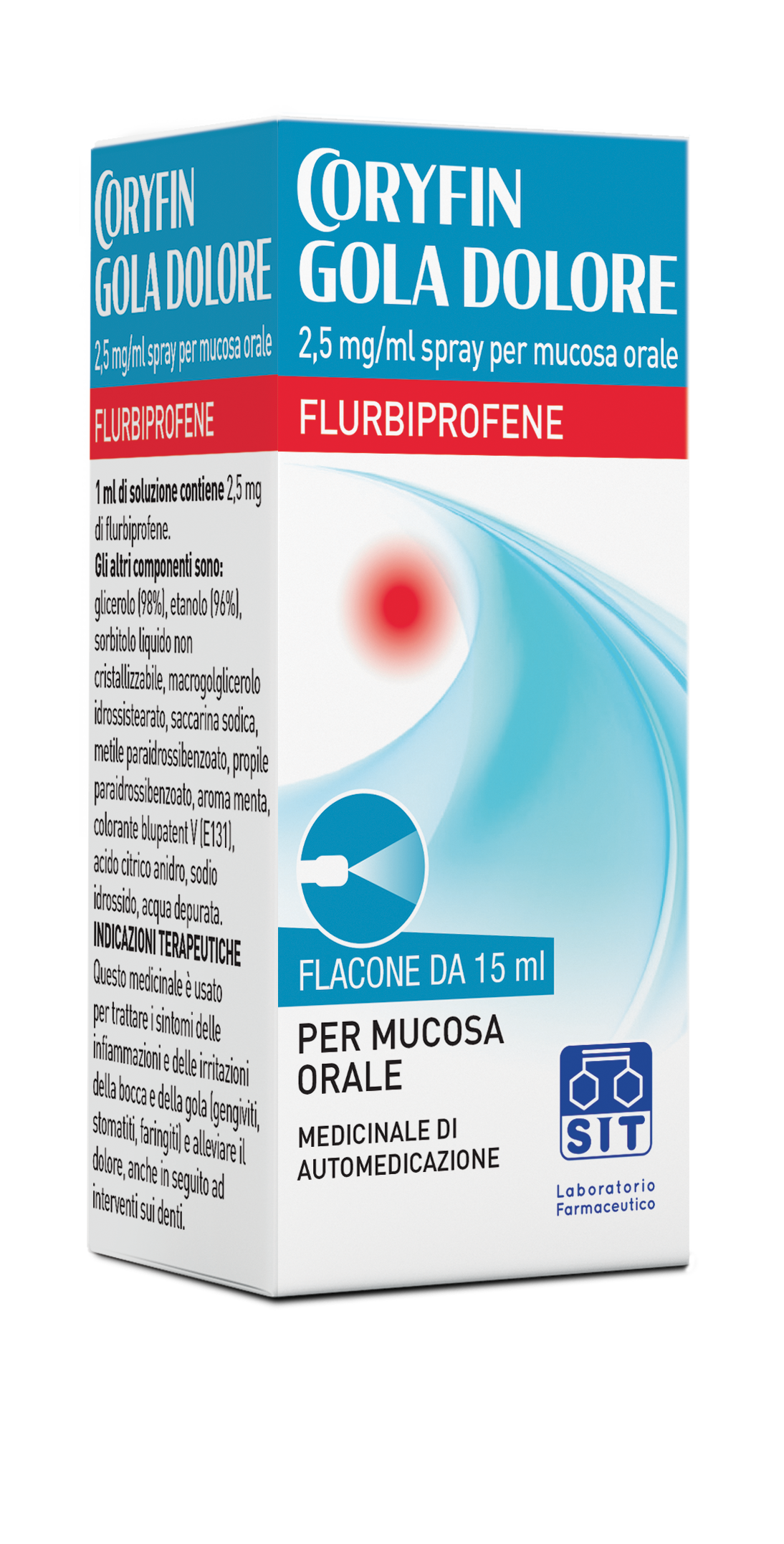
CORYFIN GOLA DOLORE 2.5 mg/ml oral mucosal spray
Flurbiprofen
What it is and what it is used for
CORYFIN GOLA DOLORE contains flurbiprofen, which belongs to the group of medicines called Non-Steroidal Anti-Inflammatory Drugs (or NSAIDs).
NSAIDs act against inflammation and pain.
This medicine is used to treat the symptoms of inflammation and irritation of the mouth and throat (e.g. gingivitis, stomatitis, pharyngitis) and to relieve pain, including after dental procedures.
Consult your doctor if you do not feel better or if you feel worse after a few days (3) of treatment.
What you need to know before taking the medicine
Do not use CORYFIN GOLA DOLORE
- if you are allergic to the active substance or to any of the other ingredients of this medicine (listed in section 6);
- if you are allergic to acetylsalicylic acid (medicine for inflammation, pain, fever and heart disorders) or other non-steroidal anti-inflammatory drugs (NSAIDs) (see section Other medicines and CORYFIN GOLA DOLORE);
- if you have had asthma (difficulty breathing) or skin reactions (e.g. urticaria) after taking acetylsalicylic acid or similar medicines (other NSAIDs). You are probably hypersensitive or allergic to these medicines;
- if you have or have had episodes of ulcer (stomach lesion), perforation or bleeding of the stomach or intestine (two or more distinct episodes of ulcer or bleeding);
- if you have had bleeding or perforation problems of the stomach or intestine related to previous treatments with non-steroidal anti-inflammatory drugs (NSAIDs);
- if you have diseases due to inflammation of the intestine (ulcerative colitis, Crohn's disease);
- if you have severe heart failure (reduced heart function), severe liver failure (reduced liver function) and severe kidney failure (reduced kidney function);
- if you are in the last three months of pregnancy (see section Pregnancy and breastfeeding).
Do not give CORYFIN GOLA DOLORE to children under 12 years of age.
Warnings and precautions
Consult your doctor or pharmacist before using CORYFIN GOLA DOLORE if:
• you are in the first six months of pregnancy;
• you are breastfeeding.
In particular, inform your doctor if:
- you have suffered from bronchial asthma (a breathing disease) in the past, as it increases the risk of bronchospasm (narrowing of the bronchi causing severe respiratory difficulty due to reduced air passage);
- you have suffered from allergies in the past;
- you are taking other Non-Steroidal Anti-Inflammatory Drugs (NSAIDs);
- you suffer from systemic lupus erythematosus or mixed connective tissue disease;
- you suffer from reduced kidney, heart or liver function (kidney, heart or liver failure);
- you suffer from hypertension (high blood pressure);
- you are taking other analgesics for a long time or without respecting the dosage, as headache may occur;
- you have suffered from peptic ulcer (stomach lesion) and other stomach and intestinal diseases in the past, as it increases the risk that these diseases may reappear.
This risk increases especially with high doses of flurbiprofen, if you are elderly or if the peptic ulcer has been complicated by bleeding or perforation of the stomach and intestine (see section 4);
- if you are elderly (as you are more likely to experience side effects);
- if you have heart or blood vessel problems, as medicines like CORYFIN GOLA DOLORE may be associated with a modest increased risk of heart attack (myocardial infarction) or stroke.
The risk of side effects increases with high doses and prolonged treatments; do not exceed the dose of CORYFIN GOLA DOLORE and do not take/give it for long periods. Inform your doctor if you have heart problems, a history of stroke or think you may be at risk for these conditions (for example, if you have high blood pressure, diabetes or high cholesterol or smoke);
- if you have an infection - refer to the Infections section below.
Report any unusual abdominal symptoms to your doctor.
The use, especially if prolonged, of this medicine can give rise to allergic phenomena or local irritation (see section 4 Possible side effects). In such cases, discontinue treatment and consult your doctor who, if necessary, will initiate appropriate therapy.
Infections
Non-steroidal anti-inflammatory drugs (NSAIDs) can mask signs of infections such as fever and pain. This can delay appropriate treatment of the infection, which, in turn, can lead to an increased risk of complications. If you take this medicine during an infection and the infection symptoms persist or worsen, contact your doctor or pharmacist immediately.
Children and adolescents
The use of CORYFIN GOLA DOLORE is contraindicated in children under 12 years of age.
Possible side effects
Like all medicines, this medicine can cause side effects, although not everybody gets them.
If you experience the following side effects while being treated with CORYFIN GOLA DOLORE, STOP treatment and contact your doctor immediately:
• allergic reactions (sensitization phenomena):
- allergic reaction
- anaphylactic reactions (severe allergic reactions)
- angioedema (sudden swelling of the mouth/throat and mucous membranes)
• local irritation;
• respiratory phenomena: asthma, bronchospasm, wheezing or shortness of breath;
• various skin disorders: skin rashes of different types, itching, redness, swelling, skin loss, blisters, desquamation or ulceration of the skin and mucous membranes.
If you experience the following side effects at the beginning of treatment with CORYFIN GOLA DOLORE, contact your doctor immediately:
- abdominal pain;
- peptic ulcer (stomach lesion);
- perforation and bleeding of the stomach or intestine.
These side effects can be fatal and you may experience them with or without warning symptoms. These side effects occur especially if you are elderly or if you have suffered from stomach and intestinal diseases in the past.
In addition, you may experience the following side effects:
Effects affecting the blood
• anaemia (reduction in the number of red blood cells in the blood);
• thrombocytopenia (reduction in the number of platelets in the blood);
• aplastic anaemia (reduction in the number of all types of blood cells, red blood cells, white blood cells, platelets);
• agranulocytosis (reduction in the number of granulocytes, a type of white blood cell, in the blood).
Effects affecting the nervous system
• dizziness;
• headache;
• paraesthesia (numbness of the limbs or other parts of the body);
• somnolence;
• cerebrovascular accidents (diseases caused by lack of blood flow to an area of the brain);
• visual disturbances;
• optic neuritis (severe inflammation of the optic nerve, which can lead to reduced vision up to blindness);
• migraine (chronic disease characterized by recurrent headaches);
• confusion;
• vertigo.
Effects affecting the immune system
• anaphylactic reactions (severe allergic reaction);
• angioedema (inflammatory skin reaction);
• hypersensitivity.
Effects affecting the eye
• visual disturbances.
Effects affecting the ear and labyrinth
• tinnitus (ringing in the ears).
Effects affecting the cardiovascular system
• heart failure;
• swelling;
• hypertension (high blood pressure).
Effects affecting the bronchi and lungs
• throat irritation;
• asthma;
• bronchospasm (narrowing of the bronchi causing severe respiratory difficulty due to reduced air passage);
• dyspnoea (shortness of breath);
• blisters in the mouth or throat;
• numbness of the mouth or throat.
Effects affecting the mouth, stomach and intestine
• diarrhoea;
• lesions inside the mouth;
• nausea;
• mouth and throat pain;
• sensation of warmth or burning, tingling in the mouth;
• abdominal distension;
• abdominal pain;
• constipation;
• dry mouth;
• indigestion;
• flatulence (emission of gas from the intestine);
• tongue inflammation;
• altered taste;
• vomiting;
• blood in faeces;
• blood in vomit;
• bleeding from the stomach and intestine;
• colitis;
• worsening of inflammatory bowel diseases (Crohn's disease);
• stomach inflammation (gastritis);
• pancreatitis (inflammation of the pancreas);
• peptic ulcer;
• gastric perforation.
Effects affecting the skin and underlying tissue
• skin rashes;
• itching;
• urticaria (skin redness accompanied by itching);
• purpura (appearance of purplish skin patches of different sizes);
• bullous dermatoses (severe skin lesions characterized by erythema, bullous lesions with areas of skin detachment), including Stevens-Johnson Syndrome, Toxic Epidermal Necrolysis and Erythema multiforme.
Effects affecting the kidneys and urinary tract
• renal toxicity;
• tubulointerstitial nephritis (inflammation of the kidneys);
• nephrotic syndrome (alteration of the renal glomeruli leading to protein loss in the urine);
• renal failure (reduced kidney function).
General effects and effects at the administration site
• fever;
• pain;
• discomfort, local irritation;
• fatigue.
Effects affecting the liver
• hepatitis.
Effects affecting the psychiatric sphere
• insomnia;
• depression;
• hallucination.
Reporting of side effects
If you get any side effects, including any not listed in this leaflet, talk to your doctor or pharmacist. You can also report side effects directly via the national reporting system at: https://www.aifa.gov.it/content/segnalazionireazioni-avverse.
By reporting side effects you can help provide more information on the safety of this medicine.
