

You will not be allowed to compare more than 4 products at a time
View compareCORYFIN COUGH EXPECTORANT*SYR200ML
CORYFIN COUGH EXPECTORANT*SYR200ML
Regular price
€5,46 EUR
Sale price
€5,46 EUR
Regular price
€10,90 EUR
Unit price
per
Tax included.
SKU
025311022In stock
Vendor
SIT LABORATORIO FARMAC. SrlDelivery time: 48/72 hours
Free Shipping: Orders over €70
This product page, including its Product Information Leaflet, has been automatically translated.
Description
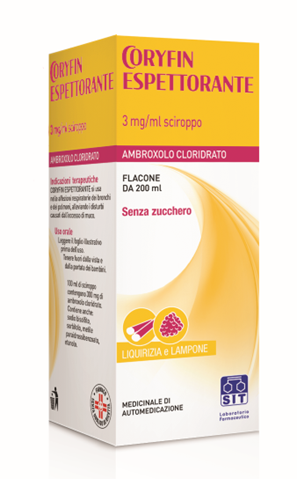
CORYFIN ESPETTORANTE 3 mg/ml syrup
Ambroxol hydrochloride
What it is and what it is used for
CORYFIN ESPETTORANTE contains ambroxol hydrochloride, a substance belonging to the group of mucolytic drugs. It works by thinning the mucous secretions of the respiratory tract. By reducing the viscosity of mucus, these medicines facilitate its elimination from the body.
CORYFIN ESPETTORANTE is used in respiratory conditions of the bronchi and lungs, alleviating the discomfort caused by excess mucus.
Consult your doctor if you do not feel better or if you feel worse.
What you need to know before taking the medicine
Do not take CORYFIN ESPETTORANTE
- if you are allergic to the active substance or any of the other ingredients of this medicine (listed in section 6);
- if you have severe liver or kidney problems;
- in children under 2 years of age.
Warnings and precautions
Consult your doctor or pharmacist before taking CORYFIN ESPETTORANTE:
- if you have a stomach ulcer (mucosal lesion);
- if you have impaired kidney function;
- during the first three months of pregnancy or if you are breastfeeding.
Severe skin reactions associated with ambroxol administration have been reported.
Stevens-Johnson syndrome and Toxic Epidermal Necrolysis
Severe skin reactions (Stevens-Johnson syndrome and toxic epidermal necrolysis) have been reported with the use of this medicine. If you develop a skin rash (including lesions of mucous membranes such as the mouth, throat, nose, eyes, genitals), stop taking CORYFIN ESPETTORANTE and contact your doctor immediately. These severe skin reactions are often preceded by flu-like symptoms such as fever, chills, rhinitis, and sore throat. The rash may progress with the appearance of widespread blistering and skin exfoliation (see section 4 Possible side effects).
Children
Do not use this medicine in children under 2 years of age, as their respiratory tract is not yet mature and this medicine can cause an obstruction of their bronchi (bronchial obstruction), causing difficulty breathing (see section 2 Do not take CORYFIN ESPETTORANTE).
Possible side effects
Like all medicines, this medicine can cause side effects, although not everybody gets them.
Stop taking this medicine and tell your doctor immediately if you:
• experience difficulty breathing, swelling of the face and lips, tongue and other parts of the body.
These may be symptoms of anaphylactic shock (a severe allergic reaction);
• experience any changes in your skin, for example mouth ulcers, sore throat, nose, genitals and conjunctivitis (red and swollen eyes), widespread blistering and skin exfoliation.
These may be symptoms of severe skin reactions called Stevens-Johnson syndrome and toxic epidermal necrolysis (see section 2 Warnings and precautions).
The following side effects have also been reported with the use of this medicine:
Common (may affect up to 1 in 10 people):
• altered taste sensation (dysgeusia);
• nausea;
• reduced sensitivity of the mouth (oral hypoesthesia);
• reduced sensitivity in the throat (pharyngeal hypoesthesia).
Uncommon (may affect up to 1 in 100 people):
• vomiting, diarrhoea, indigestion (dyspepsia), abdominal pain, dry mouth.
Rare (may affect up to 1 in 1000 people):
• hypersensitivity reactions;
• rash, urticaria;
• skin eruptions, sudden appearance of raised, itchy hives that may be pale, pink or distinctly red (urticaria).
Not known (frequency cannot be estimated from the available data):
• anaphylactic reactions including anaphylactic shock, angioedema (rapidly developing swelling of the skin, subcutaneous tissues, mucosa and submucosal tissues) and itching;
• severe cutaneous adverse reactions (including erythema multiforme, Stevens-Johnson syndrome/toxic epidermal necrolysis and acute generalised exanthematous pustulosis);
• dry throat;
• difficulty breathing due to excessive mucus production that clogs the bronchi (bronchial obstruction).
A burning sensation rising from the stomach to the throat (heartburn) has also been reported with the use of this medicine.
Reporting of side effects
If you get any side effects, including any not listed in this leaflet, tell your doctor or pharmacist. You can also report side effects directly via the national reporting system at: https://www.aifa.gov.it/content/segnalazionireazioni-avverse.
By reporting side effects you can help provide more information on the safety of this medicine.