

You will not be allowed to compare more than 4 products at a time
View compareREGOLINT*OS POWDER 20SACHETS 9.7G
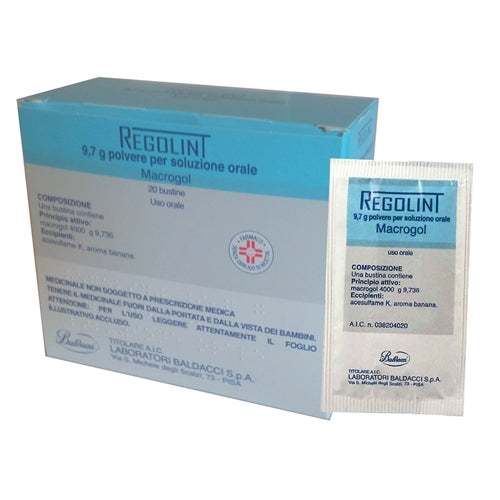
REGOLINT*OS POWDER 20SACHETS 9.7G
Regular price
€13,38 EUR
Sale price
€13,38 EUR
Regular price
€14,20 EUR
Unit price
per
Tax included.
SKU
038204020In stock
Vendor
LABORATORI BALDACCI SpADelivery time: 48/72 hours
Free Shipping: Orders over €70
This product page, including its Product Information Leaflet, has been automatically translated.
Description
Regolint 9.7 g powder for oral solution
Macrogol 4000
What it is and what it is used for
REGOLINT contains the active ingredient macrogol 4000, which belongs to a group of medicines called osmotic laxatives. These act by drawing water into the intestine and facilitating the formation of soft stools.
This medicine is indicated for the short-term treatment of occasional constipation.
Consult your doctor if you do not feel better or if you feel worse after a few days.
What you need to know before taking the medicine
Do not use REGOLINT if:
- you are allergic to macrogol 4000 or any of the other ingredients of this medicine (listed in section 6);
- you suffer from severe inflammatory bowel diseases (such as ulcerative colitis, Crohn's disease, or toxic megacolon associated with symptomatic stenosis);
- you experience acute or unknown abdominal pain;
- you show a marked increase or decrease in bowel activity (peristalsis), nausea or vomiting, rectal bleeding;
- you have an obstruction (ileus) or suspected obstruction, a narrowing (stenosis) or perforation, or risk of perforation of the intestine;
- you are in a condition characterized by excessive fluid loss (severe dehydration).
Warnings and precautions
Talk to your doctor or pharmacist before taking REGOLINT.
Before starting treatment, consult your doctor, who must ensure that your constipation is not due to other diseases. If you suffer from chronic or recurrent constipation, consult your doctor, who will recommend appropriate therapy and monitor you.
Also consult your doctor if the need for a laxative arises from any of the following conditions:
- your bowel habits (frequency and characteristics of bowel movements) have changed suddenly for more than 2 weeks;
- the laxative does not produce effects.
If you suffer from constipation, first correct your eating habits and adopt a healthy lifestyle, following a balanced diet rich in water and fiber and engaging in physical activity.
Immediately stop treatment and inform your doctor if you experience allergic reactions such as skin irritation (rash, hives), swelling of the face, lips, throat and/or tongue (edema), and severe allergic reactions (anaphylactic shock).
Do not use laxative medicines if you suffer from acute or unknown abdominal pain, nausea or vomiting, marked increase or decrease in peristalsis, rectal bleeding. In these cases, consult your doctor, who will tell you if you suffer from diseases in which the use of laxatives is contraindicated (for example: intestinal obstruction or suspected obstruction, intestinal stenosis or perforation, paralytic ileus, severe inflammatory bowel diseases).
After about 3 months of treatment, it is recommended to consult your doctor, as specific checks are necessary to establish appropriate therapy.
If you take laxatives frequently, for a long time, or in high doses, you may experience persistent diarrhea with consequent loss of water, mineral salts (especially potassium), and other essential nutrients. In the most severe cases, excessive fluid loss (dehydration) may occur, accompanied by low potassium levels in the blood (hypokalemia), which can cause problems with heart, nerve, and muscle function (cardiac or neuromuscular dysfunctions). These effects can occur especially if you simultaneously take medicines that increase heart contraction force (cardiac glycosides), facilitate urine elimination (diuretics), or treat allergies and inflammations (corticosteroids).
Use caution and inform your doctor if:
- you suffer from liver problems (hepatic insufficiency);
- you suffer from kidney problems (renal insufficiency);
- you have heart problems (heart failure);
- you are elderly.
In these cases, your doctor should periodically check your blood salt levels (serum electrolytes).
If you take laxatives excessively or incorrectly (abuse), especially certain types of laxatives (stimulant laxatives), you may develop dependence (possible need to progressively increase the dose of medicine), chronic constipation, and loss of normal bowel function (intestinal atony).
Health education notes
First of all, it should be kept in mind that, in most cases, a balanced diet rich in water and fiber (bran, vegetables and fruit) can permanently solve the problem of constipation.
Many people think they suffer from constipation if they do not have a bowel movement every day.
This is a mistaken belief, as this situation is completely normal for a large number of individuals.
Instead, constipation occurs when bowel movements are reduced compared to one's personal habits and are associated with the passage of hard stools.
If episodes of constipation occur repeatedly, a doctor should be consulted.
Children
In children, treatment with REGOLINT can only be started after consulting a doctor.
Possible side effects
Like all medicines, this medicine can cause side effects, although not everybody gets them.
The side effects that can occur are generally mild and temporary and mainly affect the gastrointestinal system. In case of hypersensitivity reactions, stop taking the medicine and consult a doctor immediately:
Common (may affect up to 1 in 10 people)
- abdominal pain;
- abdominal bloating (abdominal distension);
- diarrhea;
- nausea.
Uncommon (may affect up to 1 in 100 people)
- vomiting;
- urgency to defecate;
- difficulty holding back stool (faecal incontinence);
- irritation of the last part of the intestine (rectal irritation).
Very rare (may affect up to 1 in 10,000 people)
- allergic (hypersensitivity) reactions such as itching, skin irritation (rashes, hives), swelling due to fluid accumulation (edema) localized especially to the face, lips and throat or hands (edema, facial edema, angioedema), difficulty breathing, severe allergic reaction that can lead to death (anaphylactic shock).
Frequency not known (frequency cannot be estimated from the available data)
- alteration of body salt levels, such as reduced sodium and potassium levels in the blood (hyponatremia, hypokalemia);
- excessive fluid loss (dehydration), especially in elderly people.
Additional side effects in children
As in adults, reported adverse reactions are generally mild and temporary and mainly affect the gastrointestinal system. In case of hypersensitivity reactions, stop taking the medicine and consult a doctor immediately:
Common (may affect up to 1 in 10 people)
- abdominal pain;
- diarrhea, which can cause pain in the area near the anus (perianal).
Uncommon (may affect up to 1 in 100 people)
- vomiting;
- abdominal bloating (abdominal distension);
- nausea;
- irritation of the last part of the intestine (rectum).
Frequency not known (frequency cannot be estimated from the available data)
- allergic (hypersensitivity) reactions.
Reporting of side effects
If you get any side effects, including any not listed in this leaflet, talk to your doctor or pharmacist. You can also report side effects directly via the national reporting system at: https://www.aifa.gov.it/content/segnalazionireazioni-avverse.
By reporting side effects, you can help provide more information on the safety of this medicine.
