

You will not be allowed to compare more than 4 products at a time
View compareRINOFLUIMUCIL NASAL SPRAY 10ML
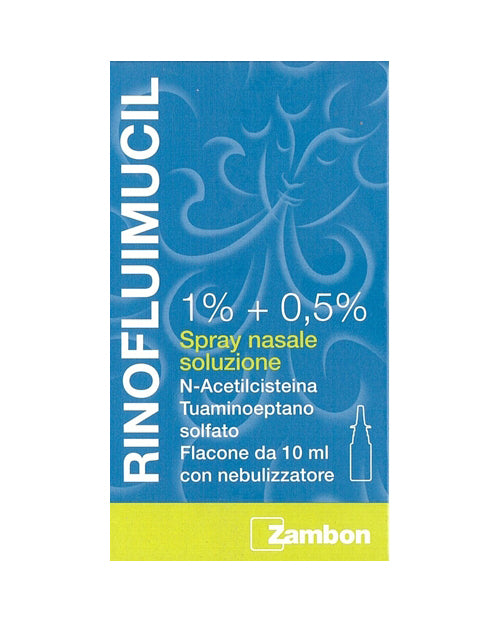
RINOFLUIMUCIL NASAL SPRAY 10ML
Regular price
€5,25 EUR
Sale price
€5,25 EUR
Regular price
€9,20 EUR
Unit price
per
Tax included.
SKU
021993050Low stock
Vendor
ZAMBON ITALIA SrlDelivery time: 48/72 hours
Free Shipping: Orders over €70
This product page, including its Product Information Leaflet, has been automatically translated.
Description
Rinofluimucil 1% + 0.5% nasal spray solution
N-acetylcysteine + tuaminoheptane sulfate
What it is and what it is used for
Rinofluimucil contains the active ingredients N-acetylcysteine, which belongs to a group of medicines called mucolytics used to thin nasal mucus, and tuaminoheptane sulfate, which belongs to a group of medicines called vasoconstrictors used as nasal decongestants.
This medicine is used for the treatment of inflammation of the nasal mucosa (acute and subacute rhinitis, with mucopurulent exudates and slow resolution, chronic and muco-crusted rhinitis, vasomotor rhinitis) and paranasal sinuses (sinusitis).
Consult your doctor if you do not feel better or if you feel worse after one week of treatment.
What you need to know before taking the medicine
Do not use Rinofluimucil
- if you are allergic to N-acetylcysteine or tuaminoheptane sulfate or any of the other ingredients of this medicine (listed in section 6);
- if you have a heart and/or blood vessel disease, including high blood pressure (hypertension);
- if you have previously suffered from a cerebrovascular disease;
- if you have previously suffered from seizures;
- if you have an eye disease with elevated pressure inside the eye (narrow-angle glaucoma);
- if you have excessive production of thyroid hormones (hyperthyroidism);
- if you are being treated with medicines for depression (selective monoamine oxidase inhibitors) or within two weeks after stopping such treatment (see “Other medicines and Rinofluimucil”);
- if you are using other sympathomimetic medicines, including other nasal decongestants (see “Other medicines and Rinofluimucil”);
- if you have a rare tumor of the adrenal gland called pheochromocytoma;
- if your pituitary gland has been surgically removed (hypophysectomy) or you have undergone surgery involving exposure of the external membrane covering the brain (dura mater);
- if you are under 12 years of age (see “Children and adolescents”).
Warnings and precautions
Consult your doctor or pharmacist before using Rinofluimucil.
Stop treatment in case of high blood pressure (arterial hypertension), accelerated heartbeat (tachycardia), palpitations, heart rhythm disturbances, nausea or any neurological signs and symptoms (such as a headache or a worsening of an existing headache).
In children over 12 years of age, the product should be used only if strictly necessary and under medical supervision.
Use this medicine only after consulting your doctor
- If you are elderly or if you suffer from an enlarged prostate (prostatic hypertrophy), due to the risk of inability or reduced ability to empty the bladder (urinary retention),
- if you have heart and/or blood vessel problems, especially high blood pressure,
- if you suffer from asthma, diabetes, blood vessel obstruction (occlusive vascular disease) or if you are being treated with beta-blockers, used in the treatment of certain cardiovascular conditions,
Consult your doctor even if these disorders have occurred in the past.
Prolonged use of medicines containing substances that act on blood vessels (vasoconstrictors) can alter the normal function of the nasal and paranasal sinus mucosa, also inducing tolerance to the medicine (habituation).
Repeated applications for long periods can be harmful.
Prolonged use can cause swelling of the nasal mucosa.
The action of the medicine can be supplemented, at the doctor's discretion, with appropriate antibacterial coverage.
Rinofluimucil is not an eye medicine.
Attention for those who practice sports:
- the product contains substances prohibited for doping. Any intake different, in terms of dosage regimen and route of administration, from those reported is prohibited.
- the use of medicines containing ethyl alcohol can lead to positive anti-doping tests in relation to the alcohol concentration limits indicated by some sports federations.
Children and adolescents
This medicine is contraindicated in children under 12 years of age (see “Do not use Rinofluimucil”).
In children and adolescents over 12 years of age, the medicine should be used only if strictly necessary and under medical supervision.
Possible side effects
Like all medicines, this medicine can cause side effects, although not everybody gets them.
The medicine can locally cause allergic phenomena (sensitization) and mucosal congestion as a consequence of a phenomenon known as "rebound effect" (reappearance of symptoms after pharmacological treatment has been suspended).
Frequent administrations of the medicine at higher doses can cause sympathomimetic side effects (such as increased excitability, palpitations, tremor, etc.). Sometimes dryness of the nose and throat and acneiform eruptions may occur. These effects disappear with the suspension of treatment.
Side effects with unknown frequency (frequency cannot be estimated from the available data):
- hypersensitivity,
- high blood pressure (hypertension),
- nausea,
- urticaria,
- appearance of red spots or patches on more or less extensive areas of the skin (rash),
- inability or reduced ability to empty the bladder (urinary retention).
Particularly with prolonged and/or excessive use:
- anxiety,
- hallucination,
- delirium,
- headache,
- restlessness,
- agitation,
- insomnia,
- tremor,
- palpitations,
- accelerated heartbeat (tachycardia),
- irregular heartbeat (arrhythmia),
- dry nose and throat,
- nasal discomfort and congestion,
- irritability,
- tolerance to the medicine (habituation).
Adhering to the information contained in the package leaflet reduces the risk of side effects. These side effects are generally temporary.
Reporting of side effects
If you get any side effects, including any not listed in this leaflet, tell your doctor or pharmacist. You can also report side effects directly via the national reporting system at: https://www.aifa.gov.it/content/segnalazionireazioni-avverse.
By reporting side effects you can help provide more information on the safety of this medicine.