

You will not be allowed to compare more than 4 products at a time
View compareRINOGUTT*NASAL SPRAY 10ML EU
RINOGUTT*NASAL SPRAY 10ML EU
Regular price
€8,37 EUR
Sale price
€8,37 EUR
Regular price
€9,90 EUR
Unit price
per
Tax included.
SKU
023547060In stock
Vendor
OPELLA HEALTHCARE ITALY SrlDelivery time: 48/72 hours
Free Shipping: Orders over €70
This product page, including its Product Information Leaflet, has been automatically translated.
Description
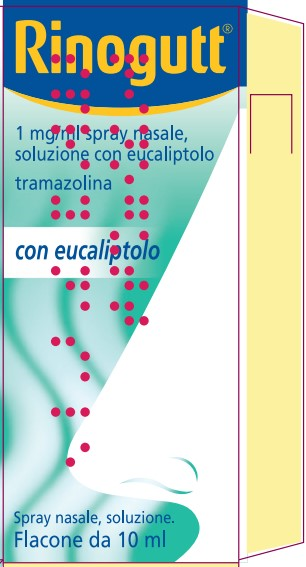
Rinogutt 1 mg/ml nasal spray solution with eucalyptol
Tramazoline
What it is and what it is used for
Rinogutt contains tramazoline.
Rinogutt is used in adults and adolescents aged 12 and over as a nasal decongestant, meaning to relieve blocked nose due to swelling of the nasal mucosa.
Consult your doctor if you do not feel better or if you feel worse after 4 days.
What you need to know before taking the medicine
Do not use Rinogutt
- if you are allergic to tramazoline or any of the other ingredients of this medicine, especially benzalkonium chloride (listed in section 6);
- if you suffer from dryness of the nasal cavities (rhinitis sicca);
- if you suffer from heart disease and severe high blood pressure;
- if you suffer from a form of glaucoma, i.e., a disease characterized by increased fluid pressure inside the eye (acute angle-closure glaucoma);
- if you suffer from a thyroid disease that can lead to weight loss, fatigue, weakness (hyperthyroidism);
- if you suffer from an enlarged prostate, the gland in men that produces seminal fluid (prostatic hypertrophy);
- if you have undergone head surgery performed transnasally;
- if you are under 12 years of age;
- if you are pregnant or breastfeeding (see section “Pregnancy and breastfeeding”).
Warnings and precautions
Consult your doctor or pharmacist before using Rinogutt:
- if you are taking monoamine oxidase inhibitors (MAOIs) or tricyclic antidepressants (medicines to treat depression);
- if you are taking vasopressor and antihypertensive medicines (medicines to treat heart disease and high blood pressure) (see section “Other medicines and Rinogutt”).
Use Rinogutt only after consulting your doctor:
- if you are elderly;
- if you suffer from pheochromocytoma (a tumor of the adrenal glands that causes an increase in blood pressure);
- if you suffer from porphyria (a disease that interferes with the production of hemoglobin, a substance that allows red blood cells to carry oxygen in the blood, whose symptoms include excessive light sensitivity, paralysis, and severe stomach pain).
Be very careful if you suffer from heart and circulatory diseases, high blood pressure, diabetes mellitus, and enlarged prostate (prostatic hypertrophy) (see section “Do not use Rinogutt”).
Consult your doctor even if these disorders have occurred in the past.
Do not use Rinogutt orally.
Avoid contact of the liquid with the eyes to prevent irritation.
Children
Do not give this medicine to children under 12 years of age.
Possible side effects
Like all medicines, this medicine can cause side effects, although not everybody gets them.
If you use Rinogutt for long periods, it can be harmful. The use, especially if prolonged, of locally administered products can lead to irritation, inflammation, and thinning of the nasal mucosa; in this case, stop the treatment and consult your doctor to establish appropriate therapy.
Prolonged use can also lead to drug addiction.
When the effect of the drug ceases, swelling of the nasal mucosa (nasal edema) may occur.
The following side effects may occur after using Rinogutt:
Common (may affect up to 1 in 10 people)
- burning inside the nose.
Uncommon (may affect up to 1 in 100 people):
- restlessness;
- headache;
- sensation of increased heart rate (palpitations);
- swelling of the nasal mucosa (nasal edema);
- nasal dryness;
- runny nose (rhinorrhea);
- sneezing;
- nausea.
Rare (may affect up to 1 in 1,000 people):
- dizziness;
- altered taste (dysgeusia);
- nosebleed (epistaxis).
Frequency not known (frequency cannot be estimated from the available data):
- allergy (hypersensitivity);
- perception of nonexistent things in reality (hallucinations);
- insomnia;
- drowsiness;
- physical and mental relaxation (sedation);
- heart rhythm disturbances (arrhythmias);
- increased heart rate (tachycardia);
- skin rash;
- itching;
- skin swelling (cutaneous edema*);
- mucous membrane swelling (mucosal edema*);
- increased blood pressure;
- fatigue.
* as a symptom of hypersensitivity.
Reporting of side effects
If you get any side effects, including any not listed in this leaflet, talk to your doctor or pharmacist. You can also report side effects directly via the national reporting system at: https://www.aifa.gov.it/content/segnalazionireazioni-avverse.
By reporting side effects, you can help provide more information on the safety of this medicine.
