

You will not be allowed to compare more than 4 products at a time
View compareSCEVADIL*SUN CUT3FL60ML50MG/ML
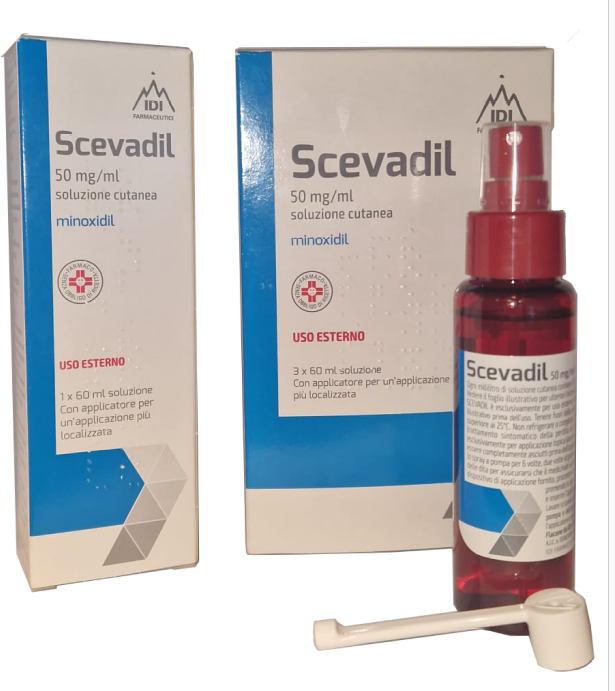
SCEVADIL*SUN CUT3FL60ML50MG/ML
Regular price
€62,26 EUR
Sale price
€62,26 EUR
Regular price
€68,70 EUR
Unit price
per
Tax included.
SKU
050655048In stock
Vendor
IDI FARMACEUTICI SrlDelivery time: 48/72 hours
Free Shipping: Orders over €70
This product page, including its Product Information Leaflet, has been automatically translated.
Description
SCEVADIL, 50 mg/ml, cutaneous solution
Minoxidil
What it is and what it is used for
SCEVADIL is a cutaneous solution containing the active ingredient minoxidil for the symptomatic treatment of androgenetic hair loss in men aged 18 to 55 years.
In men, SCEVADIL stabilises the course of androgenetic hair loss (androgenetic alopecia) in the vertex area of the scalp. The treatment can therefore counteract the progression of androgenetic hair loss.
The mechanism of action through which minoxidil and/or its metabolite stimulates hair growth is not yet clear. However, minoxidil is believed to act on hair follicles by increasing blood flow to the scalp through local vasodilation.
The onset and extent of this effect may vary from one individual to another and cannot be predicted.
SCEVADIL is for external use only and should only be applied to the scalp.
What you need to know before taking the medicine
Do not use SCEVADIL
- if you are allergic to minoxidil or any of the other ingredients of this medicine (listed in section 6);
- if you are a woman, as cosmetically distressing, reversible signs of facial hair growth may occur during treatment;
- if you are using any other medicine on your scalp;
- if you use any type of bandage or dressing on your scalp;
- if you suffer from sudden or irregular hair loss;
- if you have any condition affecting the scalp, including psoriasis (a skin disease with inflammation and itching), sunburn, shaved scalp or if your scalp skin is damaged by scars or burns, as hair follicles are not present;
- if you show signs of cardiovascular diseases or heart rhythm problems such as coronary artery disease, arrhythmias, congestive heart failure or valvular heart disease;
- if you have high blood pressure (arterial hypertension);
- if you are taking medicines to treat high blood pressure.
Warnings and precautions
Apply SCEVADIL to a normal and healthy scalp. You must not use SCEVADIL if the cause of hair loss is unknown or if the scalp is red, inflamed or sore.
There is no clinical experience to date on the efficacy on hair loss in the temporal region (receding hairline).
SCEVADIL is for external use only on the scalp. Do not apply to other parts of the body.
Pay particular attention if you have or have had cardiovascular disease or a heart arrhythmia such as tachycardia, chest pain, loss of consciousness, dizziness, unexplained weight loss or signs of fluid retention (swelling of the hands or feet). In such conditions, you must not use this medicine (see section Do not use SCEVADIL).
Patients with low blood pressure should contact their doctor before using topical minoxidil and should be monitored at the start of treatment and subsequently at regular intervals.
You should stop using SCEVADIL and consult your doctor if:
- it is found that you have low blood pressure;
- you have high blood pressure;
- you are taking medicines to treat high blood pressure;
- if one or more of the following symptoms appear: chest pain, faster heartbeat, weakness or dizziness, sudden and unexplained weight loss, swelling of the hands or feet, persistent redness or irritation of the scalp or if new unexpected symptoms occur (see section If you use more SCEVADIL than you should).
Transfer of the product to areas other than the scalp may cause unwanted hair growth.
Isolated cases of slight changes in hair colour have been reported by patients with very light hair in conjunction with the use of hair care products or after swimming in water with high chlorine content.
Accidental ingestion can cause severe cardiovascular adverse reactions. Therefore, you must keep this medicine out of the reach of children.
Avoid inhaling the nebulised spray.
Since SCEVADIL contains alcohol and propylene glycol, it can cause burning and/or irritation in case of accidental contact with sensitive areas (eyes, mucous membranes, abraded skin). In these cases, the affected area should be rinsed with plenty of running water. If burning and/or irritation persist, medical attention should be sought.
Children and adolescents
Do not apply SCEVADIL to children and adolescents under 18 years of age, as safety and efficacy in this age group have not been established.
Possible side effects
Like all medicines, SCEVADIL can cause side effects, although not everybody gets them.
Contact your doctor as soon as possible if you experience any of the following side effects - you may need urgent medical treatment.
- swelling of the face, lips or throat which may make swallowing or breathing difficult. This may be a sign of a severe allergic reaction (frequency not known, cannot be estimated from the available data)
- generalised skin redness (frequency not known, cannot be estimated from the available data)
- generalised itching (frequency not known, cannot be estimated from the available data)
- narrowing of the throat (frequency not known, cannot be estimated from the available data)
Very common (may affect more than 1 in 10 people):
- Headache.
Common (may affect up to 1 in 10 people):
- Itching;
- Increased hair growth beyond the scalp (including facial hair growth in women), inflammatory skin reaction (including acne-like rash, skin rash);
- Shortness of breath, breathing difficulties;
- Swollen legs and arms;
- Weight gain;
- High blood pressure;
- Scalp irritation with stinging, burning, itching, dryness, flaking and folliculitis.
Uncommon (may affect up to 1 in 100 people):
- Dizziness, nausea.
Not known (frequency cannot be estimated from the available data):
- Allergic dermatitis (skin inflammation related to an allergy);
- Depressed mood;
- Eye irritation;
- Rapid heartbeat, palpitations, low blood pressure;
- Vomiting;
- Symptoms at the administration site that may also affect the ears and face, such as itching, skin irritation, pain, redness, swelling, dry skin and inflammatory rash up to possible skin flaking, skin inflammation (dermatitis), blistering, bleeding and skin ulceration;
- Temporary hair loss, changes in hair colour, altered hair texture;
- Chest pain.
Reporting of side effects
If you get any side effects, including any not listed in this leaflet, tell your doctor or pharmacist. You can also report side effects directly via the national reporting system at: https://www.aifa.gov.it/content/segnalazionireazioni-avverse.
By reporting side effects you can help provide more information on the safety of this medicine.