

You will not be allowed to compare more than 4 products at a time
View compareSALIVA DRUG TEST SCREEN 6 DRUGS
SALIVA DRUG TEST SCREEN 6 DRUGS
Regular price
€18,13 EUR
Sale price
€18,13 EUR
Regular price
€29,00 EUR
Unit price
per
Tax included.
SKU
911151645Low stock
Vendor
SCREEN ITALIA SrlDelivery time: 48/72 hours
Free Shipping: Orders over €70
This product page, including its Product Information Leaflet, has been automatically translated.
Description
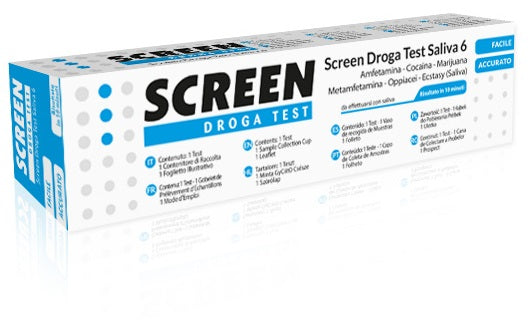
SCREEN
DRUG TEST
SALIVA 6
Rapid screening test for the simultaneous, qualitative detection of amphetamine, methamphetamine, cocaine, opiates, marijuana, ecstasy and their metabolites in human saliva.
Precautions
• Product not for medical or diagnostic use.
• Do not use beyond the expiration date.
• Keep the reactive strip panel in the sealed pouch until use.
• Store in the sealed pouch until use.
• Saliva is not classified as a biohazard unless it comes from a dental procedure.
• Used collector and Card must be disposed of in accordance with current regulations.
Intended Use and Summary
Chromatographic immunoassay for the qualitative detection of multiple drugs and metabolites in saliva at the following cut-off concentrations:
This test only provides preliminary analytical data.
More specific chemical methods must be used to confirm the analytical result.
Gas chromatography and mass spectrometry (GC/MS) are considered preferred confirmatory methods.
Any result for the determination of the presence of drugs of abuse must be correlated with clinical considerations and professional judgment, particularly when the preliminary result is positive.
Rapid urine screening test that does not require the use of special instruments.
The test uses antibodies to selectively detect high levels of specific substances in human saliva.
The detection windows are approximate for each substance as they vary based on frequency of use, body mass, age, health status, and tolerance to narcotic substances.
The product detects the presence of narcotic substances in saliva only after their metabolization.
COCAINE (COC)
Cocaine is a powerful central nervous system stimulant as well as a local anesthetic derived from the coca plant.
The substance is often self-administered by inhalation or intravenous injection or by smoking the base substance.
AMPHETAMINE (AMP)
Amphetamine is a substance also used for therapeutic purposes.
The substance is often self-administered by inhalation or ingestion.
High doses produce enhanced central nervous system stimulation and induce euphoria, alertness, decreased appetite, and a sense of increased energy and strength.
More acute reactions produce anxiety, paranoia, hallucinations, and psychotic behavior.
METHAMPHETAMINE (MET/MDMA)
Methamphetamine is a potent stimulant chemically related to amphetamine, but with a greater capacity for central nervous system stimulation.
The substance is often self-administered by inhalation, smoking, or ingestion.
MARIJUANA (THC)
Tetrahydrocannabinol is the active ingredient in cannabis.
When smoked or taken orally, THC produces euphoria.
Regular users experience short-term memory impairment and learning difficulties, and may also have transient episodes of confusion and anxiety.
Long-term relatively heavy use may be associated with behavioral disorders.
OPIATES (OPI)
The opiate class refers to any substance derived from the opium poppy, including natural compounds such as morphine, codeine, and semi-synthetic substances such as heroin.
Opiates act on pain control by depressing the central nervous system.
Withdrawal symptoms may include sweating, tremors, nausea, and irritability.
Opiates can be taken orally or by intravenous, intramuscular, and subcutaneous injection.
Users may also take the substance intravenously or by inhalation.
ECSTASY (MDMA)
Synthetic drug, first synthesized in 1914 by a German pharmaceutical company for the treatment of obesity.
Frequent users report side effects such as increased muscle tension and sweating.
MDMA is not a true stimulant, although it shares with amphetamines the ability to increase blood pressure and heart rate.
MDMA produces some perceptual changes such as increased light sensitivity, difficulty concentrating, and blurred vision in some users.
Its mechanism of action is thought to involve the release of the neurotransmitter serotonin.
MDMA can also release dopamine, although it is commonly believed that this is a secondary effect of the substance (Nichols and Oberlender, 1990).
The most obvious effect of MDMA, which potentially occurs in all who have taken a reasonable dose of the substance, is jaw clenching.
The test for MDMA contained in the product provides a positive result when the concentration of MDMA in saliva exceeds 50 ng/ml.
PRINCIPLE
It is an immunoassay based on the principle of competitive binding.
Drugs that may be present in the oral fluid sample compete against their respective conjugates for binding sites on the specific antibody.
During the test, a portion of the saliva sample migrates upwards by capillary action.
A drug, if present in the oral fluid sample below the cut-off concentration, will not saturate the binding sites of this specific antibody.
The antibody will therefore react with the drug-protein conjugate and a colored line will appear in the test region for the specific drug being tested. The presence of the drug above the cut-off concentration will saturate all antibody binding sites.
Thus, the colored line will not form in the test region.
A positive oral fluid sample will not generate a colored line in the specific test region of the strip due to drug competition, while a negative oral fluid sample for the drug will generate a line in the test region due to the absence of competition.
For procedural control, a colored line will always appear in the control region, indicating that a correct sample volume has been dispensed and that the membrane has been wet.
REAGENTS
The test contains membrane strips coated with drug-protein conjugates (purified bovine albumin) on the test line, a goat polyclonal antibody against gold-protein conjugate on the control line, and an impregnated pad containing colloidal gold particles coated with a mouse monoclonal antibody specific for Amphetamine, Methamphetamine, Cocaine, Opiates, Δ9-thc-cooh, Methadone, Ecstasy and Synthetic Marijuana.
STORAGE AND STABILITY
Store in the original sealed package at 2-30°C.
The test is stable until the expiration date printed on the package.
The test must remain in the sealed package until use.
Do not freeze.
Do not use beyond the expiration date.
SAMPLE COLLECTION AND PREPARATION
The oral fluid sample should be collected using the collector provided with the kit.
Follow the detailed instructions below.
Do not use other collection devices for analysis.
Oral fluid can be collected at any time of day.
INSTRUCTIONS FOR USE
Bring the test, sample and/or controls to room temperature (15-30°C) before testing.
Instruct the donor not to put anything in their mouth, including food, drink, gum, or tobacco, for at least 10 minutes before collection.
1. Bring the package to room temperature before opening. Remove the test from the sealed package and use within one hour.
2. Remove the test cap and insert the absorbent pad into the mouth, under the tongue, to collect saliva until the control line appears. Remove the test.
3. Place the test on a clean, flat surface. See illustration below. 4. Read the results after 10 minutes. Do not read the results after 1 hour.
INTERPRETATION OF RESULTS
Negative*: all test bands appear. One colored line must be in the control region (C), while the other must be adjacent to the test region (Substance/T). A negative result indicates that the substance concentration is below the detectable level or absent.
*the shade in the test region (Substance/T) varies, but even a weakly colored line should be considered negative
Positive: only one colored line appears in the control region (C). No test band appears in the test region (Substance/T). A positive result indicates that the substance concentration is above the detectable level.
Invalid: no control line appears. The most probable reasons for the control line not appearing are insufficient sample volume or incorrect procedural techniques. Check the procedure and repeat the test using a new card.
If the test result is positive, avoid aggressive behavior and calmly seek dialogue with the person concerned. Seek advice from your doctor, a psychologist, or contact the relevant service in your area.
QUALITY CONTROL
A procedural control is included in the test.
The line that appears in the control region (C) is considered an internal procedural control.
It confirms that a sufficient sample volume has been used, adequate membrane wetting, and correct procedural technique.
LIMITATIONS
1. The test only provides a preliminary qualitative analytical result. A secondary analytical method is required to confirm the result. The recommended confirmatory method is gas chromatography/mass spectrometry (GC/MS).
2. A positive test result does not indicate the concentration of the substance in the sample or the route of administration.
3. A negative result may not necessarily indicate a drug-free sample. Negative results can be obtained when the drug is present below the test's cut-off level.
4. Technical or procedural errors, as well as interfering substances present in the saliva sample, may cause erroneous results.
5. This test does not distinguish between drugs of abuse and certain medications.
FORMAT
• 1 swab.
• 1 Saliva Drug Test 6.
• package insert.
Precautions
• Product not for medical or diagnostic use.
• Do not use beyond the expiration date.
• Keep the reactive strip panel in the sealed pouch until use.
• Store in the sealed pouch until use.
• Saliva is not classified as a biohazard unless it comes from a dental procedure.
• Used collector and Card must be disposed of in accordance with current regulations.
Intended Use and Summary
Chromatographic immunoassay for the qualitative detection of multiple drugs and metabolites in saliva at the following cut-off concentrations:
| Test | Calibrator | Cut-off (ng/ml) |
| Amphetamine (AMP) | D-Amphetamine | 40 |
| Methamphetamine (MET) | D-Methamphetamine | 40 |
| Marijuana (THC) | 11-nor-Δ9-THC-9 COOH | 10 |
| Cocaine (COC) | Benzoylecgonine | 30 |
| Opiates (OPI/MOP) | Morphine | 40 |
| Ecstasy (MDMA) | D,L-methylenedioxymethamphetamine | 50 |
This test only provides preliminary analytical data.
More specific chemical methods must be used to confirm the analytical result.
Gas chromatography and mass spectrometry (GC/MS) are considered preferred confirmatory methods.
Any result for the determination of the presence of drugs of abuse must be correlated with clinical considerations and professional judgment, particularly when the preliminary result is positive.
Rapid urine screening test that does not require the use of special instruments.
The test uses antibodies to selectively detect high levels of specific substances in human saliva.
The detection windows are approximate for each substance as they vary based on frequency of use, body mass, age, health status, and tolerance to narcotic substances.
The product detects the presence of narcotic substances in saliva only after their metabolization.
COCAINE (COC)
Cocaine is a powerful central nervous system stimulant as well as a local anesthetic derived from the coca plant.
The substance is often self-administered by inhalation or intravenous injection or by smoking the base substance.
AMPHETAMINE (AMP)
Amphetamine is a substance also used for therapeutic purposes.
The substance is often self-administered by inhalation or ingestion.
High doses produce enhanced central nervous system stimulation and induce euphoria, alertness, decreased appetite, and a sense of increased energy and strength.
More acute reactions produce anxiety, paranoia, hallucinations, and psychotic behavior.
METHAMPHETAMINE (MET/MDMA)
Methamphetamine is a potent stimulant chemically related to amphetamine, but with a greater capacity for central nervous system stimulation.
The substance is often self-administered by inhalation, smoking, or ingestion.
MARIJUANA (THC)
Tetrahydrocannabinol is the active ingredient in cannabis.
When smoked or taken orally, THC produces euphoria.
Regular users experience short-term memory impairment and learning difficulties, and may also have transient episodes of confusion and anxiety.
Long-term relatively heavy use may be associated with behavioral disorders.
OPIATES (OPI)
The opiate class refers to any substance derived from the opium poppy, including natural compounds such as morphine, codeine, and semi-synthetic substances such as heroin.
Opiates act on pain control by depressing the central nervous system.
Withdrawal symptoms may include sweating, tremors, nausea, and irritability.
Opiates can be taken orally or by intravenous, intramuscular, and subcutaneous injection.
Users may also take the substance intravenously or by inhalation.
ECSTASY (MDMA)
Synthetic drug, first synthesized in 1914 by a German pharmaceutical company for the treatment of obesity.
Frequent users report side effects such as increased muscle tension and sweating.
MDMA is not a true stimulant, although it shares with amphetamines the ability to increase blood pressure and heart rate.
MDMA produces some perceptual changes such as increased light sensitivity, difficulty concentrating, and blurred vision in some users.
Its mechanism of action is thought to involve the release of the neurotransmitter serotonin.
MDMA can also release dopamine, although it is commonly believed that this is a secondary effect of the substance (Nichols and Oberlender, 1990).
The most obvious effect of MDMA, which potentially occurs in all who have taken a reasonable dose of the substance, is jaw clenching.
The test for MDMA contained in the product provides a positive result when the concentration of MDMA in saliva exceeds 50 ng/ml.
PRINCIPLE
It is an immunoassay based on the principle of competitive binding.
Drugs that may be present in the oral fluid sample compete against their respective conjugates for binding sites on the specific antibody.
During the test, a portion of the saliva sample migrates upwards by capillary action.
A drug, if present in the oral fluid sample below the cut-off concentration, will not saturate the binding sites of this specific antibody.
The antibody will therefore react with the drug-protein conjugate and a colored line will appear in the test region for the specific drug being tested. The presence of the drug above the cut-off concentration will saturate all antibody binding sites.
Thus, the colored line will not form in the test region.
A positive oral fluid sample will not generate a colored line in the specific test region of the strip due to drug competition, while a negative oral fluid sample for the drug will generate a line in the test region due to the absence of competition.
For procedural control, a colored line will always appear in the control region, indicating that a correct sample volume has been dispensed and that the membrane has been wet.
REAGENTS
The test contains membrane strips coated with drug-protein conjugates (purified bovine albumin) on the test line, a goat polyclonal antibody against gold-protein conjugate on the control line, and an impregnated pad containing colloidal gold particles coated with a mouse monoclonal antibody specific for Amphetamine, Methamphetamine, Cocaine, Opiates, Δ9-thc-cooh, Methadone, Ecstasy and Synthetic Marijuana.
STORAGE AND STABILITY
Store in the original sealed package at 2-30°C.
The test is stable until the expiration date printed on the package.
The test must remain in the sealed package until use.
Do not freeze.
Do not use beyond the expiration date.
SAMPLE COLLECTION AND PREPARATION
The oral fluid sample should be collected using the collector provided with the kit.
Follow the detailed instructions below.
Do not use other collection devices for analysis.
Oral fluid can be collected at any time of day.
INSTRUCTIONS FOR USE
Bring the test, sample and/or controls to room temperature (15-30°C) before testing.
Instruct the donor not to put anything in their mouth, including food, drink, gum, or tobacco, for at least 10 minutes before collection.
1. Bring the package to room temperature before opening. Remove the test from the sealed package and use within one hour.
2. Remove the test cap and insert the absorbent pad into the mouth, under the tongue, to collect saliva until the control line appears. Remove the test.
3. Place the test on a clean, flat surface. See illustration below. 4. Read the results after 10 minutes. Do not read the results after 1 hour.
INTERPRETATION OF RESULTS
Negative*: all test bands appear. One colored line must be in the control region (C), while the other must be adjacent to the test region (Substance/T). A negative result indicates that the substance concentration is below the detectable level or absent.
*the shade in the test region (Substance/T) varies, but even a weakly colored line should be considered negative
Positive: only one colored line appears in the control region (C). No test band appears in the test region (Substance/T). A positive result indicates that the substance concentration is above the detectable level.
Invalid: no control line appears. The most probable reasons for the control line not appearing are insufficient sample volume or incorrect procedural techniques. Check the procedure and repeat the test using a new card.
If the test result is positive, avoid aggressive behavior and calmly seek dialogue with the person concerned. Seek advice from your doctor, a psychologist, or contact the relevant service in your area.
QUALITY CONTROL
A procedural control is included in the test.
The line that appears in the control region (C) is considered an internal procedural control.
It confirms that a sufficient sample volume has been used, adequate membrane wetting, and correct procedural technique.
LIMITATIONS
1. The test only provides a preliminary qualitative analytical result. A secondary analytical method is required to confirm the result. The recommended confirmatory method is gas chromatography/mass spectrometry (GC/MS).
2. A positive test result does not indicate the concentration of the substance in the sample or the route of administration.
3. A negative result may not necessarily indicate a drug-free sample. Negative results can be obtained when the drug is present below the test's cut-off level.
4. Technical or procedural errors, as well as interfering substances present in the saliva sample, may cause erroneous results.
5. This test does not distinguish between drugs of abuse and certain medications.
FORMAT
• 1 swab.
• 1 Saliva Drug Test 6.
• package insert.