

You will not be allowed to compare more than 4 products at a time
View compareRAPID SCREEN TEST CELIAC DISEASE SCREEN TEST FOR GLUTEN INTOLERANCE 1 PIECE
RAPID SCREEN TEST CELIAC DISEASE SCREEN TEST FOR GLUTEN INTOLERANCE 1 PIECE
Regular price
€14,87 EUR
Sale price
€14,87 EUR
Regular price
€17,90 EUR
Unit price
per
Tax included.
SKU
987315823Low stock
Vendor
SCREEN ITALIA SrlDelivery time: 48/72 hours
Free Shipping: Orders over €70
This product page, including its Product Information Leaflet, has been automatically translated.
Description
SCREEN CHECK TEST
Celiac Disease Screen Test
Description
An immunochromatographic rapid test that can be used as an aid in the diagnosis of gluten intolerance. It detects IgA anti-transglutaminase (tTG) antibodies from a whole blood sample.
If IgA anti-tTGA antibodies are present, they bind to anti-IgA antibodies (mouse IgG) labelled with colloidal gold and to tTG (derived from the lysis of red blood cells by the dilution buffer). The tTG binds this complex to the static protein line (test line) and produces a visible reddish line. The test also includes a control system consisting of a reference line.
The test result must be confirmed by a doctor who can discuss the possibility of a gluten-free diet with the patient.
How to use
Before starting the test, bring the cassette and the sample dilution buffer to room temperature (15 °C to 27 °C). Open the container with the sample dilution buffer by removing the lid and place it vertically on the table.
Unscrew the grey cap of the automatic lancet by twisting it until it loosens. Then, twist it at least two more times. Only then can it be removed; otherwise, its function is not guaranteed. The lancet can only be used once. Press the lancet with the round opening against the side of the clean fingertip and push the trigger.
Open the plastic container and carefully remove the glass capillary tube. Squeeze a drop of blood from the fingertip. Hold the glass capillary tube horizontally in the drop of blood until the capillary tube is completely filled. Use the included plaster as needed.
Place the filled glass capillary tube in the container with the sample dilution buffer and close tightly with the lid. Shake the container a few times until the blood in the capillary tube has completely mixed with the solution. Before removing the lid from the container, wait for the liquid to collect at the bottom of the container. Then open the container lid.
Open the cassette's foil pouch just before use. Remove the test cassette and place it on a flat surface. With the pipette, draw a few drops of the diluted sample. Hold the pipette with the diluted sample vertically over the sample well (S) and pour exactly 5 drops into it. Ensure that no liquid is spilled onto the result window, marked with T and C. After applying the drops, do not touch or move the test cassette.
Once the 5 drops have been added, read the result after 10-15 minutes. Low values may not be detected before 10 minutes have passed, and false positive results may occur after more than 15 minutes.
Interpretation of results
POSITIVE: a light or dark red line appears at the control line (C) and a light or dark red line appears at the test line (T).
The test shows that IgA antibodies associated with gluten intolerance have been detected in the blood sample. The detection of these antibodies very likely indicates the presence of gluten intolerance. For a definitive diagnosis, consult your doctor.
NEGATIVE: a light to dark red line appears at the control line (C) and no red line appears at the test line (T).
The test shows that no IgA antibodies indicating gluten intolerance are detectable in the blood sample. Therefore, the presence of gluten intolerance can be virtually ruled out. In case of gastrointestinal discomfort or other symptoms, further diagnostic investigation by a doctor is necessary.
INVALID: no red line appears at the control line (C) or only a red line appears at the test line (T).
The test was not performed correctly and is invalid. Check that you have followed all instructions for use exactly. Perform a new test with a new blood sample.
Warnings
The test is for external use only.
Do not ingest test components. Avoid skin and eye contact with the sample diluent buffer.
Keep the test out of reach of children.
The product can only be used until the expiry date printed on the product itself.
If the instructions for use are not followed correctly and in detail, the test results may be inaccurate. The final diagnosis must be made by a doctor.
Do not use the test if the packaging is damaged. Do not use damaged test components.
Storage
Do not expose the test to direct sunlight or frost. Do not freeze. Store in a dry place at a temperature between 10 °C and 27 °C.
Shelf life with intact packaging: 24 months.
Format
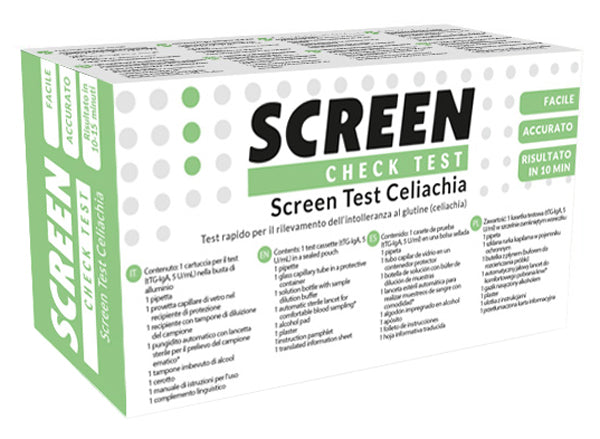
The kit contains:
- 1 test cassette;
- 1 pipette;
- 1 glass capillary tube;
- 1 bottle of solution with sample dilution buffer;
- 1 sterile lancet;
- 1 alcohol swab;
- 1 plaster;
- 1 instruction leaflet;
- 1 translated information sheet.
An immunochromatographic rapid test that can be used as an aid in the diagnosis of gluten intolerance. It detects IgA anti-transglutaminase (tTG) antibodies from a whole blood sample.
If IgA anti-tTGA antibodies are present, they bind to anti-IgA antibodies (mouse IgG) labelled with colloidal gold and to tTG (derived from the lysis of red blood cells by the dilution buffer). The tTG binds this complex to the static protein line (test line) and produces a visible reddish line. The test also includes a control system consisting of a reference line.
The test result must be confirmed by a doctor who can discuss the possibility of a gluten-free diet with the patient.
How to use
Before starting the test, bring the cassette and the sample dilution buffer to room temperature (15 °C to 27 °C). Open the container with the sample dilution buffer by removing the lid and place it vertically on the table.
Unscrew the grey cap of the automatic lancet by twisting it until it loosens. Then, twist it at least two more times. Only then can it be removed; otherwise, its function is not guaranteed. The lancet can only be used once. Press the lancet with the round opening against the side of the clean fingertip and push the trigger.
Open the plastic container and carefully remove the glass capillary tube. Squeeze a drop of blood from the fingertip. Hold the glass capillary tube horizontally in the drop of blood until the capillary tube is completely filled. Use the included plaster as needed.
Place the filled glass capillary tube in the container with the sample dilution buffer and close tightly with the lid. Shake the container a few times until the blood in the capillary tube has completely mixed with the solution. Before removing the lid from the container, wait for the liquid to collect at the bottom of the container. Then open the container lid.
Open the cassette's foil pouch just before use. Remove the test cassette and place it on a flat surface. With the pipette, draw a few drops of the diluted sample. Hold the pipette with the diluted sample vertically over the sample well (S) and pour exactly 5 drops into it. Ensure that no liquid is spilled onto the result window, marked with T and C. After applying the drops, do not touch or move the test cassette.
Once the 5 drops have been added, read the result after 10-15 minutes. Low values may not be detected before 10 minutes have passed, and false positive results may occur after more than 15 minutes.
Interpretation of results
POSITIVE: a light or dark red line appears at the control line (C) and a light or dark red line appears at the test line (T).
The test shows that IgA antibodies associated with gluten intolerance have been detected in the blood sample. The detection of these antibodies very likely indicates the presence of gluten intolerance. For a definitive diagnosis, consult your doctor.
NEGATIVE: a light to dark red line appears at the control line (C) and no red line appears at the test line (T).
The test shows that no IgA antibodies indicating gluten intolerance are detectable in the blood sample. Therefore, the presence of gluten intolerance can be virtually ruled out. In case of gastrointestinal discomfort or other symptoms, further diagnostic investigation by a doctor is necessary.
INVALID: no red line appears at the control line (C) or only a red line appears at the test line (T).
The test was not performed correctly and is invalid. Check that you have followed all instructions for use exactly. Perform a new test with a new blood sample.
Warnings
The test is for external use only.
Do not ingest test components. Avoid skin and eye contact with the sample diluent buffer.
Keep the test out of reach of children.
The product can only be used until the expiry date printed on the product itself.
If the instructions for use are not followed correctly and in detail, the test results may be inaccurate. The final diagnosis must be made by a doctor.
Do not use the test if the packaging is damaged. Do not use damaged test components.
Storage
Do not expose the test to direct sunlight or frost. Do not freeze. Store in a dry place at a temperature between 10 °C and 27 °C.
Shelf life with intact packaging: 24 months.
Format
The kit contains:
- 1 test cassette;
- 1 pipette;
- 1 glass capillary tube;
- 1 bottle of solution with sample dilution buffer;
- 1 sterile lancet;
- 1 alcohol swab;
- 1 plaster;
- 1 instruction leaflet;
- 1 translated information sheet.