

You will not be allowed to compare more than 4 products at a time
View compareSODIUM CHLORIDE EUROS*0.9% 100ML
SODIUM CHLORIDE EUROS*0.9% 100ML
Regular price
€1,13 EUR
Sale price
€1,13 EUR
Regular price
€2,40 EUR
Unit price
per
Tax included.
SKU
032182014In stock
Vendor
EUROSPITAL SpADelivery time: 48/72 hours
Free Shipping: Orders over €70
This product page, including its Product Information Leaflet, has been automatically translated.
Description
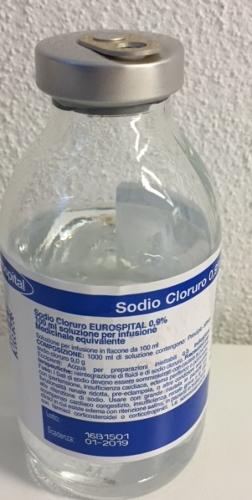
Sodium Chloride Eurospital 0.9% solution for infusion
What it is and what it is used for
Fluid and sodium chloride replacement
What you need to know before taking the medicine
Hypernatremia
Fluid and salt overload.
Warnings and precautions
Sodium salts should be administered with caution to patients with hypertension, heart failure, peripheral or pulmonary edema, impaired renal function, pre-eclampsia, or other conditions associated with sodium retention (see interactions).
Solutions with a concentration greater than 0.9% (hypertonic solutions) should be used with caution, at a controlled infusion rate and only in cases where they are specifically prescribed.
Use with great caution in patients with congestive heart failure, severe renal failure, and in clinical conditions where edema with salt retention exists; in patients treated with corticosteroid or corticotropin drugs. Continuous administration without potassium supplementation can cause hypokalemia.
Use with caution in children.
During the infusion, it is good practice to monitor fluid balance, electrolytes, plasma osmolarity, and acid-base balance.
The solution must be clear, colorless, and free of visible particles. Use immediately after opening the container. The container is for a single and uninterrupted administration and any remaining residue cannot be used.
Possible side effects
Like all medicines, Sodium chloride can cause side effects, although not everybody gets them.
The side effects of sodium chloride are listed below. There is insufficient data to establish the frequency of the individual listed effects.
Water and electrolyte balance disorders
Hypernatremia, hypervolemia, plasma hypoosmolarity (for 0.45% solutions), hyperchloremia (which can cause a loss of bicarbonates with consequent acidosis).
Nervous system disorders
Headache, dizziness, restlessness, fever, irritability, weakness, muscle stiffness, convulsions, coma, death
Psychiatric disorders
Drowsiness, confusional states
Respiratory, thoracic and mediastinal disorders
Dyspnea, respiratory arrest.
Gastrointestinal disorders
Thirst, reduced salivation, nausea, vomiting, diarrhea, abdominal pain.
Cardiac disorders
Tachycardia.
Eye disorders
Reduced lacrimation.
Renal and urinary disorders
Renal failure.
Vascular disorders
Hypotension, hypertension, pulmonary and peripheral edema.
Systemic disorders and conditions at the administration site
Infection at the infusion site, local pain or reaction, venous irritation, thrombosis or venous phlebitis extending from the infusion site, extravasation.
Adhering to the instructions in the package leaflet reduces the risk of side effects.
If any of the side effects get serious, or if you notice any side effects not listed in this leaflet, tell your doctor or pharmacist.
