

You will not be allowed to compare more than 4 products at a time
View compareSODIO FOSFATO ZETA*RECT 120ML
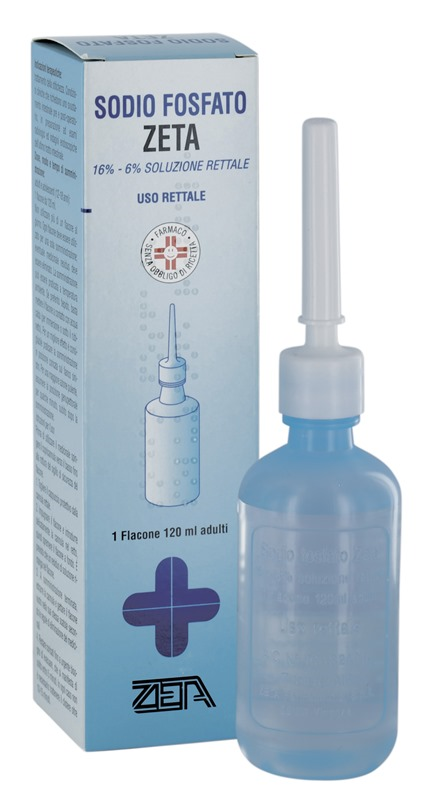
SODIO FOSFATO ZETA*RECT 120ML
Regular price
€4,90 EUR
Sale price
€4,90 EUR
Regular price
Unit price
per
Tax included.
SKU
031324015Low stock
Vendor
ZETA FARMACEUTICI SpADelivery time: 48/72 hours
Free Shipping: Orders over €70
This product page, including its Product Information Leaflet, has been automatically translated.
Description
SODIO FOSFATO ZETA 16%/6% rectal solution
Monobasic sodium phosphate monohydrate and dibasic sodium phosphate heptahydrate
What it is and what it is used for
SODIO FOSFATO ZETA contains the active ingredients monobasic sodium phosphate monohydrate and dibasic sodium phosphate heptahydrate, which belong to the group of laxative medicines used to soften and lubricate stool, promoting its passage through the intestine and evacuation. This medicine is indicated for the treatment of constipation and to empty the bowel in cases of surgical operations or certain clinical examinations, such as radiological examinations or endoscopic intestinal explorations.
Consult your doctor if you do not notice improvements or if your symptoms worsen after a few days.
What you need to know before taking the medicine
Do not use SODIO FOSFATO ZETA
- if you are allergic to monobasic sodium phosphate monohydrate, dibasic sodium phosphate heptahydrate or any of the other ingredients of this medicine (listed in paragraph 6);
- if you have severe abdominal pain, or any pain of unknown cause, and if you have nausea or vomiting;
- if you suffer from bowel or recto-anal blockage or narrowing (subocclusion or intestinal or anorectal stenosis);
- if you suffer from an arrest of the passage of intestinal contents (paralytic ileus), if it is due to an actual obstruction (mechanical ileus);
- if you have a vast dilation of the colon, from birth or acquired (megacolon);
- if you suffer from a congenital colon disease which manifests itself with severe difficulty in evacuation (Hirschsprung's disease);
- if you suffer from inflammation of the intestine or other conditions that may increase the absorption of the medicine;
- if you experience problems in the terminal part of the intestine such as rectal bleeding, acute haemorrhoids with pain and bleeding, anal perforation;
- if you are severely dehydrated;
- if the person who needs to take the medicine is a child under 12 years of age;
- if you suffer from heart and/or kidney problems (severe renal insufficiency);
- if you experience increased phosphate levels in the blood (hyperphosphatemia);
- if you are already taking other preparations with sodium phosphate, such as oral solutions or sodium phosphate tablets.
Warnings and precautions
Talk to your doctor or pharmacist before using SODIO FOSFATO ZETA.
If you use this medicine excessively, frequently or incorrectly, you may experience lasting diarrhoea, with consequent loss of water, mineral salts (especially potassium) and other essential nutrients. In more severe cases, you may experience dehydration and low potassium levels in the blood (hypokalemia), with possible heart, nerve and muscle problems, especially if you are simultaneously taking medicines to stimulate heart function (cardiac glycosides), to increase urine production (diuretics) or medicines called corticosteroids.
Drink plenty of fluids to prevent dehydration, especially if you are in conditions that may facilitate fluid loss, or if you are taking medicines that affect the kidneys, such as diuretics, angiotensin-converting enzyme inhibitors (ACE inhibitors), angiotensin receptor blockers (sartans) or non-steroidal anti-inflammatory drugs (NSAIDs).
Since Sodium phosphate Zeta contains sodium phosphates, there may be an increase in the amount of sodium and phosphate in the blood (hypernatremia, hyperphosphatemia) and a decrease in the amount of calcium and potassium in the blood (hypocalcemia and hypokalemia), which can lead to involuntary muscle contraction (tetany) and kidney problems (renal insufficiency).
If you use this medicine excessively or incorrectly, you may develop dependence (with consequent need to progressively increase the dose), chronic constipation and loss of normal bowel function (intestinal atony). Repeated use can lead to habituation or cause harm.
Prolonged use of laxatives is not recommended in cases of constipation. In case of constipation, first correct your eating habits, consuming an adequate amount of fiber and water (6-8 glasses a day) and doing physical activity. If you have been constipated for more than 2 weeks, if you notice changes in your usual bowel movements or stool characteristics, or if you do not experience improvements after using this medicine, consult your doctor.
Use this medicine with caution and after consulting your doctor, if you are elderly or not in good health, or if you suffer from cardiovascular problems (uncontrolled blood pressure, heart disease), ascites or rectal mucosal disorders (ulcers, fissures).
If you encounter resistance when using the medicine, stop use immediately as forced administration can cause injuries.
Health education notes
First and foremost, keep in mind that, in most cases, a balanced diet rich in water and fiber (bran, vegetables and fruit) can permanently resolve the problem of constipation.
Many people think they suffer from constipation if they cannot evacuate every day.
This is an incorrect belief, as this situation is completely normal for a large number of individuals. Consider, however, that constipation occurs when bowel movements are reduced compared to one's personal habits and are associated with the emission of hard stools.
If episodes of constipation occur repeatedly, consult your doctor.
Children
This medicine should not be used in children under 12 years of age.
Elderly
If you are elderly, talk to your doctor before using this medicine.
Possible side effects
Like all medicines, this medicine can cause side effects, although not everybody gets them.
The following side effects may occur:
Not known (frequency cannot be estimated from the available data)
- allergic reactions (e.g. hives)
- blisters, itching, skin burning
- abdominal pain, such as cramps and colic;
- diarrhoea with loss of salts and water;
- irritation of the end part of the intestine (rectal irritation);
- nausea, vomiting;
- increased phosphate levels in the blood (hyperphosphatemia);
- decreased potassium levels in the blood (hypokalemia);
- increased sodium levels in the blood (hypernatremia);
- decreased calcium levels in the blood (hypocalcemia);
- accumulation of calcium in various internal parts of the body (calcification).
Following the instructions in the package leaflet reduces the risk of side effects.
Reporting of side effects
If you get any side effects, including any not listed in this leaflet, talk to your doctor or pharmacist. You can also report side effects directly via the national reporting system at: https://www.aifa.gov.it/content/segnalazionireazioni-avverse.
By reporting side effects you can help provide more information on the safety of this medicine.