

You will not be allowed to compare more than 4 products at a time
View compareTACHIPIRINA*NEO 10SUPP 62.5MG
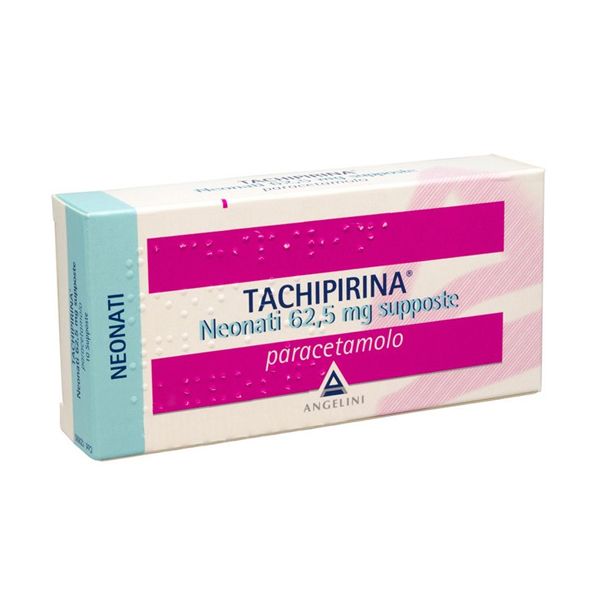
TACHIPIRINA*NEO 10SUPP 62.5MG
Regular price
€5,17 EUR
Sale price
€5,17 EUR
Regular price
€5,45 EUR
Unit price
per
Tax included.
SKU
012745271Low stock
Vendor
ANGELINI (A.C.R.A.F.) SpADelivery time: 48/72 hours
Free Shipping: Orders over €70
This product page, including its Product Information Leaflet, has been automatically translated.
Description
TACHIPIRINA Infants 62.5 mg suppositories
TACHIPIRINA Young Children 125 mg suppositories
Paracetamol
What it is and what it is used for
Tachipirina contains the active ingredient paracetamol, which works by reducing fever (antipyretic) and relieving pain (analgesic).
Tachipirina infants and Tachipirina young children should be used in children weighing between 3.2 and 12 kg for:
- the symptomatic treatment of febrile states such as influenza, exanthematous diseases (infectious diseases typical of children and adolescents), acute respiratory tract diseases, etc.;
- pain of various origins and nature (headaches, neuralgia, muscle pain and other moderate pain manifestations).
Consult your doctor if the child does not feel better or feels worse after 3 days of treatment.
What you need to know before taking the medicine
Do not give Tachipirina to the child:
- if they are allergic to paracetamol or any of the other ingredients of this medicine (listed in section 6);
- if they suffer from severe haemolytic anaemia (destruction of red blood cells);
- if they suffer from a severe liver disease (severe hepatocellular insufficiency).
Warnings and precautions
Consult your doctor or pharmacist before using Tachipirina.
In the following cases, give Tachipirina to the child with caution:
- if they suffer from anorexia (an eating disorder characterised by a lack or reduction of appetite);
- if they suffer from bulimia (an eating disorder where a person ingests an excessive amount of food and then resorts to various methods to eliminate it);
- if they suffer from cachexia (a state characterised by extreme thinness, reduced muscle mass and thinning of the skin due to chronic diseases);
- if they have been on an incorrect diet for a long time (chronic malnutrition);
- if they suffer from dehydration (severe loss of water/fluids from the body);
- if they suffer from hypovolemia (reduced blood volume in circulation);
- if they suffer from liver diseases that reduce its function (hepatic insufficiency, hepatitis, Gilbert's syndrome);
- if they are undergoing concomitant treatment with medicines that alter liver function (see "Other medicines and Tachipirina");
- if they suffer from glucose-6-phosphate dehydrogenase deficiency (a substance normally present in the human body, whose deficiency can cause a blood disorder);
- if they suffer from haemolytic anaemia (destruction of red blood cells).
Use of high doses and/or for prolonged periods
The use of high and/or prolonged doses of this medicine can cause even severe kidney and blood disorders. In these cases, the doctor will monitor liver and kidney function and blood composition over time through appropriate tests. Before giving this medicine to the child, inform the doctor if they suffer from a kidney or liver disease.
Children and adolescents
Tachipirina suppositories can be given to children weighing between 3.2 kg and 12 kg (see section 3 "How to use Tachipirina").
Possible side effects
Like all medicines, this medicine can cause side effects, although not everybody gets them.
If the child experiences the following side effects, STOP treatment with this medicine and contact the doctor immediately:
Allergic reactions with:
- skin redness accompanied by itching (urticaria);
- swelling of the throat (laryngeal oedema);
- swelling of hands, feet, ankles, face, lips, tongue and/or throat (angioedema);
- severe allergic reaction (anaphylactic shock);
In addition, those taking this medicine may experience the following side effects, for which there are insufficient data to establish the frequency.
- reduction in the number of platelets in the blood (thrombocytopenia);
- reduction in the number of white blood cells in the blood (leukopenia/agranulocytosis);
- reduction of haemoglobin in the blood, a substance that carries oxygen in the blood (anaemia);
- dizziness;
- stomach and intestinal reactions;
- abnormal liver function;
- inflammation of the liver (hepatitis);
- red spots, blistering lesions with areas of skin detachment, blisters, skin rashes (erythema multiforme, Stevens-Johnson syndrome, toxic epidermal necrolysis);
- reduced kidney function (acute renal failure);
- inflammation of the kidneys (interstitial nephritis);
- blood in the urine (haematuria);
- cessation or reduction of urine production by the kidney (anuria).
Very rare cases of severe skin reactions have been reported.
Reporting of side effects
If you get any side effects, including any not listed in this leaflet, tell your doctor or pharmacist. You can also report side effects directly via the national reporting system at: https://www.aifa.gov.it/content/segnalazioni-reazioni-avverse.
By reporting side effects, you can help provide more information on the safety of this medicine.