

You will not be allowed to compare more than 4 products at a time
View compareTACHIPIRINA OROSOL*10 oral solution sachets 250mg
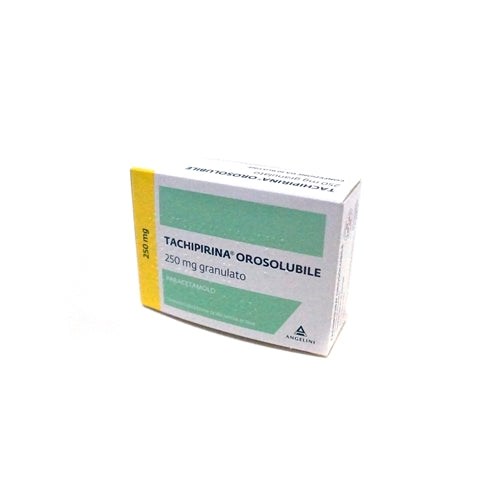
TACHIPIRINA OROSOL*10 oral solution sachets 250mg
Regular price
€6,26 EUR
Sale price
€6,26 EUR
Regular price
€5,75 EUR
Unit price
per
Tax included.
SKU
040313013In stock
Vendor
ANGELINI (A.C.R.A.F.) SpADelivery time: 48/72 hours
Free Shipping: Orders over €70
This product page, including its Product Information Leaflet, has been automatically translated.
Description
TACHIPIRINA OROSOLUBILE 250 mg granules
Paracetamol
What it is and what it is used for
Paracetamol belongs to the pharmacotherapeutic class of analgesics (painkillers) which also act as antipyretics (fever-reducing medicines) with weak anti-inflammatory effects.
TACHIPIRINA OROSOLUBILE is used to lower fever and relieve mild to moderate pain.
What you need to know before taking the medicine
Do not take TACHIPIRINA OROSOLUBILE:
- if you are allergic to paracetamol or any of the other ingredients of this medicine (listed in section 6);
- if you suffer from severe liver dysfunction.
Warnings and precautions
Talk to your doctor or pharmacist before taking TACHIPIRINA OROSOLUBILE.
Take special care with TACHIPIRINA OROSOLUBILE:
- if you suffer from severe kidney or liver failure;
- the risks of overdose are greater in patients with non-cirrhotic alcoholic liver disease;
Never exceed the recommended dose:
- if you suffer from chronic alcoholism;
- if you have a glucose-6-phosphate dehydrogenase deficiency;
- if you suffer from hemolytic anemia;
- if you suffer from Gilbert's syndrome (familial non-hemolytic jaundice).
Prolonged or frequent use is not recommended. Patients should be advised not to take other paracetamol-containing products simultaneously. Taking multiple daily doses in a single administration can severely damage the liver. In this case, the patient does not lose consciousness, however, a doctor should be consulted immediately. Prolonged use without medical supervision can be harmful. In children treated with 60 mg/kg per day of paracetamol, the association with another antipyretic is not justified except in case of ineffectiveness.
Caution should be exercised when administering paracetamol to patients with renal insufficiency (creatinine clearance ≥ 30 ml/min. (see section 3 "HOW TO TAKE TACHIPIRINA OROSOLUBILE")) or hepatocellular insufficiency (mild to moderate).
The risks of overdose are greater in patients with non-cirrhotic alcoholic liver disease. Caution should be exercised in cases of chronic alcoholism. In this case, the daily dose should not exceed 2 grams.
In case of high fever or signs of secondary infection or persistence of symptoms beyond 3 days, a re-evaluation of the treatment should be carried out.
Paracetamol should be used with caution in cases of dehydration and chronic malnutrition. The total dose of paracetamol should not exceed 3 g per day for adults and children weighing 50 kg or more.
If your symptoms worsen or do not improve after 3 days or if high fever occurs, you should contact your doctor.
Do not use paracetamol, unless prescribed by your doctor, if you have an alcohol dependency or liver damage. Do not use paracetamol with alcohol. Paracetamol does not enhance the effect of alcohol.
If you are taking other painkillers containing paracetamol at the same time, do not use TACHIPIRINA OROSOLUBILE without first consulting your doctor or pharmacist. Never take more TACHIPIRINA OROSOLUBILE than recommended. A higher dose does not increase the analgesic action, but can instead cause serious liver damage. Symptoms of liver damage appear after a few days. For this reason, it is very important that you contact your doctor as soon as possible if you have taken more TACHIPIRINA OROSOLUBILE than recommended in this leaflet.
In case of prolonged improper use of high doses of painkillers, headaches may occur which should not be treated with higher doses of the medicine.
In general, the habitual use of painkillers, particularly the combination of different analgesic drugs, can lead to permanent kidney damage with the risk of kidney failure (analgesic nephropathy).
Sudden discontinuation of analgesics after a prolonged period of improper use at high doses can cause headaches, fatigue, muscle pain, nervousness, and autonomic symptoms. These withdrawal symptoms resolve within a few days. Until then, avoid taking other painkillers and do not restart them without consulting your doctor.
You should not take TACHIPIRINA OROSOLUBILE for prolonged periods or at high doses without consulting your doctor or pharmacist.
Possible side effects
Like all medicines, this medicine can cause side effects, although not everybody gets them.
Rare frequency means an effect affecting 1 to 10 users out of 10,000.
Very rare frequency means an effect affecting less than 1 user out of 10,000.
The following rare side effects may occur:
• non-hemolytic anemia and bone marrow depression
• anemia
• thrombocytopenia
• edema
1. exocrine pancreas diseases: acute and chronic pancreatitis
2. gastrointestinal bleeding, abdominal pain, diarrhea, nausea, vomiting
3. liver failure, hepatic necrosis, jaundice
4. allergic conditions, anaphylactic reactions, drug or food allergies
5. urticaria, itching, rash, sweating, purpura, angioedema
- nephropathies and tubular disorders.
Very rare cases of severe skin reactions have been reported.
Reporting of side effects
If you get any side effects, including any not listed in this leaflet, talk to your doctor or pharmacist. You can also report side effects directly via the national reporting system at: https://www.aifa.gov.it/content/segnalazionireazioni-avverse.
By reporting side effects, you can help provide more information on the safety of this medicine.
